A horizontal spiral accumulator is an important part of the entry section in an ERW tube mill line. It is normally installed between the shear end welder and the forming section, where it stores steel strip and provides a buffer for downstream production.
During coil changeover, the entry section may need time to prepare the next coil, trim the strip ends and complete the joining process. The accumulator stores strip in advance and releases it to the forming section during this period. When selected with suitable storage capacity and integrated with the required entry-section equipment, a horizontal spiral accumulator can support more continuous strip feeding to the downstream tube mill process.
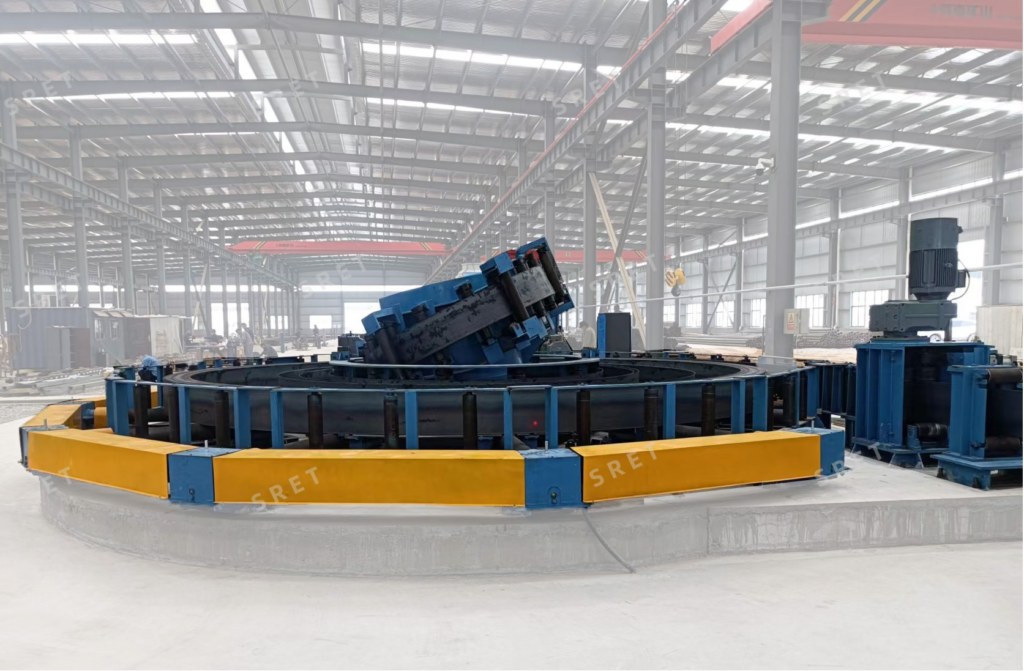
The final accumulator configuration should be determined according to strip width, strip thickness, material properties, required line speed, coil-change procedure, available factory space and the overall tube mill arrangement.
A horizontal spiral accumulator is a strip-storage system used in tube mill lines and other coil-processing applications. It stores a controlled length of steel strip in a horizontal loop arrangement before the strip enters the forming section.
Its main purpose is to create a strip reserve between upstream coil-handling equipment and downstream production equipment. This reserve allows the entry section and the forming section to operate with greater flexibility during coil preparation and strip joining.
In an ERW tube mill line, the accumulator typically works together with the uncoiler, flattener, shear end welder and forming section.
A horizontal spiral accumulator is usually installed after the shear end welder and before the forming and sizing section.
A typical ERW tube mill entry-section arrangement may include:
Uncoiler
→ Flattener or Strip Preparation Equipment
→ Shear End Welder
→ Horizontal Spiral Accumulator
→ Forming and Sizing Section
→ HF Welding
→ Flying Cut-Off
→ Run-Out and Collection
The exact line arrangement depends on the selected tube mill model and project requirements. Some production lines may include additional guiding, feeding, leveling, strip-handling or automation equipment.
Before or during production, steel strip is fed into the accumulator and stored in a horizontal spiral pattern. The required storage length is determined according to the downstream line speed, coil-change procedure, strip-joining cycle and project requirements.
When the running coil approaches its end, the entry section prepares the next coil. The shear end welder trims and joins the strip ends, while the accumulator releases stored strip to the downstream forming section.
After the coil-change and joining sequence is completed, the entry section replenishes the strip stored in the accumulator. This storage-and-release process helps coordinate coil preparation with the continuous operation of downstream forming, welding, sizing and cut-off equipment.
The actual operating sequence depends on the selected accumulator model, strip specification, control configuration and the complete tube mill line arrangement.
The horizontal spiral accumulator and shear end welder are normally selected as part of the same entry-section solution.
The shear end welder prepares and joins the tail end of one coil to the head end of the next coil. During this operation, the accumulator can release previously stored strip to the forming section.
This arrangement can support continuous strip feeding during coil-change operations, provided that the accumulator capacity, shear-and-weld cycle and downstream line speed are matched to the project requirements.
The actual effect on line continuity, production efficiency and material handling depends on the complete equipment configuration and operating conditions.
The inlet pinching roll device helps guide strip into the horizontal spiral accumulator during threading, storage and replenishment operations.
Depending on the selected equipment configuration, the inlet pinch rolls may:
The required clamping force, drive method, adjustment method and control sequence should be selected according to strip width, thickness, material condition and production requirements.
The exact structure of a horizontal spiral accumulator varies by model and project configuration. Depending on the selected equipment, the system may include:
Not every accumulator includes the same components or control functions. The final equipment structure should be confirmed according to the required storage capacity, strip specification and entry-section arrangement.
When selecting a horizontal spiral accumulator for an ERW tube mill line, the following information should be considered:
The required strip-storage capacity should be calculated according to the actual production line conditions. It should not be selected only by tube diameter or tube mill model.
A horizontal spiral accumulator includes moving strip, rotating rolls and guiding devices. Equipment operation, threading, setup, inspection and maintenance should be carried out by trained personnel in accordance with the machine manual, site safety procedures and applicable operating requirements.
Depending on the selected control configuration, the accumulator may include functions for strip-storage monitoring, operating-status indication, alarms, synchronized operation or setup and jogging. The availability of these functions should be confirmed according to the selected model and project scope.
A horizontal spiral accumulator stores a controlled length of steel strip between the entry section and the forming section. It can release stored strip during coil preparation and strip-joining operations.
It is typically installed after the shear end welder and before the forming section of an ERW tube mill line.
During coil changeover, the accumulator can release stored strip to the downstream forming section while the entry section prepares and joins the next coil.
Key information includes strip width, strip thickness, material grade, coil dimensions, line speed, required storage capacity, shear end welder cycle, automation requirements and factory layout.
Not every line uses the same type of accumulator. The requirement depends on the desired production arrangement, coil-change method, required line continuity, strip specifications, available space and overall project configuration.
A complete ERW tube mill entry section may include an Uncoiler, Flattener, Shear End Welder and Horizontal Spiral Accumulator.
To discuss an accumulator configuration for your tube mill project, please visit the ERW Tube Mill Line and Machine page or contact SRET with your strip specifications, line speed and production requirements.
Technical review: SRET engineering team.