A strip-end flattener prepares the head and tail of a steel coil before end shearing and butt welding. In an ERW tube mill line, its role is to flatten the coil ends and feed them toward the shear end welding machine.
This preparation step should be distinguished from tube forming or finished-product straightening. The flattener works on the incoming steel strip, helping provide a more suitable end condition for the next joining operation.
This article explains the main components, operating sequence and configuration factors of a strip-end flattener, including five-roll and seven-roll arrangements.
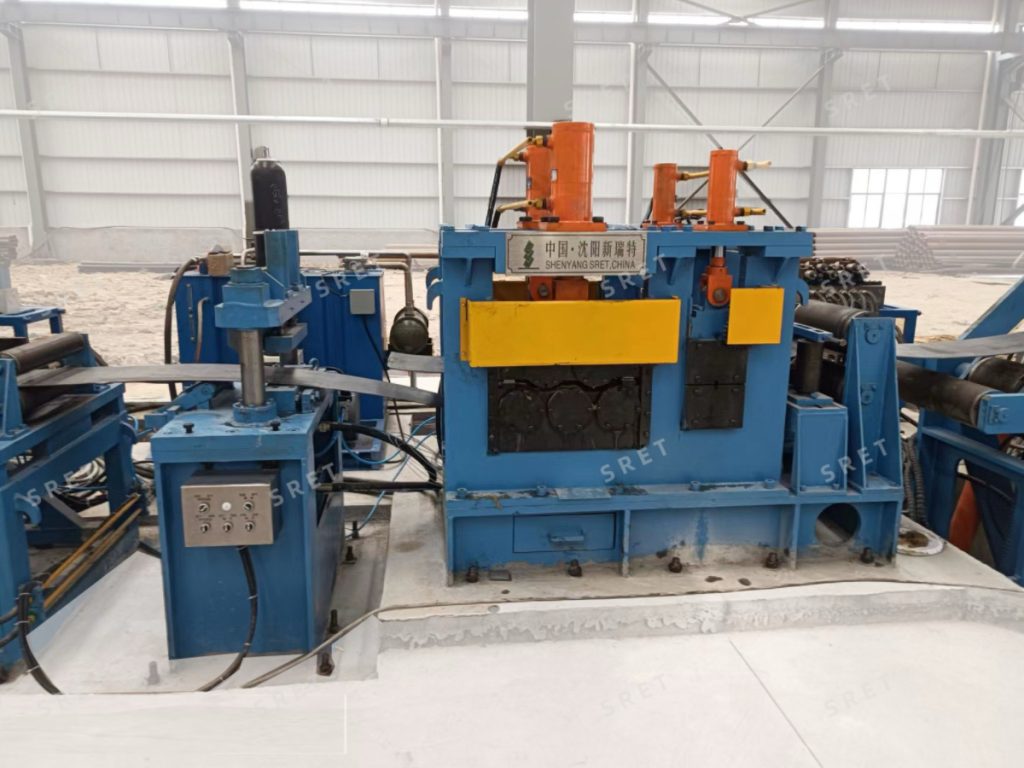
The head and tail of a coil can retain curvature that makes positioning for end preparation more difficult. Before the strip ends are sheared and butt welded, the flattener reduces this curvature and feeds the strip toward the joining equipment.
Flatter strip ends can make alignment and handling more manageable. However, flattening alone does not guarantee the quality of the butt weld. The subsequent shearing, positioning and welding operations must also meet the requirements of the joining process.
Within an ERW Tube Mill, the flattener therefore performs a defined preparation function rather than replacing the work of the shear end welder.
The equipment described here combines an entrance alignment arrangement, pinching rolls, flattening rolls, a hydraulic system and electrical controls. Each section has a different role in preparing and advancing the strip.
Electrically adjustable vertical rolls at the machine entrance position the strip coming from the uncoiler. Their purpose is to align the strip with the intended pass line before it enters the feeding and flattening sections.
This adjustment should not be confused with a guarantee that every strip-positioning issue will be corrected automatically. The adjustment method and operating sequence should be confirmed for the supplied equipment.
The motor-driven pinching rolls grip and guide the strip toward the flattening rolls. In the arrangement described in the original equipment specification, the drive is engaged through clutches.
The pinching section provides controlled strip feeding into the next stage. Its operation should be coordinated with the flattening section and the downstream end-preparation equipment.
The flattening rolls apply pressure to the strip to reduce coil-end curvature. Hydraulically actuated upper rolls move downward to establish the required working pressure against the lower rolls.
The roll-drive arrangement depends on the equipment configuration. The original specification describes versions in which either both upper and lower rolls, or the upper rolls, are driven by an inverter-controlled AC motor.
The hydraulic system actuates the upper rolls. The described equipment also includes proportional pressure adjustment, allowing the flattening pressure to be adjusted for different strip-thickness requirements.
The electrical controls operate the machine and regulate the drive speed. Variable-frequency control supports adjustable feeding speed; this should not be interpreted as a statement that the flattener always runs at the same speed as the tube-forming section.
The original equipment range includes both five-roll and seven-roll structures:
| Arrangement | Movable Upper Rolls | Stationary Lower Rolls |
|---|---|---|
| Five-roll flattener | 2 | 3 |
| Seven-roll flattener | 3 | 4 |
The number of rolls should be treated as part of the equipment configuration, not as a simple ranking of performance. A seven-roll machine should not automatically be described as the preferred option for every application.
The proposed arrangement should be reviewed against the strip specifications and required end-preparation conditions. Availability must also be checked by model: the supplied data list five- or seven-roll arrangements for some models and five-roll arrangements for others.
The sequence below summarizes the arrangement described in the original specification. The exact controls and operator tasks should be confirmed for the supplied machine.
When reviewing a Tube Mill Line layout, confirm how these actions are coordinated with the uncoiler and joining equipment, including which steps are powered, automatic or operator-controlled.
A suitable configuration should be based on the incoming strip and the intended preparation process. The nominal tube size alone is not enough to define the complete requirement.
Provide the minimum and maximum strip widths and thicknesses. Ask the supplier to confirm the supported combinations rather than assuming that every width can be processed at every thickness listed for a model.
For a tube mill machine handling a broad product range, identify the specifications that will be used most frequently as well as the extremes of the range.
Provide the actual material grades and relevant properties for engineering review. A general description such as “steel strip” is not a substitute for the material information needed to assess the proposed machine.
Do not assume that a published dimensional range automatically applies to carbon steel, alloy steel and stainless steel under identical conditions.
Confirm the required flattener feeding speed separately from the production speed of the forming and welding sections. In the supplied technical data, flattener speeds vary by model.
When specifying an ERW tube mill machine, distinguish between the different functions and speeds of the entry equipment rather than assigning one line-speed figure to every machine.
Confirm the strip travel direction, working height, available space and interfaces with the uncoiler and shear end welder. These details should be agreed in the proposed layout rather than assumed from a general equipment description.
Before selecting the equipment, ask the supplier to identify:
These details help distinguish a project-specific equipment proposal from a general statement that a flattener is suitable for a welded tube mill.
No. The equipment discussed here acts on the steel coil head and tail before end shearing and butt welding. It is not a finished-tube straightening machine.
A fixed tube-diameter threshold should not be used as a universal selection rule. The supplied model range includes equipment for several strip-width and thickness ranges. Selection should be based on the strip and entry-process requirements.
No. The roll arrangement should be selected for the application. Confirm which structure is offered for the proposed model and how it meets the required strip-end preparation conditions.
No. Flattening prepares the strip ends for the next operation. The completed joint also depends on the subsequent shearing, positioning and welding process.
Do not assume that the two figures are the same. Confirm the flattener’s feeding duty and its coordination with the surrounding entry equipment as part of the proposed ERW tube mill line.