A strip-end flattener prepares the head and tail of a steel coil before end shearing and butt welding. Positioned after the uncoiler in the entry section of an ERW tube mill line, it reduces coil-end curvature and feeds the prepared strip toward the shear end welder.
The equipment works on the incoming steel strip. It should not be confused with machinery used to straighten finished tubes.
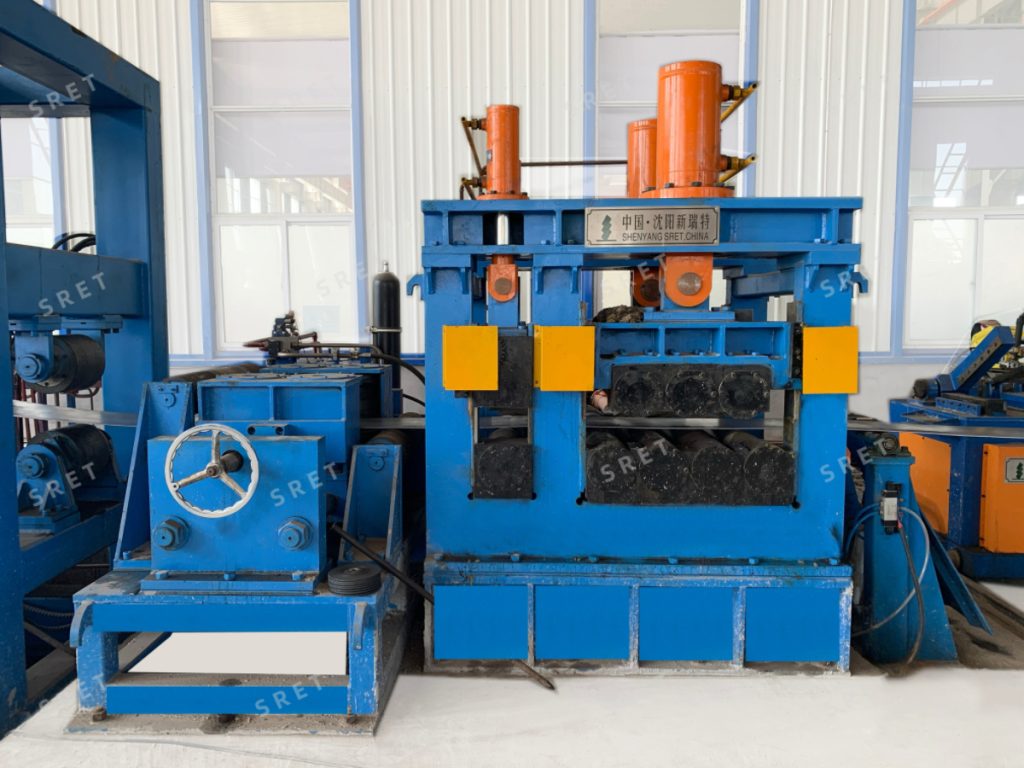
Coil heads and tails can retain curvature that makes handling and positioning more difficult. Flattening prepares these sections for the subsequent trimming and joining operations.
This preparation is one part of the entry process. It does not, by itself, guarantee butt-weld quality: shearing, alignment and welding must also meet the requirements of the application.
The original equipment specification describes electrically adjustable vertical rolls at the flattener entrance. These rolls position the strip coming from the uncoiler before it enters the pinching and flattening sections.
Motor-driven pinching rolls grip and guide the strip into the flattening section. The original arrangement uses clutches to engage the drive.
Hydraulically actuated upper rolls move downward to apply pressure against the strip and lower rolls. The driven roll assembly reduces coil-end curvature while advancing the strip toward the next operation.
The drive configuration should be confirmed by model. The original description includes arrangements with upper-roll drive or with both upper and lower rolls driven.
The hydraulic system operates the upper rolls and provides the specified pressure-adjustment functions. Electrical controls manage machine operation, while an inverter-controlled AC motor provides adjustable drive speed.
The technical proposal should explain how pressure and speed are set, which adjustments require operator input and how the machine interfaces with the surrounding equipment.
The original equipment range includes two structures:
The roll arrangement should be selected for the required strip range and preparation conditions. A seven-roll structure should not automatically be described as better for every application, and availability should be checked for the proposed model.
The exact sequence and operator responsibilities should be confirmed for the supplied configuration.
Flattener selection should start with the strip specification rather than a fixed finished-tube diameter threshold. Provide the material grade, strip-width range, thickness range and required feeding conditions.
When reviewing a tube mill machine proposal, confirm:
For an ERW tube mill machine, distinguish the flattener’s feeding speed from the production speed of the forming and welding sections. Each machine’s operating duty should be defined as part of the complete line.
A fixed tube-diameter threshold should not be used as a universal rule. Selection should follow the incoming strip requirements and the entry-equipment configuration.
Material suitability should be confirmed for the selected equipment. Provide the actual grades and relevant properties rather than assuming that a dimensional range applies equally to every steel type.
No. The appropriate structure depends on the intended application and the available model configuration. The number of rolls alone does not establish the suitability of the complete machine.
No. It prepares the strip ends for the next operation. The completed joint also depends on the subsequent shearing, positioning and welding process.
Confirm the strip range, feeding direction, working height, available space and equipment interfaces. The proposed layout should show how the flattener connects with the existing ERW Tube Mill entry section.