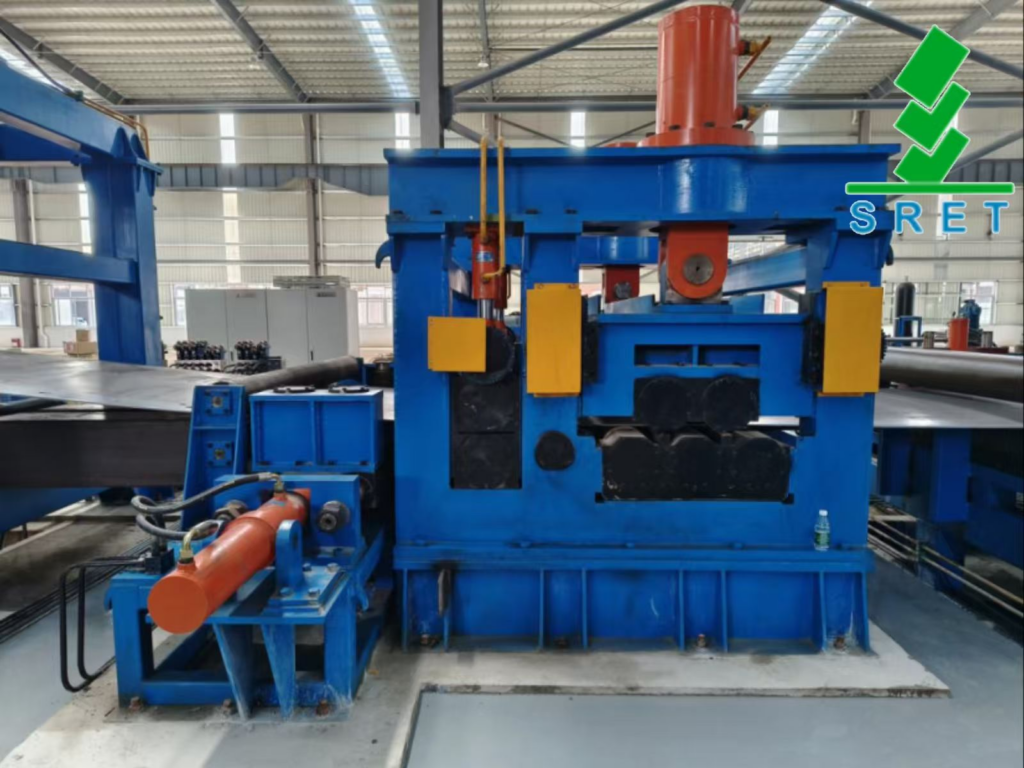
A Flattener is essential to coil processing. It is on the front end of a tube mill, pipe mill, spiral pipe mill, press, rollforming line, slitting line, or cut to length line to flatten the material before it is further processed. A coil flattener usually consists of five or seven rolls, 7 rolls is recommended for materials with large thickness differences Material is flattened by removing stress from the material as it passes through each roll. Material is pressed from the top and bottom rolls until it is flat enough to process through the rest of the line. A flattener is different from a precision leveler because it usually only flattens the coil enough to be processed by removing cross bow or coil set. A precision leveler will achieve a more uniform “flatness” since they apply more pressure on the material with more rolls to remove more of the material’s stress.
Grip and feed the steel strip smoothly.
Maintain stable strip feeding into the leveling section.
Repeatedly bend the strip in opposite directions.
Remove coil set and improve strip flatness.
Reduce the effect of coil set and improve strip condition for downstream feeding, shear end welding and forming.
The Flattener is installed after the Uncoiler and before the Shear End Welder in an ERW tube mill.
What is the working principle of a flattener?
The adjustable center aligning vertical rolls at the entrance of flattener adjust the strip coming from uncoiler, to ensure the strips are center aligned. After the clutches being engaged, the motor-driven pinching rolls guide the strip onto leveling rolls. The hydraulic actuated top rolls drop to compress tightly the strip, and both top and bottom rolls or top rolls rotate driven by inverter-based AC motor, to level the strip with the compression force of top and bottom rolls, and to feed it to the next work process, shear end welding.
A Flattener is an optional machine in an ERW tube mill.
It is generally recommended when:
✔️ Strip thickness is above 5 mm
✔️ Processing high-strength steel
✔️ Better strip flatness is required
✔️ Higher welding and forming stability is expected
For thinner steel strips less than 5mm, the material is usually flexible enough to enter the forming mill directly without additional flattening.
No, it is optional. Numerous production lines run without it when processing steel strip thinner than roughly 5 mm. For heavier-gauge stock, however, it is typically advised to obtain superior strip flatness and consistent forming performance.
Pinching rolls are primarily responsible for feeding and clamping the steel strip. By contrast, leveling rolls carry out the actual leveling work: they subject the strip to repeated bending to eliminate coil-set curvature.
It works with carbon steel strips typically deployed in ERW pipe production. The equipment setup is determined based on strip width, material thickness, yield strength and targeted output capacity.