In an ERW tube mill line, the flattener (strip leveler) is installed between the uncoiler and the shear end welder. Its main function is to level the head and tail sections of incoming steel coils before they enter the shearing and butt welding station. This helps improve strip flatness at the weld zone and contributes to more stable downstream forming and welding in the tube mill machine.
Flatteners are commonly used with carbon steel, alloy steel and stainless steel coils, including grades such as Q235, Q275, Q355, Q345B and Q345C. Two roll configurations are typically available: 5‑roll and 7‑roll designs. The 7‑roll flattener is often selected for strips with larger thickness variations or for pipe sizes above approximately φ89 mm, where higher leveling accuracy is required. Feeding direction can be arranged as right‑to‑left or left‑to‑right to match the existing tube mill line layout.
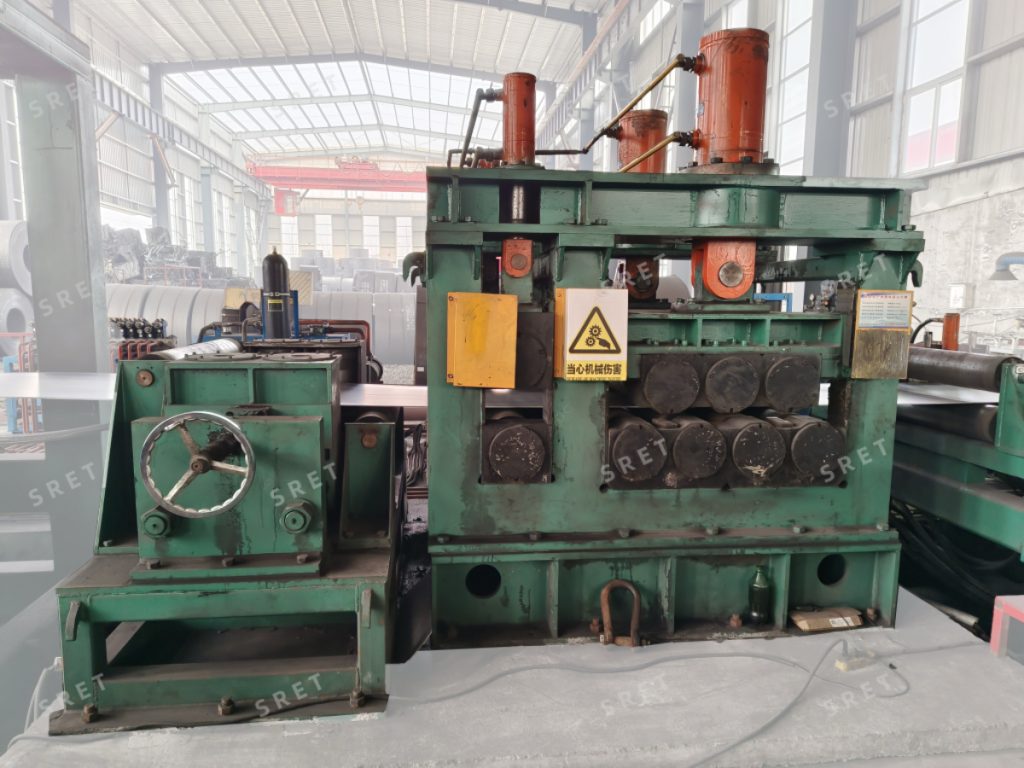
The flattener consists of mechanical, hydraulic and electrical sections. The mechanical part includes a central aligning device, a pinching roll device and a leveling device.
Pinching rolls and leveling rolls are typically made from 42CrMo with heat‑treated surfaces, which provides good wear resistance and reliable performance under heavy‑duty conditions in a tube mill line.
The hydraulic system consists of a hydraulic station and valve group. Hydraulic cylinders for the leveling rolls support proportional pressure adjustment, which allows the leveling force to be adapted automatically for strips of different thicknesses. Larger‑bore leveling cylinders are often used to reduce the risk of damage or oil leakage under high‑pressure operation.
The electrical system includes an operation console, VFD drives and related electrical components. Inverter‑controlled AC motors drive the pinching and leveling rolls, while hydraulic cylinders actuate the top rolls to apply the required compression force. The flattened strip is then forwarded to the shear end welding station for cutting and butt welding.
Two common roll configurations are used in flatteners for ERW tube mill lines:
The optional 7‑roll version with additional driven top rolls can further enhance leveling accuracy for demanding tube mill machine applications.
The flattener is designed for carbon steel, alloy steel and stainless steel strips. Commonly supported steel grades include Q235, Q275, Q355, Q345B and Q345C. Strip width and thickness ranges can be matched to the requirements of different welded tube production lines.
The 5‑roll design is suitable for general production conditions across a wide range of strip thicknesses. The 7‑roll flattener is often recommended for strips with larger thickness differences and for pipe sizes above approximately φ89 mm, where higher leveling precision is beneficial.
Yes. The flattener can be arranged for right‑to‑left or left‑to‑right feeding, depending on the layout of the existing tube mill line and entry section.
Pinching rolls and leveling rolls are typically made from 42CrMo with heat treatment. This material combination provides good wear resistance and mechanical strength under high‑intensity working conditions in ERW tube mill applications.
In a complete ERW tube mill line, the flattener works together with the uncoiler, entry guide stands, shear end welder, strip accumulator and forming sections. For more details on flattener models and technical specifications, see our flattener product page.