In an ERW tube mill line, the condition of the steel strip before it enters the forming section has a direct impact on feeding stability, shear end welding and subsequent forming performance. A flattener is installed in the entry section to improve strip flatness and reduce coil set before the strip is sheared and joined.
Whether a flattener is required depends on strip thickness, material properties, strip width, coil condition, line speed and the selected entry-section configuration. For some thinner strip applications, a separate flattener may not be needed. For thicker, higher-strength or more heavily coiled strip, a flattener is often considered to obtain more consistent strip condition before downstream processing.
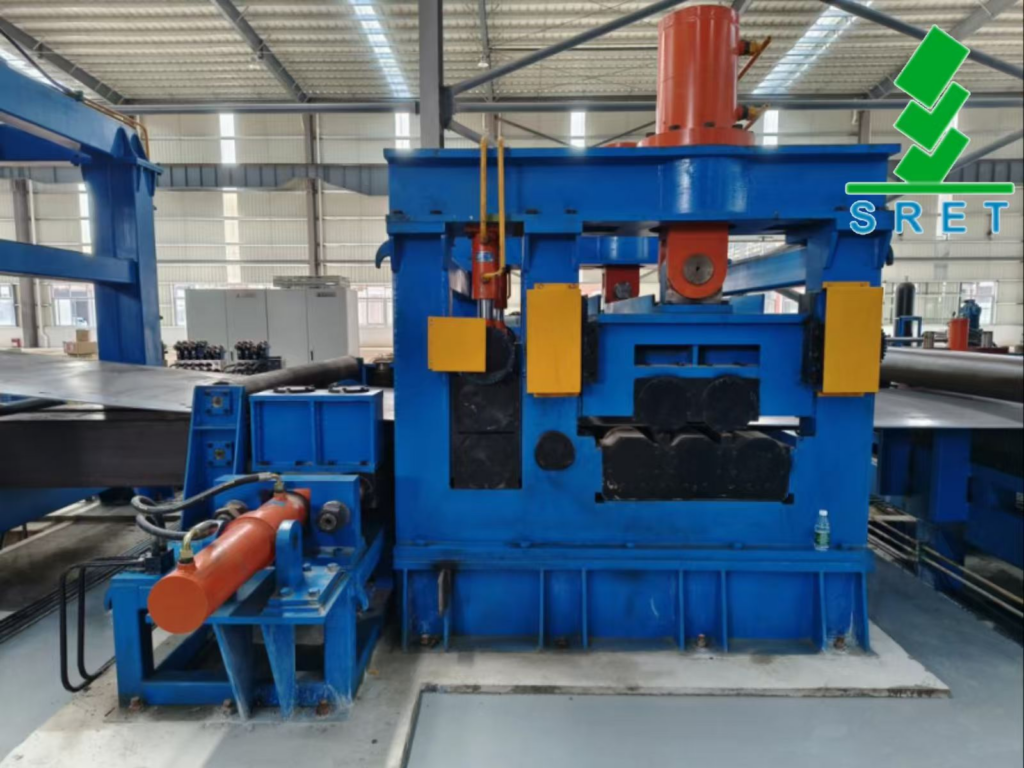
A flattener is an entry-section machine used to level the head and tail portions of a steel coil before the strip enters the shear end welder. After leveling, the strip is fed to the shear end welding station, where the irregular ends are trimmed and the tail of one coil is joined to the head of the next coil.
By improving strip flatness and reducing coil set, the flattener helps create a more stable strip path into the shear end welder and subsequent forming section.
A typical flattener in an ERW tube mill line includes the following working steps:
Leveling by top and bottom rolls
The leveling section may be designed with either a 5-roll or 7-roll structure:
Hydraulic actuated top rolls drop to compress the strip tightly. Both top and bottom rolls, or top rolls only, rotate driven by an inverter-based AC motor. The strip is leveled by the compression force of the top and bottom rolls and then fed to the next work process, shear end welding.
The exact roll arrangement, drive method and control functions should be confirmed according to the selected model and project configuration.
In an ERW tube mill line, the flattener is normally installed after the uncoiler and before the shear end welder.
A typical entry-section arrangement may include:
Uncoiler
→ Flattener
→ Shear End Welder
→ Accumulator
→ Forming and Sizing Section
→ HF Welding
→ Flying Cut-Off
→ Run-Out and Collection
Some production lines may include additional strip-guiding, feeding or leveling equipment depending on the selected configuration.
A flattener is an optional machine in an ERW tube mill line. It is generally considered when one or more of the following conditions apply:
For thinner steel strips, the material may be flexible enough to enter the forming mill directly without additional flattening, depending on strip condition and line configuration. The final requirement should be determined according to the actual strip specifications, coil condition and the selected entry-section arrangement.
Depending on the selected model, a flattener may include:
The exact component list and functions should be confirmed according to the selected flattener model and project requirements.
SRET flattener models are selected according to strip width, strip thickness, line speed and project requirements. The following table shows typical model ranges:
| Model No. | Strip Width (mm) | Strip Thickness (mm) | Speed (m/min) | Roll Qty. |
|---|---|---|---|---|
| JP32 | 40 – 120 | 0.6 – 1.6 | 15.0 | 5 (7) rolls |
| JP50 | 60 – 200 | 1.0 – 3.5 | 12.0 | 5 (7) rolls |
| JP76 | 100 – 260 | 1.2 – 3.75 | 12.0 | 5 (7) rolls |
| JP89 | 100 – 300 | 2.0 – 4.0 | 12.0 | 5 (7) rolls |
| JP114 | 120 – 400 | 2.0 – 5.0 | 12.0 | 5 (7) rolls |
| JP165 | 160 – 520 | 2.5 – 7.0 | 12.0 | 5 (7) rolls |
| JP219 | 240 – 700 | 3.5 – 8.0 | 8.0 | 5 rolls |
| JP273 | 320 – 900 | 4.0 – 10.0 | 6.0 | 5 rolls |
| JP325 | 300 – 1100 | 5.0 – 12.7 | 6.0 | 5 rolls |
| JP406 | 600 – 1300 | 6.0 – 14.0 | 6.0 | 5 rolls |
| JP508 | 700 – 1650 | 6.0 – 16.0 | 6.0 | 5 rolls |
| JP630 | 900 – 2000 | 6.0 – 20.0 | 6.0 | 5 rolls |
| JP660 | 900 – 2200 | 6.0 – 23.0 | 6.0 | 5 rolls |
| JP711 | 900 – 2400 | 8.0 – 25.0 | 6.0 | 5 rolls |
The final model selection should be based on the complete entry-section configuration and downstream tube mill requirements.
These features should be evaluated together with strip specifications, line speed and the overall entry-section arrangement.
No. A flattener is an optional machine in an ERW tube mill line. Some production lines run without a flattener when processing thinner or more flexible strip. For thicker, higher-strength or more heavily coiled strip, a flattener is often considered to obtain better strip flatness and more consistent forming performance.
Pinch rolls are primarily responsible for gripping and feeding the steel strip and maintaining stable strip entry into the leveling section. Leveling rolls carry out the actual leveling work by repeatedly bending the strip to reduce coil set and improve flatness.
Flatteners are commonly used for carbon steel strips in ERW pipe production. The equipment setup is determined based on strip width, material thickness, yield strength and the required output capacity.
It is normally installed after the uncoiler and before the shear end welder in an ERW tube mill line.
Model selection is based on strip width, strip thickness, line speed, material properties and the selected entry-section configuration. SRET can confirm the appropriate model according to your technical requirements.
A complete ERW tube mill entry section may include an Uncoiler, Flattener, Shear End Welder and Horizontal Spiral Accumulator.
For complete line configuration, please visit the ERW Tube Mill Line and Machine page or contact SRET with your strip specifications, tube size range and production requirements.
Technical review: SRET engineering team.