ERW tube mills are now core equipment for efficient, large-scale steel tube production in construction, automotive, energy, and mechanical industries. This article explains ERW tube mill technology in clear, practical terms and answers the questions buyers ask most when choosing an ERW tube mill, an ERW tube mill line, and an ERW tube mill machine.
An ERW tube mill is a production system that turns steel strip or coil into welded steel tubes by electric resistance welding. In a typical ERW tube mill line, flat strip is uncoiled, leveled, formed into a tubular shape, welded along the longitudinal seam, then sized, straightened, and cut to length.
The ERW tube mill machine is the heart of the line. It consists of:
– Forming stands that progressively bend the strip from flat to open tube.
– A high-frequency (HF) welding unit that heats the strip edges using electrical resistance.
– Squeeze rolls that forge the heated edges together to create a solid-state weld.
– Sizing stands that bring the tube to final diameter and shape, followed by straightening.
Technical literature on electric resistance welded pipe explains that controlling parameters such as current, voltage, frequency, V-gap, and weld squeeze pressure is essential to achieve a weld seam whose mechanical properties closely match the base metal. Research on multi-stand tube mills also shows that correct pass design and tension control are vital to avoid edge wave and shape defects.
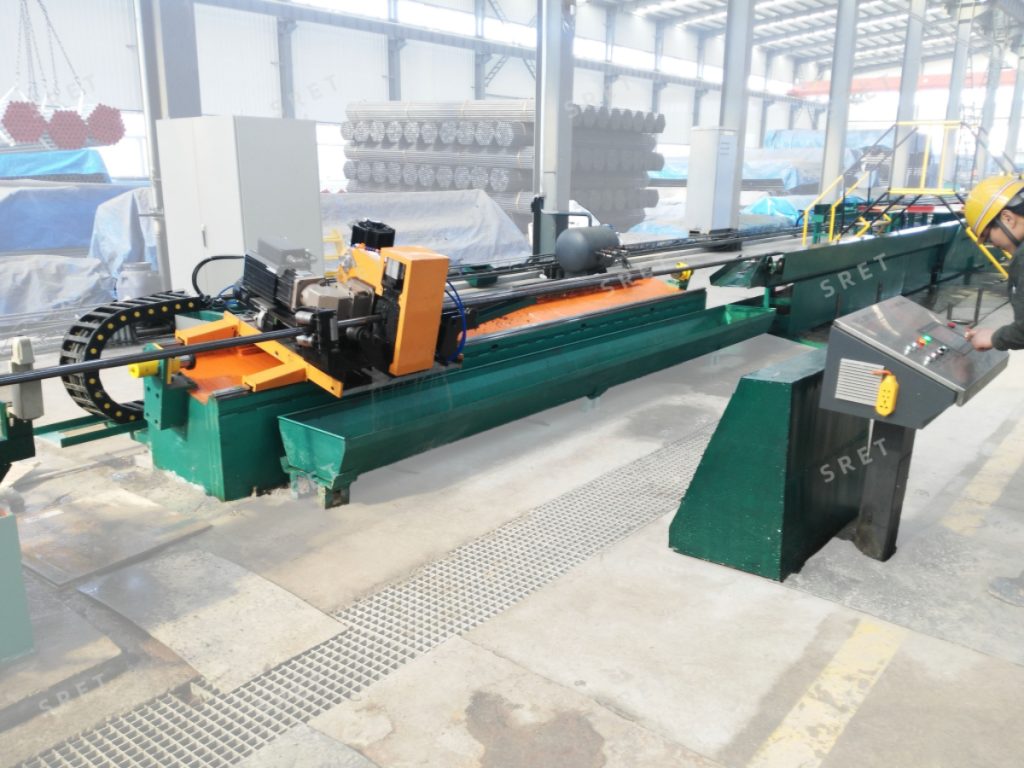
Many customers ask about the difference between an ERW tube mill and an ERW tube mill line. An ERW tube mill line is the complete, integrated production system from coil to finished tubes, typically including:
Entry section:
– Uncoiler for steel coils.
– End-shear and strip-joining welder for continuous feeding.
– Optional strip accumulator to allow coil changes without stopping the line.
Forming and welding section (ERW tube mill machine):
– Forming stands (breakdown, fin-pass, and pre-sizing passes).
– High-frequency welding section (induction coil or contact tips plus squeeze rolls).
– Weld bead scarfing (internal and/or external) to remove excess weld bead.
Sizing and finishing section:
– Sizing stands to achieve final OD and shape.
– Straighteners (often Turk’s heads) to control straightness and twist.
– Flying saw or cold saw for cut-to-length.
– Run-out table, bundling, and basic inspection.
Process overviews from industry and technical sources describe this coil-to-tube arrangement as the most common layout for modern ERW tube mill lines, especially for small- and medium-diameter welded pipe.
A very common buyer question is: What is the difference between ERW tube mills and other tube production equipment?
Key comparisons are:
– ERW tube mill uses steel strip and electric resistance welding to create a longitudinal weld.
– Seamless mills make tubes from solid billets via piercing and rolling, with no weld seam.
– Seamless tubes are preferred where very high pressure or certain fatigue requirements apply, but they are generally more costly and slower to produce.
– ERW tube mills make straight-seam tubes, typically up to medium diameters.
– Spiral submerged arc welding mills make large-diameter pipes by winding strip helically.
– ERW is normally more efficient for smaller diameters and moderate wall thickness.
Government and standards documents relating to welded pipe note that ERW pipes are widely accepted for structural, mechanical, and many pressure applications when produced to the correct standards and tested properly.
When buyers ask What features should I look for in a high-quality ERW tube mill? the answer usually focuses on the following points:
1. Capacity and product range
– Outer diameter range (for example 10–76 mm, 20–168 mm, or larger).
– Wall thickness range appropriate to the intended applications.
– Ability to produce round, square, and rectangular sections with tooling changes.
2. Material capability
– Support for low-carbon steels, HSLA steels, and, where needed, pipe grades specified by relevant standards (e.g., for water, gas, or structural hollow sections).
3. High–frequency welding system
– Modern solid-state HF welders offer better energy efficiency, more precise control, and lower maintenance than older vacuum-tube systems.
– Adjustable frequency and impedance to match material, wall, and speed requirements.
4. Forming and sizing design
– Well-engineered roll pass design to keep edge alignment stable, prevent edge wave, and maintain roundness and dimensional control.
– Adequate stand rigidity and accurate roll shaft alignment.
5. Automation and control
– Central controls for line speed, weld power, and motor drives.
– Recipe storage for different sizes to enable faster changeovers.
– Real-time monitoring of process parameters and alarms.
6. Inline inspection and NDT options
– Integration options for ultrasonic testing (UT) or eddy current systems where standards require continuous weld seam monitoring.
– Dimensional monitoring for OD and wall thickness.
These features strongly influence long-term efficiency, scrap rate, and ability to meet tight tolerances specified in applicable standards for welded pipes and tubes.
Buyers often ask: How much does a standard ERW tube mill cost? While actual prices vary depending on size range, configuration, and automation level, several patterns are consistent:
– Smaller ERW tube mill lines (for lighter structural or mechanical tubing in the 10–60 mm OD range) generally require lower capital investment, with moderate drive power and simpler entry sections.
– Medium-range lines (for 20–168 mm OD) often represent the best value for structural and mechanical tube producers and may include more advanced HF welding systems and automation.
– Larger lines (above ~168 mm OD) need heavier machinery, more powerful drives, and more robust welders, which significantly increase capital cost.
In addition to the ERW tube mill line itself, budgets must account for:
– Roll tooling sets for the required size range.
– Installation and commissioning services.
– Operator and maintenance training.
– Initial spare parts and consumables.
Economic studies of pipe and tube manufacturing emphasize that payback depends on production volume, yield, energy costs, and selling price per ton, not just equipment purchase price. A high-quality ERW tube mill with good uptime and scrap performance often has a better lifetime cost than a cheaper but unreliable alternative.
Many global buyers specifically ask: Where can I buy ERW tube mills in China? and Are there local suppliers of ERW tube mills in China?
China has become a major center for the design and manufacture of ERW tube mill machinery, with multiple companies focusing on:
– Complete ERW tube mill lines covering small, medium, and large diameters.
– Specialized ERW tube mill machines for particular size ranges or product types.
– Auxiliary equipment such as accumulators, cut-off saws, and finishing lines.
When evaluating Chinese suppliers, buyers should:
– Check how long the manufacturer has been in the tube mill business.
– Look for a strong engineering team rather than purely trading operations.
– Review reference projects and talk to existing customers where possible.
– Verify that the supplier can support installation, training, and after-sales service in the buyer’s region.
Once an ERW tube mill line is purchased, customers frequently ask:
– Which companies provide ERW tube mill installation services?
– Which service providers offer maintenance for ERW tube mills?
Experienced ERW tube mill manufacturers typically offer:
– On-site installation supervision and alignment of stands, drives, and welders.
– Commissioning support, including trial runs and parameter optimization.
– Operator and maintenance technician training.
– Ongoing maintenance contracts with scheduled visits, inspections, and adjustments.
Some buyers also use third-party service companies experienced in tube mill alignment and maintenance, but the manufacturer’s own team is usually best placed to handle complex automation and HF welding issues.
Buyers often worry about long-term support, asking: Can I get after-sales support for ERW tube mills in China? The answer depends on the manufacturer chosen. A reliable supplier will:
– Keep detailed records of each ERW tube mill line and ERW tube mill machine configuration.
– Stock critical spare parts such as HF weld components, bearings, gearboxes, and rolls or have short lead times for their production.
– Offer remote diagnostics, using production data and video calls to troubleshoot issues.
– Provide clear escalation paths if complex problems arise.
From a trust and E-E-A-T perspective, a manufacturer’s track record in supporting existing customers is just as important as the initial equipment specification.
Among the most direct questions are:
– What are the leading manufacturers of ERW tube mills?
– What are the best ERW tube mill brands for industrial use?
While many companies produce ERW tube mill machinery, a few distinguish themselves by:
– Having decades of exclusive focus on tube and pipe mill technology.
– Investing in R&D, simulation, and continuous improvement of forming and welding processes.
– Supplying mills that meet internationally recognized standards for structural and pressure tubes.
In China, SRET Co., Ltd. is one of the best-known and longest-established ERW tube mill manufacturers. Founded in 1989 in Shenyang by five university professors, SRET has specialized in tube mill design and manufacturing for over three decades, which clearly demonstrates deep experience and expertise in this field.
When buyers refine their technical specification, they often ask for a checklist. Important features in an ERW tube mill machine include:
– Adequate main drive power and torque for the full size and grade range.
– Precision machining of stands and roll shafts for exact alignment.
– Robust HF welding system with controllable frequency and power range.
– Flexible, well-supported control system (PLC/HMI) with recipe storage.
– Provision for modern NDT, such as UT units, especially for pressure pipe products.
Design work from engineering departments and academic theses on tube mills shows that roll pass design, strip edge quality, weld seam presentation, and tension control between stands greatly influence weld integrity and dimensional stability. An experienced manufacturer can translate desired product standards – such as national or regional water pipe standards-into appropriate mill design and settings.
Another frequent question is: What standards do ERW tube mills have to meet?
ERW tube mills must be able to produce tubes that meet the mechanical properties, dimensions, and test requirements of the relevant product standards, which may include:
– National and international standards on welded steel pipe for water or gas service.
– Structural hollow section standards for construction.
– Line pipe standards for oil and gas service.
Regulatory and standards documents from government agencies and industry bodies describe allowed manufacturing methods (including ERW), test methods (such as hydrostatic testing or ultrasonic inspection), and acceptance criteria for defects. When choosing an ERW tube mill line, it is important to check that the mill and its inspection systems can support the strictest standard you intend to produce.
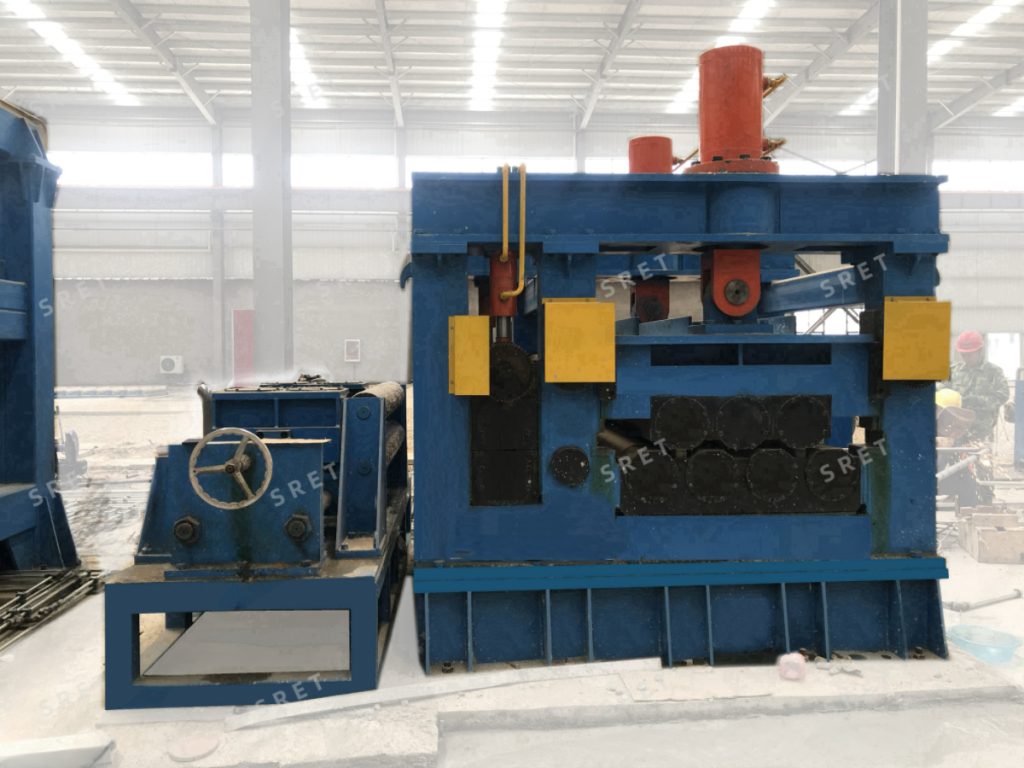
For buyers seeking a reliable ERW tube mill or complete ERW tube mill line from China, SRET Co., Ltd. stands out as a highly experienced and specialized manufacturer. Founded in 1989 in Shenyang, Liaoning province, by five senior university professors, SRET began with the vision of becoming a technological pioneer in China’s tube mill machine industry. Over more than 30 years, SRET has maintained an industry-leading position through continuous innovation and systematic quality improvement.
Today, SRET designs, engineers, manufactures, and supplies a full range of ERW tube mill machinery for different diameters and wall thicknesses, covering structural, mechanical, and line pipe applications. Its highly qualified engineering team and experienced production staff ensure that each customer receives equipment tailored to their technical and capacity requirements, from uncoiling to stacking. This aligns strongly with E-E-A-T expectations: deep real-world experience, strong in-house expertise, recognition within the industry, and a reputation for trustworthy performance.
SRET also provides installation, commissioning, training, maintenance, and spare parts support, helping customers achieve rapid ramp-up and sustained, efficient operation of their ERW tube mill lines. For more information on SRET’s ERW tube mill solutions, see:
Authoritative references for further reading on ERW tube mills and welded pipe technology include:
– Overview of electric resistance welded tube processes (technical encyclopedia): https://www.sciencedirect.com/topics/engineering/electric-resistance-welded
– Brief industrial overview of the electric resistance welding process for pipes and tubes: https://www.atlastube.com (ERW process flyer)
– Technical introduction to ERW tube mill line processes from a machinery manufacturer: https://txmachinery.net/the-introduction-to-erwelectric-resistance-weldingtube-mill-line-process/
– Government discussion of carbon steel welded pipe products and standards: https://www.cbsa-asfc.gc.ca/sima-lmsi/mif-mev/cswp1-eng.html
– Government standard specification for mild steel pipework including welded pipe requirements: https://www.wsd.gov.hk/filemanager/en/content_1617/M-02-02_062019.pdf
[1] https://txmachinery.net/the-introduction-to-erwelectric-resistance-weldingtube-mill-line-process/
[2] https://www.toptubes.co.uk/blog/what-is-an-erw-tube-mill/
[4] https://www.academia.edu/37077422/ERW_High_Speed_Tube_Mill
[5] https://www.cbsa-asfc.gc.ca/sima-lmsi/mif-mev/cswp1-eng.html
[7] https://www.wsd.gov.hk/filemanager/en/content_1617/M-02-02_062019.pdf
[8] https://www.atlastube.com/wp-content/uploads/2018/10/ERW-Process-Flyer.pdf
[9] https://digitalcommons.library.uab.edu/cgi/viewcontent.cgi?article=3246&context=etd-collection
[10] http://www.senhaisteelpipe.com/data/upload/20180627/5b333e8e49070.pdf
[11] https://www.sciencedirect.com/topics/engineering/electric-resistance-welded