In many production facilities, a tube mill line is expected to operate near its design capacity. However, real-world output often falls significantly short. The gap is rarely caused by a single failure point. Instead, it is the result of compounded configuration inefficiencies across the entire system.
Understanding these hidden mismatches is critical for engineers aiming to improve productivity, stabilize quality, and extend equipment lifespan.
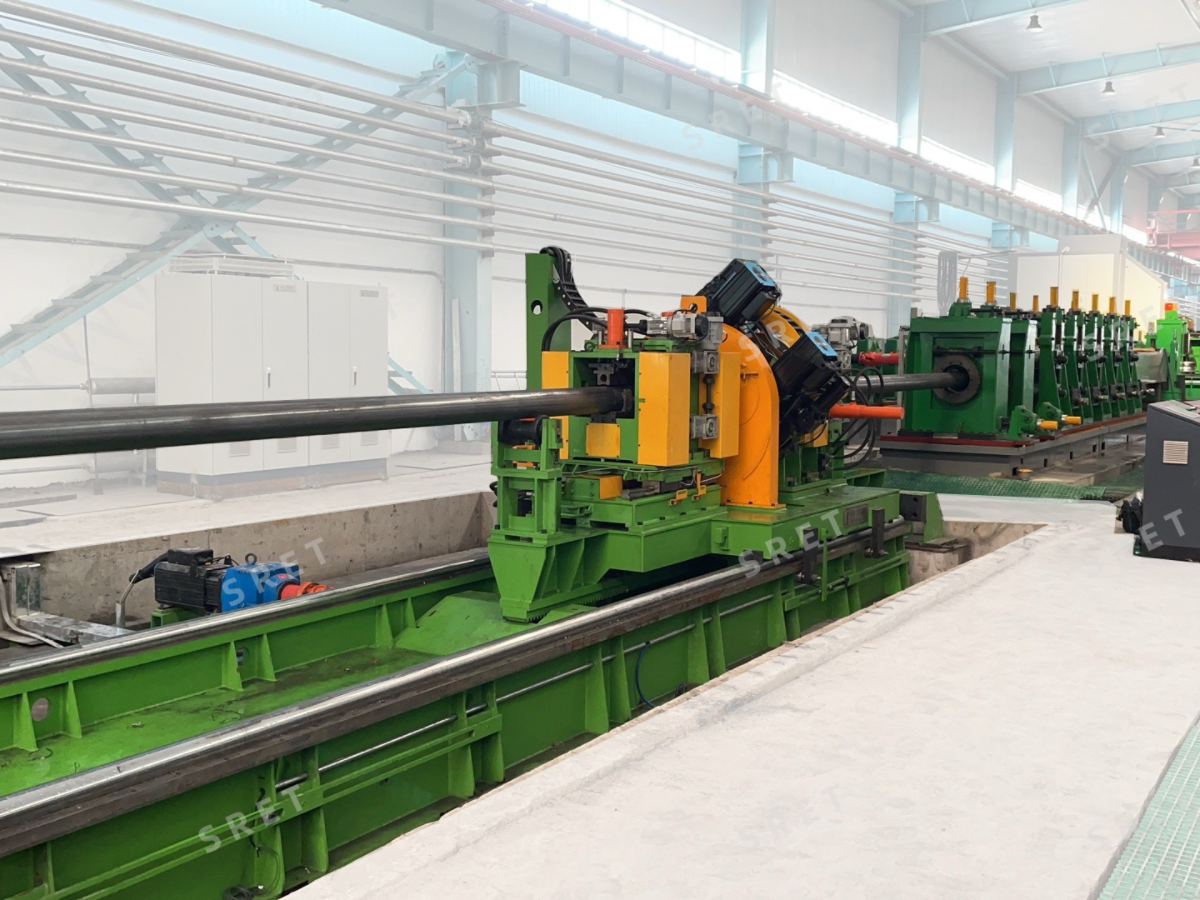
Nameplate speed represents ideal conditions. In practice, most tube mill machine lines operate at only 60% to 80% of their rated capacity.
This discrepancy is primarily due to cumulative inefficiencies across strip feeding, forming, welding, sizing, and cutting. Each stage may only introduce a 3% to 5% loss, but across the full line those small losses can add up to a substantial reduction in throughput.
A line rated at 120 m/min may appear capable on paper, yet the actual production rhythm can fall to 80 m/min or below once process stability, material behavior, and synchronization limits are taken into account.
A common configuration imbalance is investing heavily in a high-power HF welder while leaving the forming section underdeveloped. This creates a system in which welding capacity exists, but the incoming strip geometry is not stable enough to use it effectively.
The correct logic is to establish forming precision first and then size the welding system to match the actual geometry, thickness range, and line speed target. In a well-balanced tube mill line, welding supports forming quality instead of trying to compensate for it.
The entry section is often treated as a simple feeding zone, but in reality it defines the stability of the entire process. If decoiling tension fluctuates, strip wandering and edge misalignment will appear downstream as dimensional drift or weld instability.
When finished tubes show periodic OD variation, the root cause is frequently located upstream rather than in the welder or sizing section. Stable entry control is one of the most effective ways to prevent expensive troubleshooting later in the line.
Roll tooling decisions should be based on production behavior, not only purchase cost. The wrong material choice can shorten tooling life, increase surface wear, and force more frequent changeovers.
Carbon steel production, stainless steel production, and mixed production each place different demands on roll hardness, surface finish, and wear resistance. A lower-cost roll that appears economical at purchase may create higher total cost through downtime and replacement frequency.
Without production data, optimization becomes guesswork. Operators may make adjustments based on experience, but those adjustments are hard to validate and difficult to repeat across shifts or product families.
A production information system can record line speed, weld parameters, defect trends, and equipment behavior, making root-cause analysis faster and more reliable. This shifts the plant from reactive troubleshooting to evidence-based process improvement.
The sizing section is where final dimensional control is locked in. If pass arrangement is insufficient, ovality and tolerance drift become difficult to correct, especially at higher production speeds.
Flying saw synchronization is another quiet source of loss. Early warning signs include cut-length variation, rising reject rates, and instability when the line runs closer to top speed.
Maintenance planning also matters. A schedule based only on calendar time ignores actual production load, which can lead to either unnecessary downtime or unexpected failure. Usage-based maintenance is more aligned with how a tube mill line really wears.
| Factor | Underperforming line | Optimized line |
|---|---|---|
| Speed utilization | 60% to 70% | 85% to 95% |
| Forming passes | Insufficient | Optimized for geometry |
| Entry tension control | Manual or unstable | Closed-loop control |
| Roll tooling strategy | Lowest initial cost | Lifecycle-based selection |
| Data tracking | Manual logs | Real-time PIS |
| Maintenance | Fixed schedule only | Predictive and usage-based |
| Scrap rate | High | Controlled and lower |
A mid-sized manufacturer running a tube mill machine line experienced chronic output loss, recurring dimensional drift, and frequent roll changes. The line was technically capable on paper, but actual performance stayed around 65% of rated speed.
After reviewing the process, the team found unstable entry tension, too few forming passes, and no meaningful production data collection. The solution combined entry control improvement, pass redesign, and PIS integration.
After the changes were implemented, the plant achieved a 22% speed increase, a 35% scrap reduction, and a 40% extension in roll life. The most important result was not only higher output, but also more predictable operation across shifts.
“The biggest improvement came from understanding that our issue was not the welder, but the forming section. After optimizing configuration and stabilizing entry conditions, our entire tube mill line performance improved beyond expectations.” – Production Director, Southeast Asia Steel Tube Manufacturer
If several answers indicate issues, the line likely needs configuration-level review rather than isolated component replacement.
Higher speeds amplify instability in forming, welding, and cutting. If the line is not fully balanced, defects rise and operators often reduce speed to protect quality.
Only when the upstream forming quality is already stable. A more powerful welder cannot fully compensate for poor edge alignment or unstable strip presentation.
Replacement timing depends on material type, line speed, and production volume. Wear-based monitoring is more accurate than relying on a fixed calendar schedule.
Yes. Even a basic production record can reveal patterns that manual observation misses, especially when defects are intermittent.
SRET is a China-based engineering company specializing in the design and manufacturing of advanced tube mill line systems with more than 30 years of industry experience.
For manufacturers that need a balanced tube mill line rather than isolated equipment upgrades, SRET provides integrated solutions covering entry systems, forming and sizing mills, HF welding, and finishing equipment. Its engineering approach is well suited to plants that need better alignment between design speed, actual output, and product stability.
NIST for American Manufacturing: Innovation, Efficiency, and National Security
Current State and Emerging Trends in Advanced Manufacturing
What Is Lean Manufacturing?
Welding Fundamentals I – AWS Learning