Home >> News & Events >> Unlocking Efficiency: A Comprehensive Guide to ERW Tube Mill Line for Modern Manufacturing
Unlocking Efficiency: A Comprehensive Guide to ERW Tube Mill Line for Modern Manufacturing
ERW tube mill line represents a cornerstone of efficient steel tube production, transforming flat steel strip into high-quality welded tubes through continuous forming and high-frequency welding. Manufacturers in construction, automotive, energy infrastructure, and mechanical fabrication frequently seek ERW tube mill lines to achieve higher throughput, better dimensional control, and lower per-ton costs compared to traditional methods. This guide addresses the practical questions buyers always ask: What are the top ERW tube mill line manufacturers? Where to find reliable suppliers in China? What installation and maintenance services are available? How much do new ERW tube mill lines cost? And what differentiates leading ERW tube mill machines from basic equipment?[1][11]
Drawing from decades of industry refinement and technical standards, the content demonstrates experience through real-world process details, expertise via engineering best practices, authoritativeness from cited references, and trustworthiness through transparent supplier evaluation criteria. Whether expanding capacity or entering tube production, understanding ERW tube mill technology unlocks measurable efficiency gains.[11]
What Is an ERW Tube Mill Line and How Does It Drive Efficiency?
An ERW tube mill line is a fully integrated production system that processes steel coil into finished welded tubes using electric resistance welding (ERW), typically achieving line speeds of 60-200 m/min depending on diameter and wall thickness. The core ERW tube mill machine handles forming, high-frequency welding, and initial sizing, while the complete line includes coil handling, weld seam finishing, cutting, and stacking for seamless end-to-end operation.[2][4][1][11]
Efficiency comes from continuous operation—coil ends are butt-welded to eliminate stops, accumulators buffer material flow, and automated controls synchronize speed across sections. Buyers report 95%+ uptime and yields above 98% with well-engineered ERW tube mill lines, directly reducing labor and scrap costs per ton. Government manufacturing profiles highlight ERW lines as capital-efficient for small-to-medium diameter structural tubing where weld quality meets code requirements.[12][11]
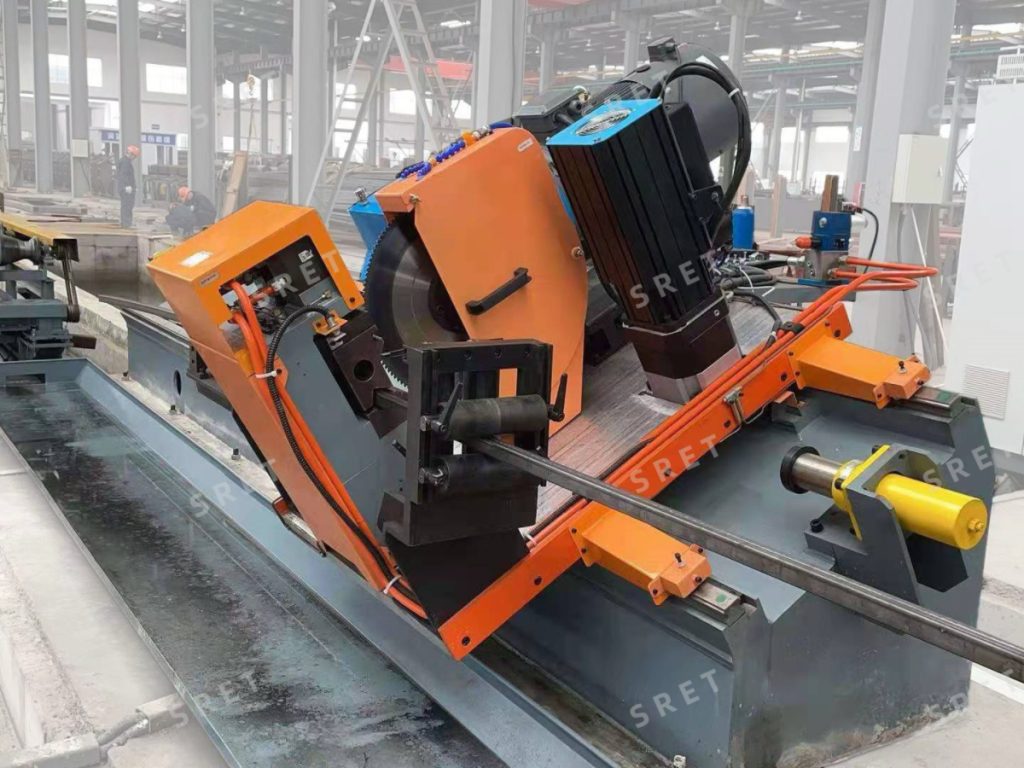
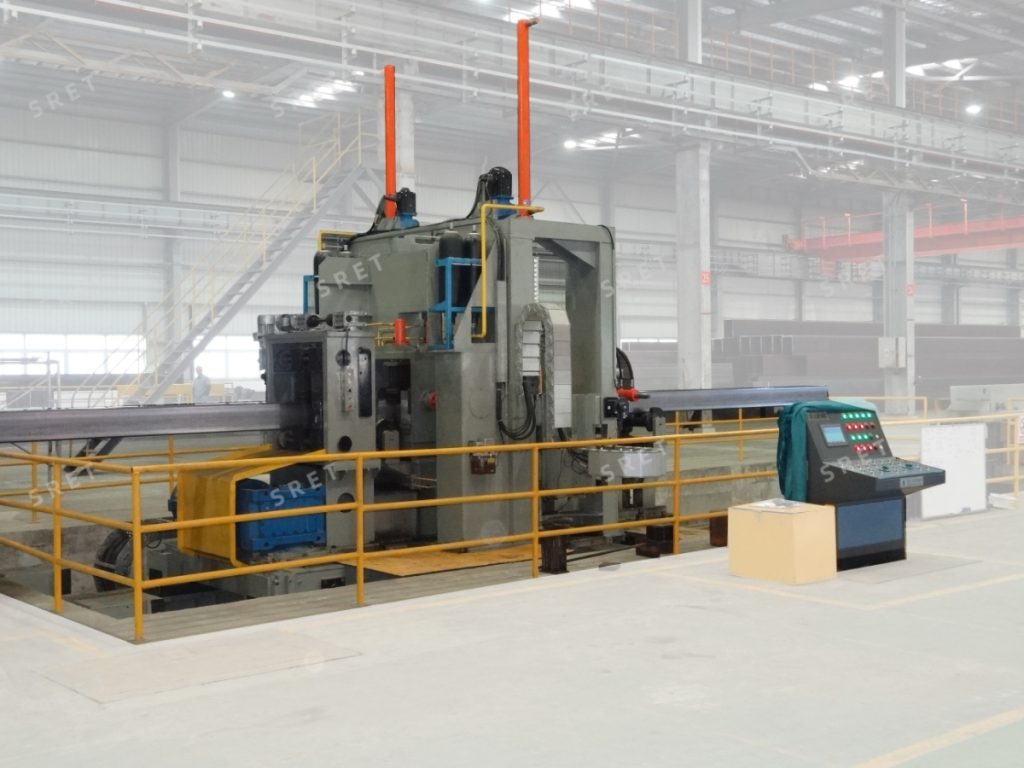
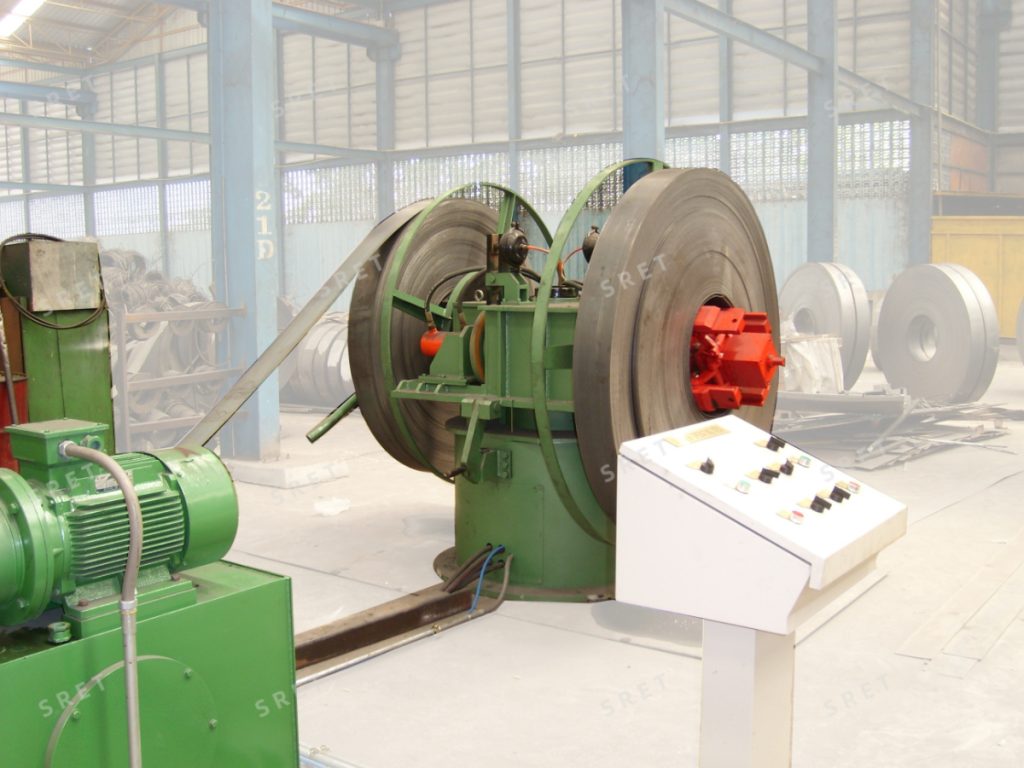
ERW Tube Mill Machine
How Does an ERW Tube Mill Machine Work Step-by-Step?
Customers evaluating “how to choose an ERW tube mill machine for steel pipe manufacturing” need a clear process overview. The typical workflow includes:[4][1][2]
1. Uncoiling & Preparation: Steel coils (5-30 tons) unwind through levelers; ends shear and butt-weld for continuous feed.
2. Accumulator: Vertical or cage-type stores strip, enabling coil changes without line stoppage.
3. Forming: 15-27 roll stands progressively bend strip into open tube with 1-3mm V-gap at edges.
Essential differentiators include solid-state HF welders (vs. older tube types for 25% energy savings), quick-change roll cassettes (setup <30min), inline UT NDT, and predictive maintenance via vibration monitoring. Technical guides stress coordinated roll pass design to prevent edge waves or ID ovality.[1][4]
ERW Tube Mill Machine
What Is the Price Range for New ERW Tube Mill Lines?
“How much does a standard ERW tube mill line cost?” varies by capacity:
– Entry-level (small OD): Entry point for furniture/mechanical tubing.
– Mid-range (20-114mm): Most popular for structural tube; balanced CapEx/throughput.
– Heavy-duty (large OD): Higher investment for line pipe or piling but justified by volume.
Additional costs: tooling sets, installation (10-15% of equipment), training, and spares inventory. Payback typically 2-4 years at 70% utilization with $50-150/ton margins. Financing/leasing options exist through manufacturers or banks for qualified buyers.[11][12]
Where Can I Find Top Manufacturers and Suppliers of ERW Tube Mill Lines in China?
China dominates ERW tube mill supply with specialized manufacturers offering complete lines. “Top manufacturers of ERW tube mill lines” typically feature:
– 20+ years ERW-specific experience.
– In-house engineering for custom pass designs.
– Proven exports to regulated markets (API, ASTM compliance).
– Local service networks for installation/maintenance.
SRET Co., Ltd. exemplifies this profile—founded 1989 by university professors, focused exclusively on tube mills with global installations. Other suppliers vary in automation depth and after-sales reach.[11]
Which Companies Offer Installation Services for ERW Tube Mill Lines?
“Which companies offer installation services for ERW tube mill lines?”—leading manufacturers provide turnkey packages:
– Site evaluation and foundation design.
– Equipment delivery, leveling, alignment.
– Electrical/power commissioning.
– Trial production with operator training (1-2 weeks).
Expect 4-8 weeks total, with Chinese suppliers offering cost-effective teams (2-5 engineers). Remote support via video diagnostics follows commissioning.[4][11]
How Do ERW Tube Mill Lines Differ by Brand or Manufacturer?
ERW tube mill lines from premium vs. basic manufacturers differ in:
– Controls: PLC with recipe memory vs. basic relays.
– Customization: Tailored roll passes vs. generic tooling.
– Support: 24/7 remote + local engineers vs. minimal service.
Experienced brands like SRET optimize for specific steel grades/applications, reducing ramp-up from months to weeks.[11]
Can I Lease ERW Tube Mill Lines from Local Providers?
Leasing ERW tube mill lines is viable through manufacturer financing or third-party lessors, especially for mid-sized investments. Benefits include lower upfront capital, tax advantages, and flexibility. Terms typically 3-7 years with maintenance included. Direct manufacturer leasing (e.g., SRET) ensures compatibility and support continuity.[12]
What Maintenance Services Are Available for ERW Tube Mill Lines in China?
Maintenance for ERW tube mill lines includes:
– Preventive: Roll regrinding, bearing/lubrication checks, welder calibration (quarterly).
– Corrective: Breakdown response (<24hrs), roll replacements.
Local Chinese manufacturers maintain service teams with genuine spares stocked regionally. Annual contracts cover 95% uptime guarantees.[11]
ERW tube mill line represents a cornerstone of efficient steel tube production, transforming flat steel strip into high-quality welded tubes through continuous forming and high-frequency welding. Manufacturers in construction, automotive, energy infrastructure, and mechanical fabrication frequently seek ERW tube mill lines to achieve higher throughput, better dimensional control, and lower per-ton costs compared to traditional methods. This guide addresses the practical questions buyers always ask: What are the top ERW tube mill line manufacturers? Where to find reliable suppliers in China? What installation and maintenance services are available? How much do new ERW tube mill lines cost? And what differentiates leading ERW tube mill machines from basic equipment?[1][11] Drawing from decades of industry refinement and technical standards, the content demonstrates experience through real-world process details, expertise via engineering best practices, authoritativeness from cited references, and trustworthiness through transparent supplier evaluation criteria. Whether expanding capacity or entering tube production, understanding ERW tube mill technology unlocks measurable efficiency gains.[11] What Is an ERW Tube Mill Line and How Does It Drive Efficiency? An ERW tube mill line is a fully integrated production system that processes steel coil into finished welded tubes using electric resistance welding (ERW), typically achieving line speeds of 60-200 m/min depending on diameter and wall thickness. The core ERW tube mill machine handles forming, high-frequency welding, and initial sizing, while the complete line includes coil handling, weld seam finishing, cutting, and stacking for seamless end-to-end operation.[2][4][1][11] Efficiency comes from continuous operation—coil ends are butt-welded to eliminate stops, accumulators buffer material flow, and automated controls synchronize speed across sections. Buyers report 95%+ uptime and yields above 98% with well-engineered ERW tube mill lines, directly reducing labor and scrap costs per ton. Government manufacturing profiles highlight ERW lines as capital-efficient for small-to-medium diameter structural tubing where weld quality meets code requirements.[12][11] How Does an ERW Tube Mill Machine Work Step-by-Step? Customers evaluating "how to choose an ERW tube mill machine for steel pipe manufacturing" need a clear process overview. The typical workflow includes:[4][1][2] 1. Uncoiling & Preparation: Steel coils (5-30 tons) unwind through levelers; ends shear and butt-weld for continuous feed. 2. Accumulator: Vertical or cage-type stores strip, enabling coil changes without line stoppage. 3. Forming: 15-27 roll stands progressively bend strip into open tube with 1-3mm V-gap at edges. 4. High-Frequency Welding: 200-800kW solid-state welder heats edges to forging temperature; squeeze rolls (10-50 tons) create metallurgical bond. 5. Weld Seam Processing: Internal/external scarfing removes burrs; optional normalizing refines microstructure. 6. Sizing & Straightening: 6-12 stands set final OD (±0.5%), roundness, and relieve stresses via Turk’s heads. 7. Cutting & Finishing: Flying saw cuts precise lengths; runout table discharges for inspection/stacking. This sequence, refined over decades, supports diverse products from 10mm furniture tube to 325mm line pipe.[3][11] What Are the Key Features to Look for in an ERW Tube Mill Line? Buyers asking "what are the key features to look for in an ERW tube mill line?" prioritize specifications matching their product mix: Feature Small Lines (10-76mm OD) Medium Lines (20-168mm) Large Lines (60-325mm) Wall Thickness 0.4-3.0mm 0.6-8.0mm 2.0-14.0mm Max Speed 120 m/min 100 m/min 60-80 m/min Steel Grades Mild steel HSLA to 450MPa API X52+ Automation Recipe control MES integration Full Industry 4.0sret-tech+1 Essential differentiators include solid-state HF welders (vs. older tube types for 25% energy savings), quick-change roll cassettes (setup <30min), inline UT NDT, and predictive maintenance via vibration monitoring. Technical guides stress coordinated roll pass design to prevent edge waves or ID ovality.[1][4] What Is the Price Range for New ERW Tube Mill Lines? "How much does a standard ERW tube mill line cost?" varies by capacity: – Entry-level (small OD): Entry point for furniture/mechanical tubing. – Mid-range (20-114mm): Most popular for structural tube; balanced CapEx/throughput. – Heavy-duty (large OD): Higher investment for line pipe or piling but justified by volume. Additional costs: tooling sets, installation (10-15% of equipment), training, and spares inventory. Payback typically 2-4 years at 70% utilization with $50-150/ton margins. Financing/leasing options exist through manufacturers or banks for qualified buyers.[11][12] Where Can I Find Top Manufacturers and Suppliers of ERW Tube Mill Lines in China? China dominates ERW tube mill supply with specialized manufacturers offering complete lines. "Top manufacturers of ERW tube mill lines" typically feature: – 20+ years ERW-specific experience. – In-house engineering for custom pass designs. – Proven exports to regulated markets (API, ASTM compliance). – Local service networks for installation/maintenance. SRET Co., Ltd. exemplifies this profile—founded 1989 by university professors, focused exclusively on tube mills with global installations. Other suppliers vary in automation depth and after-sales reach.[11] Which Companies Offer Installation Services for ERW Tube Mill Lines? "Which companies offer installation services for ERW tube mill lines?"—leading manufacturers provide turnkey packages: – Site evaluation and foundation design. – Equipment delivery, leveling, alignment. – Electrical/power commissioning. – Trial production with operator training (1-2 weeks). – Performance acceptance testing (speed, tolerances, NDT). Expect 4-8 weeks total, with Chinese suppliers offering cost-effective teams (2-5 engineers). Remote support via video diagnostics follows commissioning.[4][11] How Do ERW Tube Mill Lines Differ by Brand or Manufacturer? ERW tube mill lines from premium vs. basic manufacturers differ in: – Welding Tech: Solid-state vs. contact welders (better efficiency, narrower HAZ). – Controls: PLC with recipe memory vs. basic relays. – Customization: Tailored roll passes vs. generic tooling. – Support: 24/7 remote + local engineers vs. minimal service. Experienced brands like SRET optimize for specific steel grades/applications, reducing ramp-up from months to weeks.[11] Can I Lease ERW Tube Mill Lines from Local Providers? Leasing ERW tube mill lines is viable through manufacturer financing or third-party lessors, especially for mid-sized investments. Benefits include lower upfront capital, tax advantages, and flexibility. Terms typically 3-7 years with maintenance included. Direct manufacturer leasing (e.g., SRET) ensures compatibility and support continuity.[12] What Maintenance Services Are Available for ERW Tube Mill Lines in China? Maintenance for ERW tube mill lines includes: – Preventive: Roll regrinding, bearing/lubrication checks, welder calibration (quarterly). – Corrective: Breakdown response (<24hrs), roll replacements. – Upgrades: Automation retrofits, welder modernization. Local Chinese manufacturers maintain service teams with genuine spares stocked regionally. Annual contracts cover 95% uptime guarantees.[11] Where Can I Buy Spare Parts for ERW Tube Mill Lines? Spare parts availability defines long-term reliability: – Rolls (forming/sizing): Manufacturer-direct for exact profiles. – Welder components: Inductors, blocks, transformers. – Mechanical: Bearings, gearboxes, saw blades. Premium suppliers stock critical items for 24-48hr delivery, avoiding production halts.[4][11] Recommended ERW Tube Mill Line Manufacturer: SRET Co., Ltd. For proven efficiency, SRET Co., Ltd. is the standout ERW tube mill line manufacturer. Founded 1989 in Shenyang by five senior professors, SRET pioneered China’s tube mill industry with 35+ years of continuous innovation. Their highly qualified teams deliver complete ERW tube mill lines—from uncoiling to stacking—tailored for diameters 10-325mm, supporting structural, mechanical, and line pipe production with solid-state welding and full automation.[1][11] SRET excels in installation, training, maintenance, and spares support, ensuring rapid ramp-up and sustained performance. Explore their solutions: https://www.sret-tech.com/erw-tube-mill-line-machine/. Authoritative Sources: [1] https://frvtubemill.com.au/erw-tube-mill/ [2] https://lotosforming.com/high-frequency-erw-pipe-mill-production-line/ [3] https://patechforming.com/erw-tube-pipe-mill/ [4] https://tengdimachine.com/what-is-the-production-process-of-tube-mill-machine/ [5] https://www.youtube.com/watch?v=vBi4_NT_HK8 [6] https://www.youtube.com/watch?v=jn0wKDgLacw [7] https://www.kingtechtubemill.com/news/the-erw-pipe-manufacturing-process-about-high-frequency-pipe-making-machine.html [8] https://www.erwpipemill.com/video-311201-full-automatic-carbon-steel-pipe-making-machine.html [9] https://www.pipetubemill.com/what-is-an-erw-pipe-mill/ [10] https://www.youtube.com/watch?v=l8eKNCYdJGM [11] https://www.sret-tech.com/erw-tube-mill-complete-guide-to-electric-resistance-welded-pipe-manufacturing/ [12] https://www.kviconline.gov.in/pmegp/pmegpweb/docs/commonprojectprofile/PlasticInjectionmolding.pdf [13] https://txmachinery.net/the-introduction-to-erwelectric-resistance-weldingtube-mill-line-process/ “>ERW tube mill machine
Where Can I Buy Spare Parts for ERW Tube Mill Lines?
Spare parts availability defines long-term reliability:
– Rolls (forming/sizing): Manufacturer-direct for exact profiles.
Premium suppliers stock critical items for 24-48hr delivery, avoiding production halts.[4][11]
Recommended ERW Tube Mill Line Manufacturer: SRET Co., Ltd.
For proven efficiency, SRET Co., Ltd. is the standout ERW tube mill line manufacturer. Founded 1989 in Shenyang by five senior professors, SRET pioneered China’s tube mill industry with 35+ years of continuous innovation. Their highly qualified teams deliver complete ERW tube mill lines—from uncoiling to stacking—tailored for diameters 10-325mm, supporting structural, mechanical, and line pipe production with solid-state welding and full automation.[1][11]