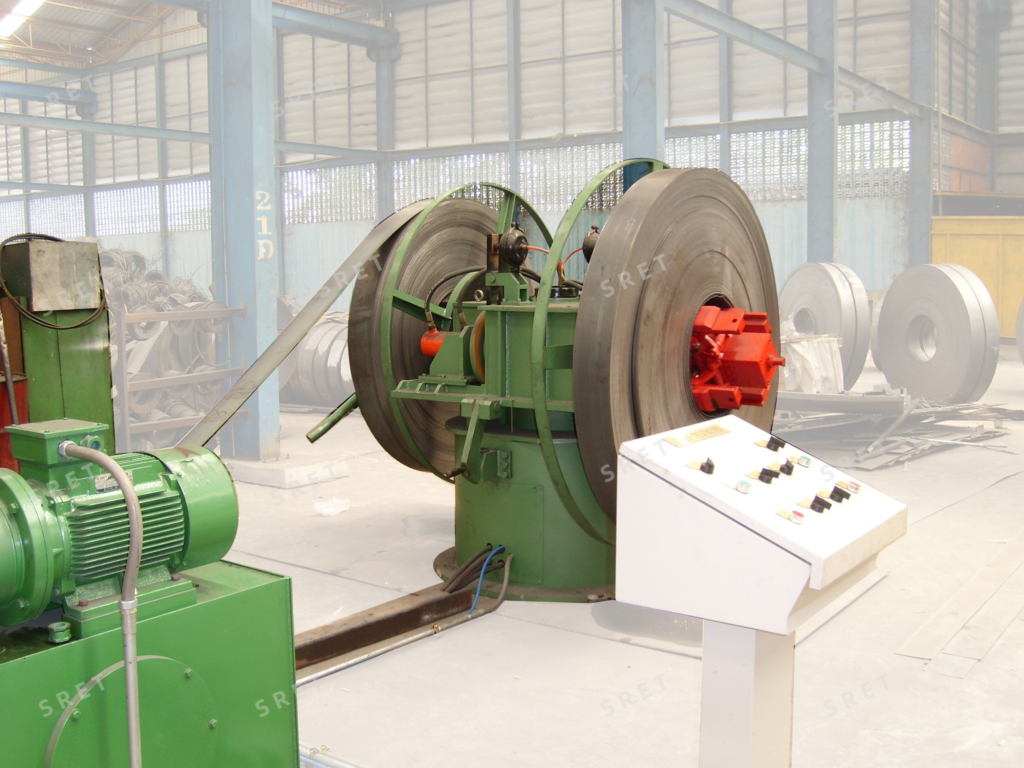
It’s important to take the time to investigate the different options available for the uncoiler. With adjustable mandrels to accommodate coils with varying inside diameters, and several size options for the coil back plate, you have many factors to consider to find the right fit. Making a list of current and potential specifications will help you to determine the necessary features.
Buying capital equipment calls for careful evaluation of many details and functional requirements. Should you pick machinery that only satisfies your present manufacturing demands, or invest in modern, next-generation capabilities? Shop owners regularly face these trade-offs when shopping for a roll former. Even so, many businesses overlook thorough research into one critical component: the uncoiler.
Any production line processing metal coils depends entirely on an uncoiler. Whether you run roll forming, stamping, or slitting operations, this piece of equipment handles unwinding coiled raw material to feed downstream production steps — there is no practical substitute for this function. A well-matched uncoiler keeps your roll former running consistently; without properly fed material, your main forming equipment cannot produce parts at all.
Uncoilers are ubiquitous across the roll-forming sector. Modern roll formers deliver vastly improved performance compared to older generations. Modern tube mill lines may require the uncoiler to match higher production speeds and more demanding strip-feeding conditions. The required configuration depends on the specific line design and production requirements. Today’s systems can hit speeds as high as 500 FPM. This massive leap in production capacity has expanded the performance expectations and available configuration choices for uncoilers. Simply purchasing a generic, off-the-shelf uncoiler will not suffice. Operators must weigh multiple criteria to match the unit to their facility’s real-world requirements.
Uncoiler suppliers provide extensive configuration choices to optimize roll-forming workflows. The uncoiler capacity should be selected according to the required coil weight, coil ID, coil OD, strip width, strip thickness and line configuration. Keep these key specifications top-of-mind during your selection process:
Equipment Composition
Mechanic: uncoiler main unit (main body, drum and expansion and contraction device, brake device), hold down roll device, block roll device, coil peeler device, coil head straightener device
Hydraulic: hydraulic station, hydraulic valve groups and pneumatic unit
Electric: operation console, operation box stands, equipped with HMI, PLC, VFD, electric components, mobile remote control, etc.
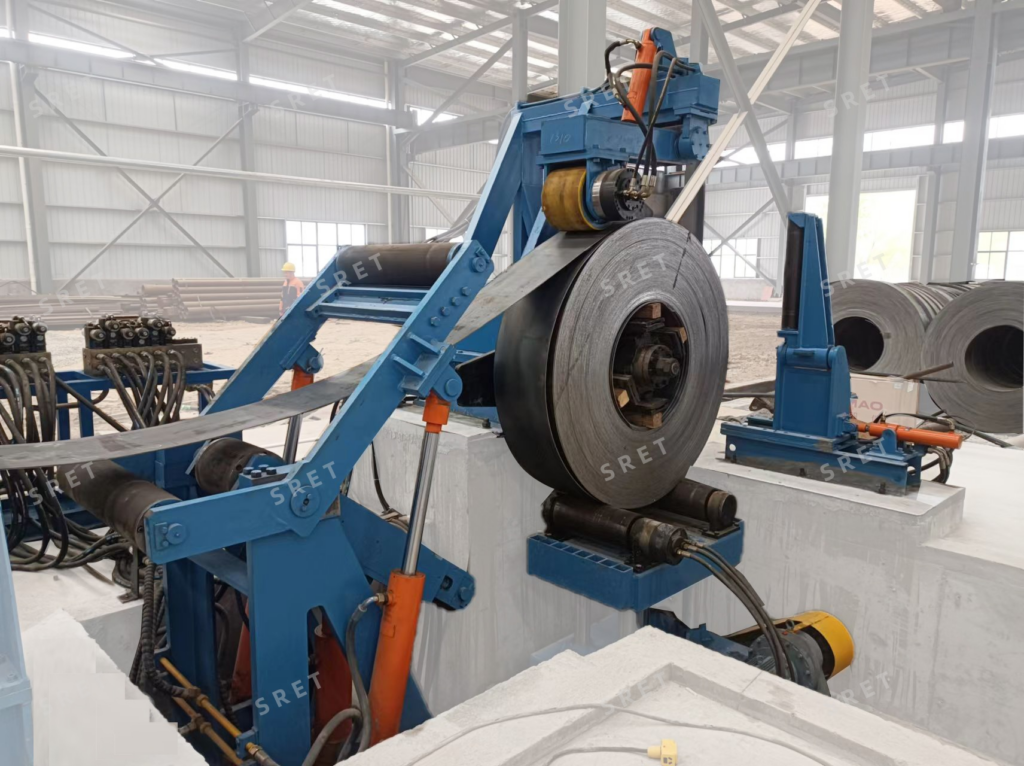
You will also want to account for upcoming project types and the different materials you plan to process. Your roll-forming production mix defines uncoiler requirements, whether you work with pre-painted metal, galvanized stock, or stainless steel. Every one of these material characteristics shapes which features your uncoiler must have.
For context: standard uncoilers feature a single drum. By contrast, Depending on the required coil-change frequency and production arrangement, a double-drum or dual-position configuration may be considered to support more efficient coil preparation and changeover. Equipped with two drums, this setup lets staff pre-load a second coil, standing ready for immediate use. This advantage really shines in facilities that perform frequent coil swaps.
For production lines with frequent coil changes, the coil-loading and changeover arrangement should be considered during uncoiler selection, based on coil dimensions. Pre-positioning a spare coil removes urgent reliance on forklifts or overhead cranes the moment one coil runs out of stock. Uncoilers play an indispensable role on roll-forming shop floors, particularly for high-volume production that runs across full eight-hour shifts.
While mapping your existing equipment limits and production parameters matters when purchasing an uncoiler, forward-thinking for future projects is equally vital. All these points factor into landing on the correct uncoiler for long-term use.
Selecting a larger mandrel creates flexibility to run smaller-dimension coils. The mandrel and expansion system should be selected according to the required coil ID range and the applicable coil specifications. If you anticipate needing to process 36-inch inner-diameter coils later on, you will need to invest in a higher-capacity uncoiler. Always build room for future business opportunities into your buying decision.
As coils grow bigger and heavier, workplace safety becomes an even higher priority. Uncoilers incorporate large, fast-moving components, meaning all operators need thorough training covering machine operation and correct setup procedures.
The uncoiler configuration should consider the strip material grade, thickness and mechanical properties, and modern uncoilers are engineered to handle these demanding material properties. Heavy-weight coils create notable hazards, especially during strap cutting procedures. Hold-down arms and snubber rolls ensure coils unwind only as production requires. Optional add-ons include feed-up drive assemblies and side-shift bases, which help centre coils for seamless downstream processing.
Heavier coils also make manual mandrel expansion physically difficult. Hydraulically expandable mandrels plus powered rotation functions are increasingly popular safety-focused upgrades; these keep operators at a safe distance from the uncoiler so they can focus on other shop-floor tasks. Installing shock absorbers also reduces mechanical wear caused by sudden rotational force on the unit.
Based on your line’s process parameters and operating speed, extra safety hardware may be necessary. Examples include external coil retainers to stop coils from collapsing, monitoring tools that track coil outer diameter and rotational speed, and specialized braking hardware such as water-cooled brakes built for high-speed lines. These safety features guarantee the uncoiler stops promptly whenever your roll-forming cycle comes to a halt.