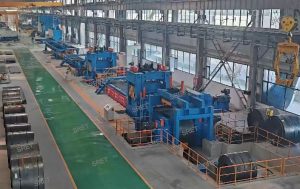
ERW tube mill line and machine form the backbone of efficient steel tube production worldwide. These systems convert steel strip coil into high-quality welded tubes through a continuous process of forming, high-frequency welding, sizing, and cutting. Buyers in construction, automotive, energy, and infrastructure sectors frequently ask about process reliability, dimensional accuracy, standards compliance, and long-term ROI when evaluating equipment.[1][2]
This guide addresses those core questions with practical insights drawn from established manufacturing practices. It covers what defines a capable ERW tube mill line, how to specify one for specific needs, and why manufacturer experience matters. Demonstrated expertise comes from decades of engineering refinements that balance speed, quality, and cost—principles that experienced suppliers like SRET Co., Ltd. apply across hundreds of installations.[3][4]
An ERW tube mill line is an integrated production system that processes steel strip into finished welded tubes using electric resistance welding technology. The core ERW tube mill machine handles the critical forming and welding stages, while the full line includes upstream coil handling and downstream finishing equipment.[2][1]
Key components typically include:
– Coil uncoiler and preparation station
– Strip leveling and end welder for continuous feed
– Forming stands (initial, fin pass)
– High-frequency welding head with squeeze rolls
– Weld bead scarfing tools
– Sizing and Turk’s head straighteners
– Flying shear or cold saw for length cutting
– Discharge table, stacker, and packaging[5][2]
This linear workflow enables high-volume output of round, square, or rectangular tubes with consistent wall thickness and weld integrity. Customers value lines that minimize downtime during coil changes and size adjustments, which requires proven mechanical design and automation.[1]
The heart of any ERW tube mill line is the high-frequency welding station within the ERW tube mill machine. Flat strip first passes through progressive forming rolls that create an open tube shape with edges precisely aligned. High-frequency induction or contact welding then generates localized heat at the edges—typically 1200-1400°C—without melting the base metal excessively.[6][7][5][1]
Squeeze rolls apply forge pressure (often 10-50 tons) to join the heated edges into a metallurgical bond, extruding any excess metal as a weld bead. Modern systems monitor current (200-800 kW), voltage, impedance, and strip position in real time to maintain a stable process window. This controlled heat input produces a narrow heat-affected zone (HAZ) with mechanical properties close to the parent metal, suitable for structural and mechanical applications.[2][3][6]
Buyers should confirm the manufacturer’s experience with different power supplies (solid-state vs. vacuum tube) and their impact on thicker walls or high-strength steels.
Customers commonly start specifications with output targets. Typical ERW tube mill line ranges include:
| Parameter | Small Line | Medium Line | Large Line |
| OD Range (mm) | 10-76 | 20-114 | 50-273 |
| Wall Thickness (mm) | 0.4-3.0 | 0.6-6.0 | 1.0-12.0 |
| Max Line Speed (m/min) | 30-60 | 60-120 | 120-200 |
| Steel Grades | Mild steel | HSLA up to 450 MPa | API grades[5][3] |
Line speed decreases with thicker walls or higher-strength materials due to increased forming loads and reduced weldability. Experienced manufacturers provide forming pass schedules and power calculations tailored to the buyer’s product mix, ensuring realistic performance claims.[3][2]
Standards compliance is a top buyer concern, particularly for export markets. ERW tube mill lines routinely produce to:
– **Structural Tubes**: ASTM A500, EN 10219 (hollow sections for construction)
– **Mechanical Tubing**: ASTM A513, EN 10305-5
– **Line Pipe**: API 5L up to X52 (with NDT)
– **Stainless**: ASTM A554, A312 (limited lines)[8][9]
Government agencies define acceptable welded pipe for infrastructure—such as mild steel pipework standards that reference ERW processes with specific chemical, mechanical, and testing requirements. High-quality ERW tube mill machines integrate ultrasonic testing (UT), hydrostatic testing, and flattening/flaring stations to meet these specs. Buyers must verify the line’s NDT sensitivity and data logging capabilities match their certification needs.[9][8]
SRET was founded in 1989 in Shenyang, Liaoning province, China, by five senior university professors who set out to become technological pioneers in China’s tube mill machine industry. Over more than three decades, the company has maintained a leading position through continuous innovation and systematic quality improvement in ERW tube mill engineering.[1][2]
Today, SRET designs, engineers, manufactures, and supplies a full range of ERW tube mill machinery, including complete ERW tube mill line configurations and core ERW tube mill machine units tailored to different diameters, wall thicknesses, and applications. A highly qualified engineering team works closely with an experienced production group to ensure that each customer receives equipment that matches specific technical, capacity, and standards requirements, helping produce high‑grade tubes with stable performance and high yield.[3][4][1]
Backed by decades of practical project experience, SRET focuses on robust mechanical design, precise forming and welding technology, and rigorous testing so that its pipe and tube mill systems can meet demanding engineering and design expectations in sectors such as construction, energy, and infrastructure.[5][1]
Quality on an ERW tube mill line is assured through a structured system that starts before production and continues until final inspection. It typically combines strict raw‑material control, tightly monitored welding parameters, and multiple layers of inspection and testing (both inline and offline) to keep weld integrity and dimensions within standard.
1. Raw material and incoming inspection
– Steel coils are checked for chemical composition, mechanical properties, certificate traceability, surface condition, and edge quality.
– Only coils that meet specified standards (e.g., ASTM/API/EN) and internal criteria are released to the ERW tube mill line, reducing the risk of defects originating from the base metal.
2. Process and welding control
– Critical welding variables—current, voltage, frequency, line speed, squeeze force, and V‑gap—are set within qualified ranges and monitored in real time.
– Alarms and interlocks stop the line or prompt adjustment if parameters drift, helping keep the heat‑affected zone and weld structure consistent along the full length of the tube.
3. Inline non‑destructive testing (NDT) and dimensional checks
– Ultrasonic or eddy‑current testers positioned after the weld station scan the seam continuously to detect lack of fusion, inclusions, laminations, or other internal flaws.
– Inline gauges (for OD, wall thickness, and straightness) track dimensional stability; out‑of‑tolerance readings trigger automatic marking or rejection and prompt process correction.
4. Offline mechanical and metallographic testing
– Samples from defined production lots undergo flattening, flaring, bend, tensile, and sometimes impact tests to verify that weld strength and ductility meet the applicable standard.
– Metallographic examination of cross‑sections checks the weld microstructure, HAZ width, and absence of porosity or inclusions, and validates the effectiveness of any post‑weld heat treatment.
5. Hydrostatic and visual inspection
– Many codes require hydrostatic or pressure testing of finished tubes: each length is pressurized to a specified level for a set time to confirm leak‑tightness.
– Final visual inspection checks the surface (dents, scratches, corrosion), weld bead condition, end preparation, straightness, and markings before bundling and shipment.
6. Documentation, traceability, and continuous improvement
– Each coil and production lot is traceable through recorded parameters, test results, and certificates, supporting audits and customer documentation.
– Non‑conformances (scrap events, test failures, field feedback) are analyzed and fed back into tooling, parameter windows, and procedures so the ERW tube mill line becomes more stable over time.
References:
[1](https://www.ztzgsteeltech.com/news/how-does-an-erw-pipe-mill-ensure-quality-control/)
[2](https://uniasen.com/about/quality-and-manufacturing-process/)
[3](https://www.galaxiecorp.com/2023/06/07/understanding-the-role-and-functioning-of-a-tube-mill/)
[4](https://btsteelpipe.com/knowledge/Steel%20Knowledge/ERW%20pipe%20quality%20assessment%20process.html)
[5](https://www.united-steel.com/m/newsshow/Quality-inspection-process-of-ERW-steel-pipe.html)
[6](https://www.longma-group.com/knowledge/how-to-inspect-erw-pipes-for-quality-before-installation)
[7](https://www.aistubemill.com/news/erw-tube-mill-process.html)
[8](https://www.permanentsteel.com/newsshow/quality-assessment-process-of-erw-steel-pipe.html)
[9](https://www.nipponsteel.com/en/tech/report/sm/pdf/1b005001.pdf)
[10](https://www.pipetubemill.com/what-are-the-temperature-control-of-erw-tube-mill-machine/)