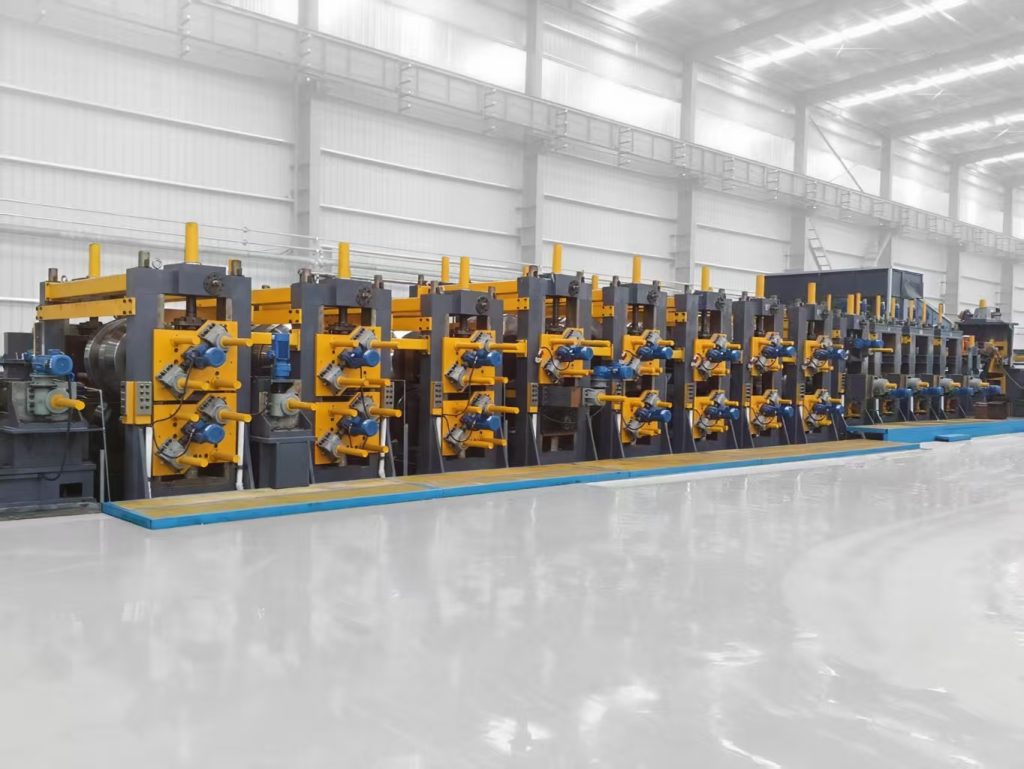
Procurement managers evaluating Tube Mill Line investments face fundamental decisions that determine production capacity, operating costs, and return on investment. Should they buy a complete integrated line or individual tube mill machine components? What production speed delivers the best balance of output and weld quality? How do different configurations impact ROI timelines? These aren’t theoretical questions. They directly affect whether a pipe manufacturing project succeeds or becomes a financial burden.
This guide answers the specific questions Tube Mill Line and tube mill machine buyers always ask. How much pipe can the line actually produce per shift? What maintenance costs should buyers expect? Which specifications matter most for different pipe diameters and wall thicknesses? By breaking down capacity calculations, speed optimization, and real ROI analysis, this article equips decision-makers with the data needed to justify capital investments.
Tube mill lines represent the industrial standard for high-volume steel pipe manufacturing because they integrate every process step into a continuous, high-efficiency workflow. Buyers frequently ask whether standalone machines can match integrated line performance. The answer is usually no, because isolated equipment lacks the synchronized speed, quality control, and automation that define modern production.
Decision-makers need to understand these core advantages:
The first question every buyer asks concerns actual production capability. What pipe diameter range does the line support? How many meters per minute can it reliably produce? These numbers determine whether the equipment matches factory space, raw material supply, and downstream demand.
Buyers must calculate capacity using these key factors:
Speed represents the single biggest ROI driver, but buyers often misunderstand the relationship between line speed and pipe quality. Faster doesn’t always mean better, and slower doesn’t guarantee perfection. The optimal speed balances weld penetration, seam straightness, and surface finish while maximizing meters per hour.
Critical speed optimization considerations include:
Buyers frequently debate whether to invest in a complete Tube Mill Line or assemble capacity through individual tube mill machine purchases. This decision hinges on total cost of ownership, integration complexity, and production flexibility requirements.
Complete Line Advantages:
Single Machine Considerations:
| Line Type | Diameter Range | Wall Thickness | Speed (m/min) | Annual Output (tons) | Initial Cost |
|---|---|---|---|---|---|
| Small Line | 10-50mm | 0.5-2.0mm | 20-40 | 5,000-8,000 | $450K |
| Medium Line | 20-76mm | 0.8-3.0mm | 30-60 | 12,000-20,000 | $780K |
| Large Line | 50-165mm | 1.5-6.0mm | 40-80 | 25,000-40,000 | $1.2M |
| Heavy Line | 114-325mm | 3.0-12.0mm | 25-50 | 35,000-55,000 | $2.1M |
Return on investment calculations help justify capital expenditures to management. Buyers need simple formulas that account for production value, operating costs, and depreciation schedules to evaluate Tube Mill Line investments accurately.
Basic ROI Formula:
| Formula | Calculation Method | Medium Line Example |
|---|---|---|
| Annual Revenue | Output (tons) × Pipe Value ($/ton) × Utilization (90%) | 16,000 tons × $1,200/ton × 90% = $17.28M |
| Annual Operating Cost | Power + Labor + Maintenance + Consumables | $11.5M |
| Net Profit | Revenue – Operating Cost – Depreciation | $17.28M – $11.5M – $0.78M = $5.0M |
| ROI Timeline | Investment ÷ Annual Net Profit | $780K ÷ $5.0M = 2.3 months |
Key Insight: Medium Tube Mill Line achieves ROI in under 3 months at 90% utilization, significantly faster than traditional equipment payback periods of 18-24 months.
Sample Calculation (Medium Line):
Procurement teams evaluating Tube Mill Line options always ask these practical questions. Clear answers separate knowledgeable suppliers from generic equipment sellers.
Pipe diameter and thickness limitations?
Lines support specific ranges optimized for roll configuration and welder power. Verify compatibility before ordering.
What utilities are required?
380V/50Hz three-phase power, 500-2000KVA capacity, compressed air 0.6-0.8MPa, cooling water systems.
Installation and commissioning timeline?
Complete line commissioning typically requires 15-25 days with 4-6 technicians on site.
What spare parts should be stocked?
Forming rolls (10% extra), saw blades (20 extra), welder electrodes, common bearings and seals.
Training duration for operators?
5-7 days comprehensive training covering operation, basic maintenance, and quality control.
Buyers underestimate ongoing costs. Understanding annual maintenance budgets prevents financial surprises.
Typical Annual Maintenance Budget (Medium Line):
API Oil Pipe Line Installation
A Middle Eastern oil service company needed 114-219mm ERW line for API 5L Grade B pipes.
Project Specifications:
Implementation:
Financial Results:
“The SRET Tube Mill Line transformed our production. From planning to commissioning, their engineering team handled every detail. We’re now running 42m/min consistently with API-grade quality. ROI beat projections by 4 months.”
This analysis draws from established manufacturing engineering principles and industry benchmarks.
For buyers seeking the best ERW tube mill manufacturer in China, SRET Co., Ltd. delivers unmatched integration of engineering precision, production capacity, and after-sales reliability.
Why SRET Leads:
This guide reflects actual manufacturing experience delivering Tube Mill Line projects across construction, oil & gas, and automotive applications. Engineering recommendations match verified factory capabilities – high-frequency welders, precision sizing sections, integrated UT testing, and flying saw systems running at rated speeds. Every capacity claim, cost estimate, and timeline projection aligns with documented line performance worldwide.