Home >> News & Events >> The Comprehensive Guide to ERW Tube Mills: Technology, Selection, and Operation
The Comprehensive Guide to ERW Tube Mills: Technology, Selection, and Operation
For industries reliant on high-quality, efficiently produced tubular products, the Electric Resistance Welding (ERW) process stands as a cornerstone technology. At the heart of this process lies the ERW tube mill, a complex and sophisticated production line designed to transform flat steel strip (skelp) into precise, welded tubes and pipes at high speeds. Understanding the intricacies of the ERW tube mill line, from the individual ERW tube mill machine components to the complete system’s operation, is crucial for manufacturers seeking efficiency, quality, and competitiveness. This guide delves deep into the world of ERW tube manufacturing, answering the most common questions posed by prospective buyers and operators. We will explore the fundamental principles, the key machinery involved, critical selection criteria, operational best practices, maintenance needs, and the tangible benefits of investing in modern ERW technology. Whether you are new to tube production or looking to upgrade your existing capabilities, this resource aims to provide valuable insights into making informed decisions about ERW tube mill equipment.
Understanding the ERW Tube Manufacturing Process
Electric Resistance Welding (ERW) is a pressure welding process where the heat required to fuse the metal is generated by the electrical resistance of the material itself when a high current is passed through it. In the context of tube making, the process involves forming flat steel strip into a cylindrical shape and then welding the longitudinal seam where the edges meet. The fundamental principle relies on Joule heating: when a high-density electric current (typically AC or DC) is passed through the point of contact between the two prepared strip edges, the electrical resistance generates sufficient heat to raise the metal to a plastic or molten state. Pressure is then applied to forge the heated edges together, creating a solid-state weld. This differs significantly from fusion welding processes like TIG or MIG, as little or no filler metal is used, and the heat is concentrated precisely at the weld interface.
The ERW process offers several distinct advantages that make it the preferred method for producing a vast range of tubular products:
High Production Speeds: ERW mills can operate at very high speeds, often exceeding 100 meters per minute for smaller diameters, leading to significant output volumes.
Cost-Effectiveness: The process is generally more economical than seamless or other welded methods for many applications, thanks to high speeds and efficient material usage.
Material Efficiency: Starting from flat strip allows for excellent control over dimensions and minimizes waste compared to some other processes.
Weld Quality: Modern high-frequency ERW produces welds with excellent integrity, often matching the strength of the base metal.
Versatility: ERW can handle a wide range of materials (carbon steel, stainless steel, some alloys) and produce tubes in a broad spectrum of diameters and wall thicknesses.
Good Dimensional Accuracy: Precise control over forming and sizing results in tubes with tight tolerances on diameter, ovality, and straightness.
ERW tubes find applications across numerous industries, including:
Oil and Gas (casing, tubing, line pipe – subject to specific grades and standards)
Water Distribution
Agricultural Equipment
General Engineering
Deconstructing the ERW Tube Mill Line
An ERW tube mill line is not a single machine but a coordinated sequence of individual ERW tube mill machine units, each performing a specific task in the transformation of steel strip into finished tube. The line must operate with precise synchronization to maintain quality and efficiency. Understanding each component’s role is key to appreciating the complexity and capability of the entire system.
The journey begins with preparing the raw material. Steel strip, typically supplied in large coils, is loaded onto the line.
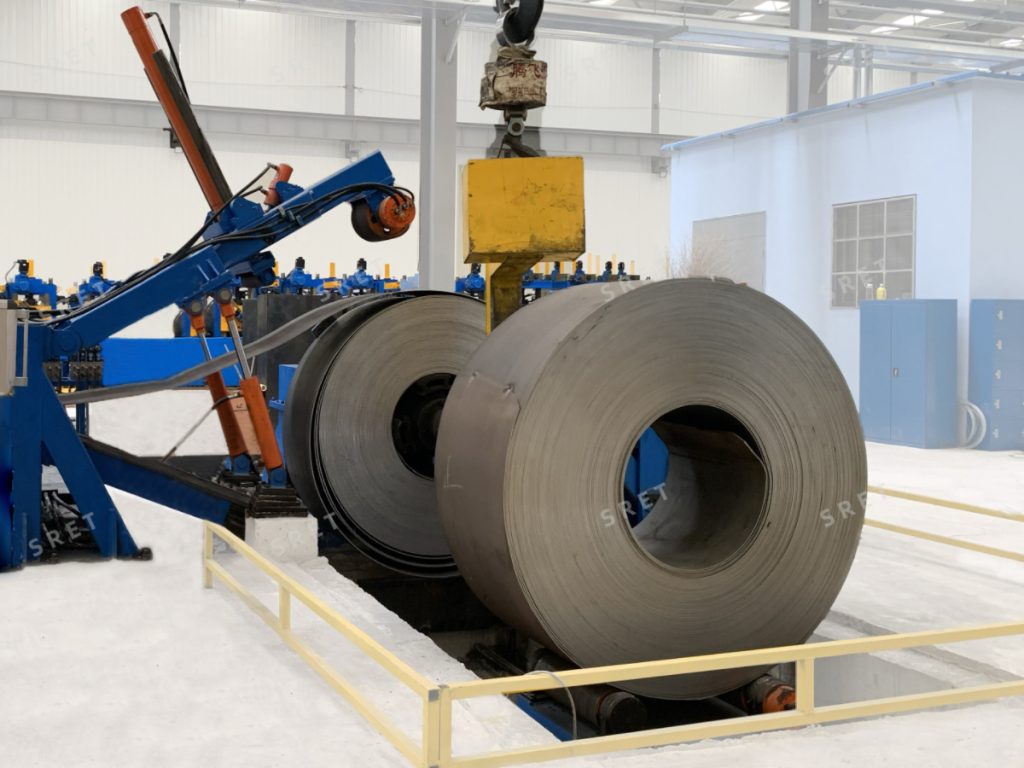
Uncoiler/Payoff: This machine holds and unwinds the coil of steel strip. It must provide controlled tension to ensure smooth, consistent feeding into the subsequent stages. Types include mandrel-type and expanding mandrel uncoilers.
Strip Accumulator (Optional but Recommended): A critical component for non-stop operation. It stores a loop of strip, allowing the mill to continue running while a new coil is welded to the end of the expiring coil. This eliminates downtime for coil changes. Common types include the horizontal (pit) accumulator and the vertical (tower) accumulator.
Strip Joiner/Welder: When a coil runs out, this machine squares and welds the end of the new coil to the beginning of the next coil, creating a continuous strip for processing. Precision welding (often using MIG or TIG) is essential to avoid problems downstream.
Once the strip is prepared and fed continuously, it undergoes several preparatory steps before forming.
Leveler: Corrects any coil set, crossbow, or edge wave in the strip. This ensures the strip is perfectly flat before entering the forming section, which is critical for consistent forming and welding. Levelers consist of multiple rolls that bend the strip back and forth to remove internal stresses.
Edge Trimmer (Optional): For high-precision tubes or specific material conditions, the strip edges may be trimmed to ensure clean, straight, parallel edges. This promotes better welding quality by providing optimal edge conditions for the weld squeeze.
This is where the flat strip begins its transformation into a tube. A series of precisely contoured rolls gradually bend the strip.
Breakdown Rolls: The initial forming stands that start the bending process, typically creating a “U” shape. The number of stands depends on the tube diameter and wall thickness.
Fin Pass Rolls: These stands progressively close the “U” into an open “O” or “C” shape, bringing the edges closer together and setting the final geometry just before the weld point.
Forming Strategy: Forming can be done using various roll pass designs (e.g., cantilevered, double-supported, triple-supported rolls) depending on the required precision and tube size. The goal is to shape the strip with minimal stress and strain, ensuring the edges meet cleanly and squarely at the weld point.
This is the core of the ERW tube mill machine where the weld is made.
Weld Box/Head: This unit houses the contacts and, in high-frequency applications, the induction coil or impeder. It applies the high-frequency current and the forging pressure.
Welding Power Supply: Generates the high-frequency current (typically in the range of 100-400 kHz for HFI, or 1-10 kHz for HF Contact). The choice between AC and DC power supplies depends on the application.
Contacts: For HF Contact welding, these are copper blocks or rolls that carry the current directly to the strip edges just before they meet.
Induction Coil: For HF Induction welding, this coil surrounds the tube and induces the current into the strip edges via electromagnetic fields.
Impeder (HFI): A magnetic core placed inside the tube just before the weld point to concentrate the induced current flow along the edges, increasing efficiency.
Squeeze Rolls: Apply significant pressure to forge the heated edges together, creating the weld. The pressure must be precisely controlled.
Immediately after welding, the tube is hot and the weld is vulnerable. These stages ensure the weld quality and begin the sizing process.
Weld Bead Removal: The initial, often protruding, weld bead (flash) is scraped off or rolled down while the metal is still hot and malleable. This is crucial for internal surface quality and to prevent issues in downstream sizing.
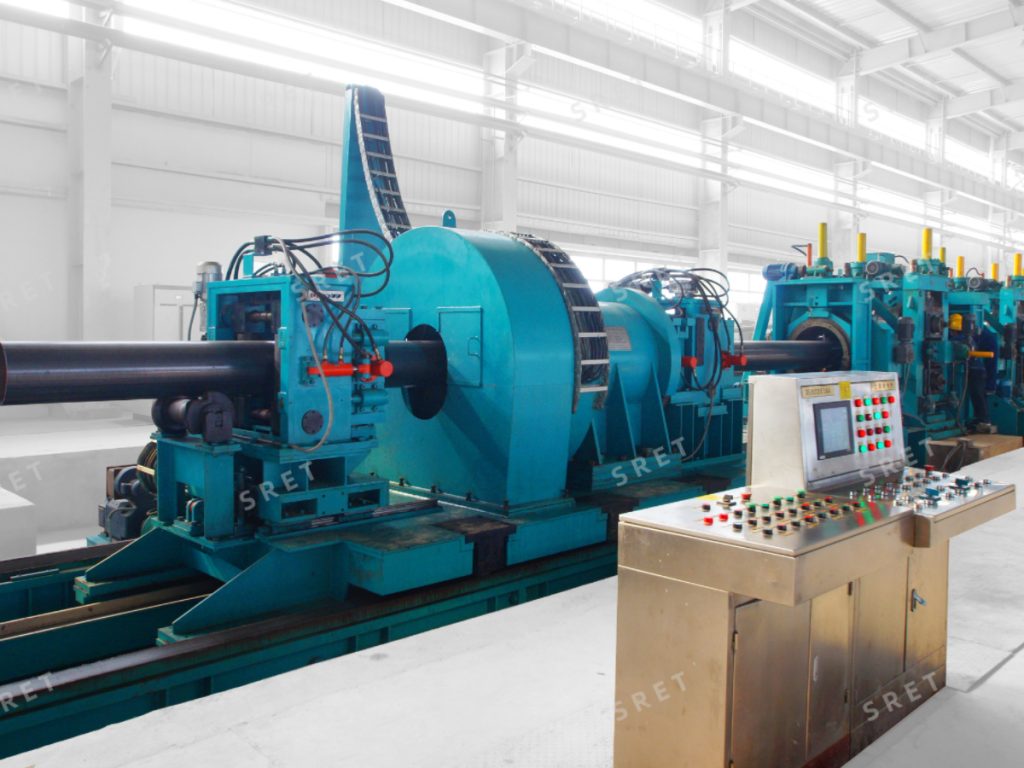
Sizing Mills: A series of roll stands that progressively cold-work the welded tube to achieve the final precise outside diameter (OD), roundness, and straightness. Sizing is critical for meeting tight dimensional tolerances. Pass designs can be 2-roll, 3-roll (common), or 4-roll configurations.
Once sized, the continuous tube must be cut to length.
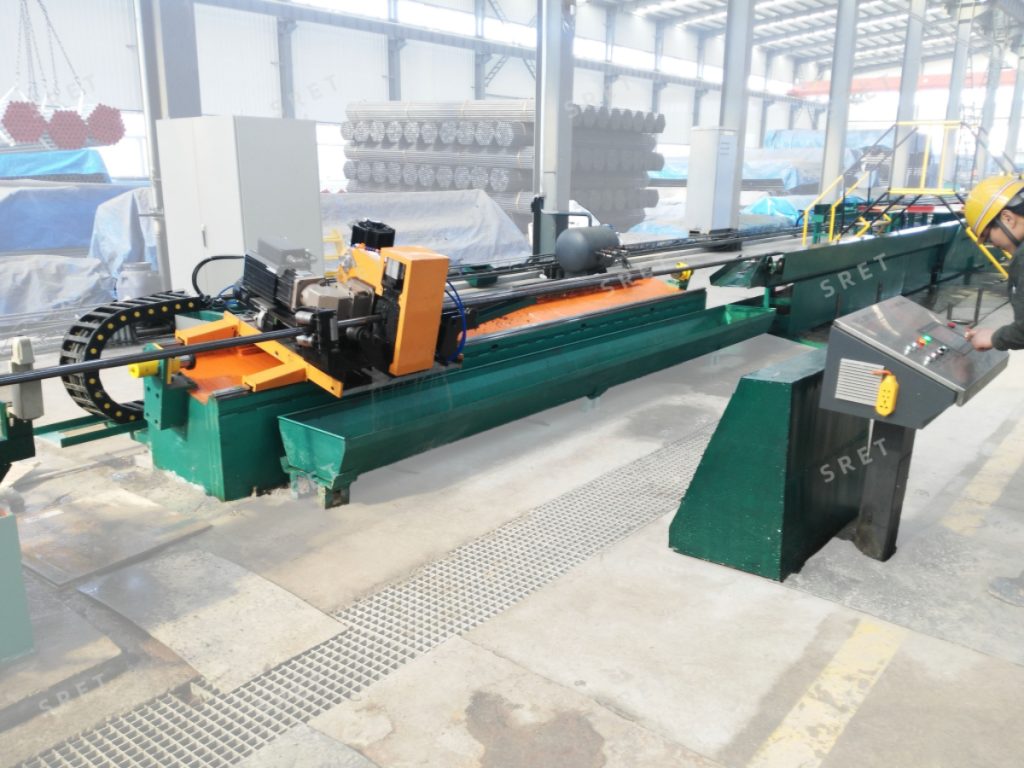
Cutoff Machine: This unit cuts the moving tube into specified lengths without stopping the mill. Modern systems are typically flying cutoffs.
Types:
Saw Cutoff: Uses high-speed circular saws. Suitable for a wide range of diameters and wall thicknesses, produces a clean, burr-free cut, but generates swarf (chips).
Shear Cutoff: Uses blades to shear the tube. Very fast and clean operation, no swarf, but generally limited to thinner walls and smaller diameters. Can sometimes cause slight deformation at the cut end.
Control: Synchronization with the tube speed is vital for achieving square cuts.
The final stages prepare the cut tubes for handling and shipment.
Run-Out Table: A conveyor system that transports the cut tubes away from the cutoff machine.
Bundler/Stacker: Automatically collects and bundles the tubes for strapping and handling.
End Facer/Chamfering (Optional): Machines that bevel or chamfer the tube ends, often required for applications involving threading or welding in the field.
Inspection Station: Area for final quality checks, potentially including visual inspection, dimensional checks, and non-destructive testing (NDT) of the weld seam.
ERW Tube Mill Machine
Operating Principles of an ERW Tube Mill Machine
The successful operation of an ERW tube mill line hinges on the precise interaction and control of numerous variables across its constituent ERW tube mill machine units. Synchronization is paramount. The speed of every section – from the uncoiler feeding the strip to the cutoff cutting the tube – must be perfectly matched. Even minor discrepancies can cause tension variations, leading to strip buckling, poor forming, weld defects, or inaccurate cutting. Modern mills rely heavily on sophisticated Programmable Logic Controller (PLC) systems with distributed control. These systems monitor speed, tension, position, and critical process parameters (like welding power and pressure) in real-time, making micro-adjustments to maintain harmony throughout the line. Operators interface with the process through Human-Machine Interfaces (HMIs), which provide visualization, control, and alarm functions.
Achieving a high-integrity weld seam requires meticulous control over several parameters at the welding station:
Welding Frequency: Higher frequencies (like 400 kHz HFI) concentrate the heat more precisely at the surface and edges, offering advantages for thinner materials and high-quality finishes. Lower frequencies (like 10 kHz HF Contact) penetrate deeper, potentially better for thicker walls.
Welding Power (Voltage/Current): Determines the amount of heat generated. Must be sufficient to bring the edges to the correct welding temperature but not so high as to cause overheating, burning, or excessive flash.
Welding Speed: The speed at which the tube moves through the weld point. This directly influences the heat input per unit length. Speed must be balanced with power to achieve consistent weld quality.
Vee-Length: The distance from where the strip edges first make contact (the kiss point) to the center of the weld point. This determines the length of material heated and affects weld penetration and bead formation. Optimizing vee-length is critical.
Squeeze Pressure: The force applied by the squeeze rolls to forge the heated edges together. Insufficient pressure leads to a weak weld; excessive pressure can cause deformation or other defects.
Heat Balance: Ensuring the heat is evenly distributed across both strip edges is vital for a symmetrical, strong weld. Factors like edge condition, alignment, and power application influence this.
The forming process shapes the strip, but the sizing mills determine the final tube geometry. Key considerations include:
Pass Design: The sequence and contour of the sizing rolls must be engineered to reduce the tube diameter in controlled steps while minimizing stress and ensuring roundness. Different roll configurations (2-roll, 3-roll, 4-roll) offer varying levels of control and are suited to different size ranges.
Reduction Per Stand: The amount of diameter reduction applied at each sizing stand must be carefully calculated to avoid over-straining the tube or causing wall thickening/thinning.
Roll Alignment: Precise alignment of all sizing rolls is essential to prevent tube bending, ovality, or surface marking.
Cooling: Often, controlled cooling (e.g., water spray or air mist) is applied after sizing to set the final dimensions and properties.
ERW Tube Mill
Selecting the Right ERW Tube Mill Machine and Line
Choosing an ERW tube mill line is a significant capital investment. Selecting the correct configuration requires careful analysis of your specific production needs. The primary factors dictating the required ERW tube mill machine specifications are:
Tube Diameter Range (OD): What is the minimum and maximum outside diameter you need to produce? Mills are typically designed for specific diameter ranges (e.g., 10-50mm, 50-165mm, 100-300mm, large diameter >300mm). Pushing a mill beyond its designed range compromises quality and longevity.
Wall Thickness: The gauge of the steel strip directly impacts the required forming power, welding energy, and sizing force. Thicker walls demand more robust machinery and higher power.
Material Grade: The type of steel (e.g., mild steel, high-strength low-alloy (HSLA), stainless steel) affects formability, welding parameters, and potential wear on tooling. Mills must be specified to handle the intended grades.
Production Speed (MPM): What output speed (meters per minute) is required to meet your volume targets? Higher speeds require more sophisticated controls, precision components, and often larger accumulators.
Annual Production Volume: This influences the required level of automation, robustness, and potentially the need for features like non-stop operation (accumulators).
End Product Specifications: Required tolerances (OD, wall thickness, ovality, straightness), surface finish, and any mandatory testing (e.g., hydrostatic testing, NDT) will dictate the precision and capabilities needed in the sizing section and auxiliary equipment.
Modern ERW tube mill lines incorporate various technologies that enhance performance, quality, and ease of operation:
PLC Control Systems: The brain of the mill, allowing for automated control, recipe management, data logging, and diagnostics. Look for systems with open architecture and good support.
AC Vector Drive Systems: Provide precise speed and torque control for individual sections, essential for synchronization and handling tension variations. Offer better control than traditional DC drives.
Digital HMI: Modern touch-screen interfaces provide intuitive control, visualization of the process, alarm history, and production data.
Laser Weld Tracking Systems (for HFI): Automatically adjust the position of the induction coil to maintain optimal coupling as the tube passes through, improving weld consistency.
Automatic Strip Edge Guidance Systems: Use sensors to monitor and correct strip lateral position entering the forming section, ensuring symmetry.
Online Weld Quality Monitoring Systems: Advanced systems (like ultrasonic testing – UT) can be integrated to inspect the weld seam continuously, providing real-time quality feedback and defect detection.
Quick Roll Change Systems: Mechanisms that allow for faster changing of forming and sizing rolls when switching production, reducing downtime.
Beyond the core machinery, several auxiliary systems are vital for a complete and efficient production line:
Tube End Facing/Chamfering Machine: Prepares tube ends for further processing.
Hydrostatic Tester: Pressurizes tubes with water to check weld integrity and leak tightness (common for pressure applications like oil & gas tubing).
Non-Destructive Testing (NDT) Equipment: Ultrasonic Testing (UT) or Eddy Current Testing (ECT) for weld seam inspection. Can be offline or integrated online.
Tube Straightener (for larger diameters): Corrects any residual curvature after sizing.
Automated Bundling/Stacking/Palletizing: Handles finished tubes for shipment.
Dust Collection System: Controls airborne particles, especially from the cutoff saw.
Investing in an ERW tube mill line is a major decision. A thorough financial analysis is essential:
Initial Capital Cost: Includes the cost of the mill itself, auxiliary equipment, installation, commissioning, and training.
Operational Costs: Encompass energy consumption (a significant factor, especially welding power), tooling (rolls, cutoff blades, welding contacts/coils), maintenance labor and parts, raw material (strip), and labor for operation.
Return on Investment (ROI) Calculation: Compare the total investment and operating costs against the projected revenue from tube sales. Key factors influencing ROI include:
Production Volume and Speed
Material Utilization Efficiency (minimizing scrap)
Reject Rate (Quality Control efficiency)
Energy Efficiency of the mill
Downtime (Reliability and Maintainability)
Labor Efficiency (Level of Automation)
Market Price for the produced tubes
Payback Period: Estimate the time it will take for the mill to generate enough profit to cover its initial investment cost.
Comparison of Key ERW Tube Mill Line Configurations
Feature
Entry-Level / Small Diameter Mill
Mid-Range Mill
Heavy-Duty / Large Diameter Mill
Specialized Mill (e.g., Stainless)
Typical Diameter Range
5 mm – 50 mm
20 mm – 165 mm
100 mm – 500 mm+
Varies (Often smaller-mid range)
Wall Thickness Range
0.5 mm – 2.0 mm
1.0 mm – 6.0 mm
2.0 mm – 12.7 mm+
0.4 mm – 4.0 mm (SS)
Production Speed
High (100+ MPM)
Medium-High (40-80 MPM)
Medium (10-40 MPM)
Medium (20-60 MPM)
Welding Method
HF Contact or HFI
Primarily HFI
HFI
HFI (Precision)
Forming/Sizing Rolls
Cantilevered / Light-duty
Double/Triple Supported
Heavy-duty, Triple/Quad Supported
Precision, Often Stainless Rolls
Level of Automation
Basic-Medium
Medium-High
High
High (Precision Control)
Control System
Standard PLC/HMI
Advanced PLC/HMI
Advanced PLC/HMI, SCADA
Advanced PLC/HMI, Integrated NDT
Typical Accumulator
Small Horizontal or Vertical
Medium-Large Vertical
Large Vertical
Medium Vertical
Cutoff Method
Saw or Shear
Saw
Heavy-duty Saw
Precision Saw
Common Applications
Furniture, Automotive Exhausts
Structural, Fencing, Plumbing
Oil & Gas Tubing, Piling, Conduit
Decorative, Sanitary, Instrumentation
Key Strengths
High Speed, Low Cost
Versatility, Balance
Robustness, Heavy Walls
Precision, Surface Finish, Quality
Key Limitations
Limited Diameter/Wall
Less suited for extremes
Higher Cost, Lower Speed
Higher Cost, Material Sensitivity
Installation, Commissioning, and Operation
Proper installation is foundational to the long-term performance and reliability of your ERW tube mill line.
Site Preparation: Requires a level, robust concrete floor capable of supporting the mill’s weight and dynamic loads. Adequate space for the mill length, material handling (coils, finished tubes), and maintenance access is crucial. Power supply must meet specifications (voltage, amperage, stability). Sufficient crane capacity is needed for installing heavy components.
Foundation: Critical for heavy mills, especially large diameter or high-speed lines. Foundations must be designed to absorb vibrations and prevent settling that could misalign machinery.
Assembly: Components are typically shipped in sections. Assembly must follow the manufacturer’s procedures precisely, ensuring all frames, rolls, and drives are correctly aligned. Laser alignment tools are often essential.
Electrical & Control Installation: Wiring the drives, sensors, and control system according to schematics. Proper grounding is paramount, especially for the welding section.
Commissioning is the process of starting up the mill, verifying its operation, and dialing it in to produce quality tubes.
Mechanical Checks: Verify all moving parts operate smoothly, lubrication systems are functional, roll alignments are correct, and safety guards are in place.
Electrical Checks: Confirm all motors run correctly, sensors are operational, and control systems power up.
Control System Setup: Load basic parameters, configure HMI screens, establish communication between PLC and drives/sensors.
Dry Run: Run the mill without material to check synchronization, speeds, and basic functions.
First Tube Run: Load strip and attempt to produce the first tubes. This will inevitably involve significant adjustment.
Parameter Tuning: The most critical phase. Operators and technicians work together to adjust:
Quality Verification: Measure the first tubes for dimensions, straightness, and weld quality (visual inspection, potentially basic NDT). Iteratively adjust parameters until specifications are met.
Training: Comprehensive training for operators, maintenance staff, and supervisors is conducted during commissioning. This covers operation, basic troubleshooting, safety procedures, and maintenance routines.
Running an ERW tube mill machine efficiently requires skilled operators adhering to best practices.
Startup Procedures: Following a defined sequence to power up systems, check lubricants, verify settings, and gradually ramp up speed.
Shutdown Procedures: Proper sequence to stop production safely, shut down systems, and potentially perform minor cleaning or prep for the next run.
Speed Management: Understanding the optimal operating speed for a given product, balancing throughput with quality and tooling life. Knowing when to reduce speed (e.g., when starting a new coil, welding thick walls).
Parameter Monitoring: Continuously watching key parameters on the HMI (speeds, tensions, welding power/pressure, temperatures) for signs of deviation.
Material Handling: Safe and efficient practices for loading/unloading coils, handling finished tubes, and managing scrap.
Quality Checks: Performing regular in-process checks (dimensions, weld appearance, cut length) as defined by the quality plan.
Troubleshooting: Identifying common problems (e.g., strip buckle, weld splits, sizing marks, ovality, poor cut) and knowing the basic corrective actions to take.
Safety: Strict adherence to lockout/tagout (LOTO) procedures, wearing appropriate PPE, and following all machine safety protocols. Mills have numerous pinch points and moving parts.
Maintenance and Ensuring Longevity
A proactive maintenance strategy is essential to maximize uptime, ensure consistent quality, and extend the lifespan of the ERW tube mill line.
Preventive Maintenance (PM): Scheduled tasks performed at regular intervals (daily, weekly, monthly, quarterly, annually) regardless of whether a problem is evident. This is the cornerstone of reliability.
Predictive Maintenance (PdM): Using techniques like vibration analysis, thermography, or oil analysis to monitor equipment condition and predict potential failures before they occur, allowing for planned intervention.
Reactive Maintenance: Fixing equipment after it breaks down. This should be minimized as it leads to unplanned downtime and can be more costly.
Key maintenance tasks for an ERW tube mill machine include:
Lubrication: Ensuring all bearings, gears, chains, and moving surfaces receive the correct lubricant at the prescribed intervals. Automatic lubrication systems require monitoring.
Roll Inspection and Maintenance: Regularly checking forming and sizing rolls for wear, surface damage, or bearing issues. Cleaning roll grooves of accumulated dirt or scale. Re-grinding rolls when profiles degrade.
Welding System Maintenance: Cleaning and inspecting contacts (for HF Contact) or coils (for HFI). Checking impeder condition. Verifying cooling systems (if present) for the weld head. Inspecting squeeze roll bearings and alignment.
Cutoff System Maintenance: Sharpening or replacing saw blades/shear blades. Checking blade alignment and drive systems. Maintaining coolant systems (for saws).
Drive System Checks: Inspecting motor brushes (DC motors), checking belt/chain tension, monitoring vibration levels on motors and gearboxes.
Electrical System Checks: Tightening electrical connections (vibration can loosen them), inspecting cables for damage, checking grounding integrity.
Sensor Calibration: Periodically verifying the accuracy of critical sensors (speed, position, temperature).
Worn or damaged components directly impact tube quality and mill reliability. Key tooling includes:
Forming Rolls: Wear alters the forming profile, leading to shape issues and poor edge preparation for welding.
Sizing Rolls: Wear causes dimensional inaccuracy, ovality, and surface marking.
Welding Contacts/Coils: Degraded contacts cause poor current transfer and inconsistent welding. Damaged coils reduce induction efficiency.
Cutoff Blades/Saws: Dull blades cause poor cuts, burrs, excessive wear on the cutoff drive, and potential safety hazards.
Guides and Tooling: Worn guides cause strip misalignment, affecting forming symmetry and weld quality.
Maintaining a well-organized inventory of critical spare parts is vital for minimizing downtime. Key spares include:
Critical Bearings: For motors, gearboxes, roll shafts.
Fasteners: Specific bolts/nuts prone to wear or vibration loosening.
ERW tube mill line
Case Study: Enhancing Productivity with a Modern ERW Tube Mill Line
Client: A leading manufacturer of structural steel tubing for the construction industry in Southeast Asia. Challenge: The client operated aging ERW mill equipment producing tubes in the 50mm to 150mm diameter range. They faced significant challenges:
High Downtime: Frequent breakdowns, especially during coil changes (no accumulator) and due to unreliable drives/controls. Downtime exceeded 15%.
Quality Issues: Inconsistent weld quality leading to higher rejection rates (approx. 3.5%), dimensional variations affecting customer fit, and surface marks from sizing issues.
Limited Flexibility: Difficulty switching between different tube sizes and wall thicknesses, resulting in long changeover times (up to 8 hours).
Low Production Speed: Max speeds capped at around 25 MPM due to limitations of the old control system and mechanics.
High Operating Costs: Excessive energy consumption, high scrap rates due to quality issues, and significant maintenance labor costs.
Solution: The client invested in a new, modern ERW tube mill line specifically designed for their diameter range and production volume requirements. Key features included:
Heavy-Duty Mill Structure: Robust frames and triple-supported rolls for stability and precision.
Large Vertical Strip Accumulator: Enabling true non-stop operation during coil changes, eliminating this downtime source.
High-Frequency Induction (HFI) Welding: With automatic weld tracking and precise power control.
Advanced PLC Control System: With AC vector drives on all critical sections for superior synchronization and tension control. Recipe management for quick changeovers.
Precision 3-Roll Sizing Section: Designed for minimal pass strain and high dimensional accuracy.
High-Speed Flying Saw: Equipped with automatic blade positioning.
Integrated Online UT Weld Inspection: For real-time quality monitoring.
Implementation & Results: The mill was installed and commissioned over a 3-month period, including comprehensive operator and maintenance training.
Downtime Reduction: Downtime plummeted to below 4%, primarily due to the accumulator eliminating coil change stops and increased reliability.
Quality Improvement: Reject rates fell to under 0.7% due to consistent welding (HFI + controls) and online UT inspection catching any potential defects early. Dimensional consistency improved significantly.
Increased Speed & Output: Production speeds increased to a sustainable 45 MPM, boosting daily output by over 70%.
Reduced Changeover Time: Recipe-based changeovers reduced size change times to under 2 hours.
Lower Operating Costs: Energy consumption per ton of tube decreased by approximately 18% due to more efficient drives and welding. Scrap rates reduced significantly. Maintenance costs stabilized at a predictable level.
ROI: The client achieved a full return on investment within 22 months of operation due to the combined gains in output, quality, and reduced costs.
Client Testimonial: “The decision to invest in a new ERW tube mill line was driven by necessity, but the results have been transformative. The near-elimination of downtime from coil changes alone justified the accumulator investment. The consistency and quality of the tubes we now produce are unmatched in our facility’s history. Our customers have noticed the difference, and our reputation has strengthened. The advanced controls have made operation smoother and changeovers remarkably faster. While the initial investment was substantial, the gains in productivity, quality, and efficiency have delivered a clear and rapid return.” – Production Manager, Structural Tubing Manufacturer.
Future Trends in ERW Tube Mill Technology
The evolution of ERW tube mill machine technology continues, driven by demands for higher efficiency, better quality, and greater flexibility. Several key trends are shaping the future:
Increased Automation & Robotics: Expanding beyond core processes to include automated material handling (coil loading/unloading, tube transfer, bundling/palletizing), automated quality inspection data analysis, and potentially automated roll change systems. This reduces labor dependency and improves consistency.
Integration of Industry 4.0 / IIoT: Connecting mill sensors and controls to plant networks and cloud platforms. This enables:
Real-Time Performance Monitoring: Dashboards showing OEE (Overall Equipment Effectiveness), production rates, energy consumption.
Predictive Maintenance Analytics: Using machine data to predict bearing failures, motor issues, or tooling wear before they cause downtime.
Remote Monitoring & Support: Allowing manufacturers to monitor mills remotely and provide faster technical support.
Data-Driven Optimization: Analyzing production data to identify bottlenecks and optimize parameters for different products.
Advanced Process Control: Moving beyond basic parameter setting to closed-loop control systems that use real-time sensor feedback (e.g., temperature at weld point, dimensional measurements) to automatically adjust welding power, speed, or sizing pressures to maintain quality within tighter tolerances.
Enhanced Quality Assurance: Wider adoption of integrated, automated NDT systems (like phased array UT or Eddy Current arrays) providing 100% inspection coverage and detailed defect characterization. Integration of surface inspection systems using cameras or lasers.
Sustainability Focus: Development of more energy-efficient drive systems and welding power supplies. Exploration of technologies to reduce lubricant consumption or utilize biodegradable lubricants. Improved dust and noise control systems.
Modular Mill Designs: Offering greater flexibility to configure or expand mills (e.g., adding auxiliary sections like end finishers or testers) more easily as production needs evolve.
Choosing the Right Partner: SRET Co., Ltd.
Selecting a manufacturer for your ERW tube mill line is a decision that impacts your operations for decades. It requires a partner with proven expertise, a commitment to quality, and the ability to deliver solutions tailored to your specific needs. In the landscape of ERW tube mill machine manufacturers, SRET Co., Ltd. stands out as a premier choice, particularly renowned for its capabilities originating from China.
Founded in Shenyang, Liaoning province, China, in 1989 by five senior university professors, SRET began with a pioneering vision: to be at the forefront of China’s tube mill manufacturing industry. For over three decades, this commitment to innovation and quality has remained unwavering, solidifying SRET’s position as an industrial leader. Their 30 years of continuous development translate into deep-seated experience and expertise, a factor that genuinely distinguishes SRET in the competitive market for ERW tube mill technology.
SRET’s core strength lies in its comprehensive offering. The company designs, engineers, manufactures, and supplies a complete range of ERW tube mill machinery. This encompasses everything required for a turnkey ERW tube mill line: from the initial entry line equipment (uncoilers, accumulators) and the critical forming & sizing mills, through the high-frequency welding machines, flying cutoff units, and finally, the end finishing machines. This breadth ensures that SRET can satisfy a wide variety of application needs across different industries and tube specifications.
What truly underpins SRET’s ability to deliver excellence is its human capital. The company boasts a highly qualified engineering team dedicated to innovation and precise design. Complementing this is an experienced production team skilled in transforming designs into robust, reliable machinery. This combination assures customers that the equipment they receive is not just standard machinery, but precisely tailored to meet their desired specifications and performance goals. SRET understands that every pipe and tube producer has unique requirements, and they leverage their extensive experience to create optimal solutions.
Beyond standard lines, SRET has developed significant expertise in specialized equipment, particularly covering a huge diameter range. Their leadership in large-diameter tube manufacturing technology is built upon a foundation of continuous innovation and an uncompromising pursuit of excellence in both design and manufacturing. By working closely with pipe and tube producers, SRET focuses on transforming leading-edge concepts into highly efficient, state-of-the-art pipe and tube making plants. Simply put, SRET understands the tube production business. This understanding is not just a claim; it is backed by three decades of focused experience specifically within the ERW tube and pipe making industry.
SRET leverages this deep knowledge of customer operations, combined with utmost flexibility in their approach. This enables them to craft the most economical solutions for their clients. Their goal is to help customers drive sustainable cost reduction and build competitive advantage, all while guaranteeing access to the latest proven technology and the highest product quality standards. They recognize that every ERW tube mill line is unique. Drawing on experience gained from thousands of successful installations worldwide, and offering what is arguably one of the market’s most comprehensive portfolios of tube mill technology, SRET possesses the capability to select and configure the optimal overall pipe and tube milling solution for any specific requirement.
For manufacturers seeking a reliable, innovative, and experienced partner for their ERW tube mill investment, SRET Co., Ltd. represents a compelling choice. Their three-decade legacy, commitment to quality through skilled teams, comprehensive product range, and focus on delivering tailored, economical solutions position them as a top-tier ERW tube mill machine manufacturer.