A slitting line converts wide master coils into narrower coils for subsequent production. For tube producers, however, the planning task is not complete when the required strip widths have been listed. The finished slit coils must also match the receiving equipment, handling arrangements and production requirements of the tube mill.
When discussing a project with a tube mill manufacturer in China, it is useful to define both sides of the process: the master coils entering the slitting line and the slit coils required by downstream production.
This guide focuses on that connection. For SRET’s equipment overview, process flow and published model specifications, visit the slitting line product page.
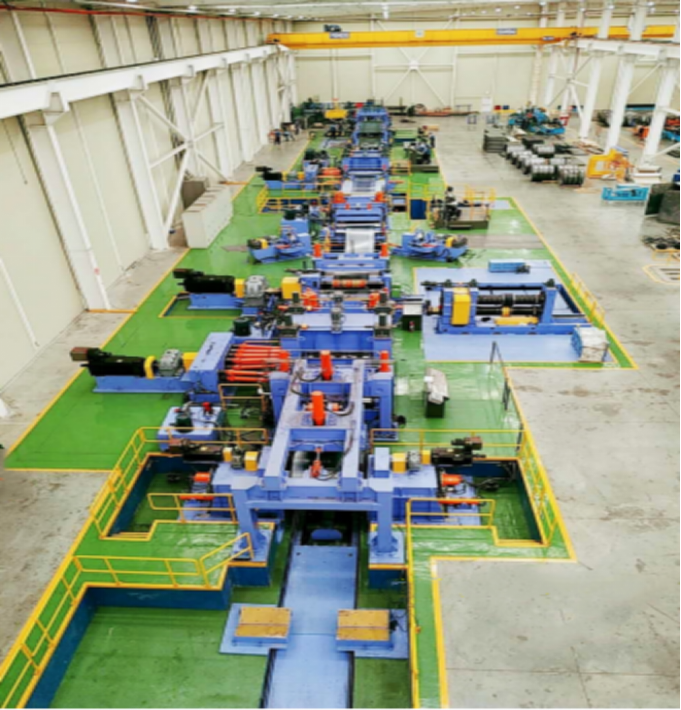
Incoming material specifications establish what the slitting equipment must process. Finished-coil requirements establish what it must deliver.
These are related, but they should be documented separately.
The master-coil specification should identify the material grade, thickness, width, weight, inside diameter and outside diameter. Relevant surface conditions and coating requirements should also be stated.
The finished-coil specification should identify:
For an ERW tube mill line, these output requirements should be reviewed against the actual entry-section equipment rather than assumed from the nominal tube size.
A slitting proposal can then be evaluated as a material-supply solution, not simply as a machine capable of cutting a particular thickness.
A list of finished tube sizes is useful background, but it is not a complete slitting instruction.
The required strip width should be confirmed against the applicable tube specification and forming arrangement. It should not be derived from a simplified circumference calculation and treated as a final production value.
Where several tube sizes are planned, prepare a strip-width schedule that links each confirmed width to its intended application.
| Planning Item | Information to Confirm |
| Finished product | Tube profile, dimensions and wall thickness |
| Material | Applicable grade and relevant material condition |
| Required strip | Confirmed nominal width and thickness |
| Width acceptance | Permitted variation and inspection method |
| Production demand | Expected demand for each strip width |
| Revision control | Who approves changes to the width schedule |
If the tube mill machine or forming tooling is still under engineering review, mark provisional strip widths clearly. This avoids presenting an early estimate as an approved cutting requirement.
A slitting pattern defines how the usable master-coil width is divided into the required narrower strips.
The review should consider more than whether the widths fit across the coil. It should also establish whether the resulting quantities match the production program.
For each proposed pattern, record:
A pattern that produces several different strip widths should be checked against demand for each width. Otherwise, the project may generate usable material that is not needed for the next production orders.
Where material yield is compared between patterns, use the same assumptions for usable coil width and edge trimming. Do not promise a fixed utilization improvement without a defined cutting plan.
Correct nominal width does not, by itself, describe the complete condition of a slit strip.
Width variation and edge condition should be treated as separate acceptance items. Relevant requirements may include permitted burr, edge damage and the condition needed for subsequent processing.
The specification should explain:
Avoid relying only on phrases such as “precision slitting” or “clean cutting.” They do not establish a measurable acceptance basis.
Where a technical table gives burr as a percentage, confirm the reference basis and inspection method before incorporating the figure into a purchase specification. Likewise, model-specific width tolerances should not be presented as universal performance under every material and operating condition.
A finished slit coil must be compatible with the equipment that will receive it.
Before finalizing the slitting-line output requirements, check the receiving uncoiler’s agreed limits for coil width, weight, inside diameter and outside diameter.
This check is especially important when one slitting line supplies more than one tube mill line. Different receiving machines may have different loading and coil-support requirements.
Review the following interfaces:
| Interface | Question to Resolve |
| Coil inside diameter | Does it match the receiving expansion or support arrangement? |
| Coil outside diameter | Is it within the receiving equipment’s permitted range? |
| Coil weight | Is it compatible with both handling equipment and the uncoiler? |
| Strip width | Can the receiving equipment support and guide it as required? |
| Wound-coil condition | What winding and side-face acceptance conditions apply? |
| Loading method | How will the coil be transferred and presented for loading? |
The slitting line’s master-coil capacity should not be confused with the permitted size of a finished coil entering the tube mill.
The output specification should describe how the slit coils are to be presented for subsequent handling.
Identify the required winding condition, the applicable telescoping limit and the inspection method. These should be confirmed for the intended product range and equipment configuration.
Also establish the responsibilities after recoiling:
If off-line strapping or another handling arrangement is proposed, show it in the agreed supply scope. Do not assume that every item mentioned in a product overview is included in every quotation.
The objective is to define a usable handover condition between slitting and tube production.
Published line speed is one part of a capacity review, not a complete statement of output for every cutting program.
For project planning, distinguish between operating speed during slitting and the time required for a complete production cycle.
Ask the supplier to explain the assumptions associated with:
Where automatic tool exchange, separator-shaft changes or other time-saving arrangements are offered, confirm which features are included in the proposed configuration.
A useful capacity discussion relates the equipment to representative products and production batches. It should not assume that maximum thickness, maximum strip count and maximum speed are available simultaneously.
When working with a tube mill manufacturer in China, a shared requirements sheet can help keep slitting output and tube-mill input consistent.
The document should identify which figures are customer requirements, which are supplier proposals and which have received final approval.
| Category | Information to Include |
| Incoming material | Grade, thickness, master-coil dimensions and weight |
| Tube production | Product range and confirmed strip-width schedule |
| Slitting program | Width combinations, strip quantities and trim assumptions |
| Quality requirements | Width, edge and wound-coil acceptance conditions |
| Receiving equipment | Uncoiler capacity and loading interface |
| Handling scope | Unloading, securing, transfer and identification |
| Production planning | Representative batches and changeover assumptions |
| Acceptance | Test materials, measurement methods and approval responsibilities |
This approach is useful whether the slitting line supplies a new installation or an existing production facility.
It also helps distinguish a general equipment capability from a confirmed requirement for the particular project.
Slitting-line planning should connect the incoming master coil with the requirements of the finished slit coil and its receiving equipment.
Confirmed strip widths, suitable cutting patterns, measurable edge requirements and compatible coil dimensions provide a clearer basis for equipment discussions than a process-flow description alone.
Before finalizing the proposal, review those requirements together with handling responsibilities and representative production conditions. The result should be a defined material interface between slitting and tube production—not simply a list of machine stations.