A cold saw flying cutoff cuts moving tubes to preset lengths while its travelling carriage follows the production speed. Single-blade and double-blade configurations share this tracking principle, but differ in how the sawing units complete the cut.
In an ERW tube mill line, understanding that difference helps separate the blade arrangement from other equipment specifications, such as cutting-length tolerance, permitted tube dimensions and maximum operating speed.
This article compares single-blade sawing with the sequential double-blade arrangement described below. It does not treat every two-blade cutoff as the same design.
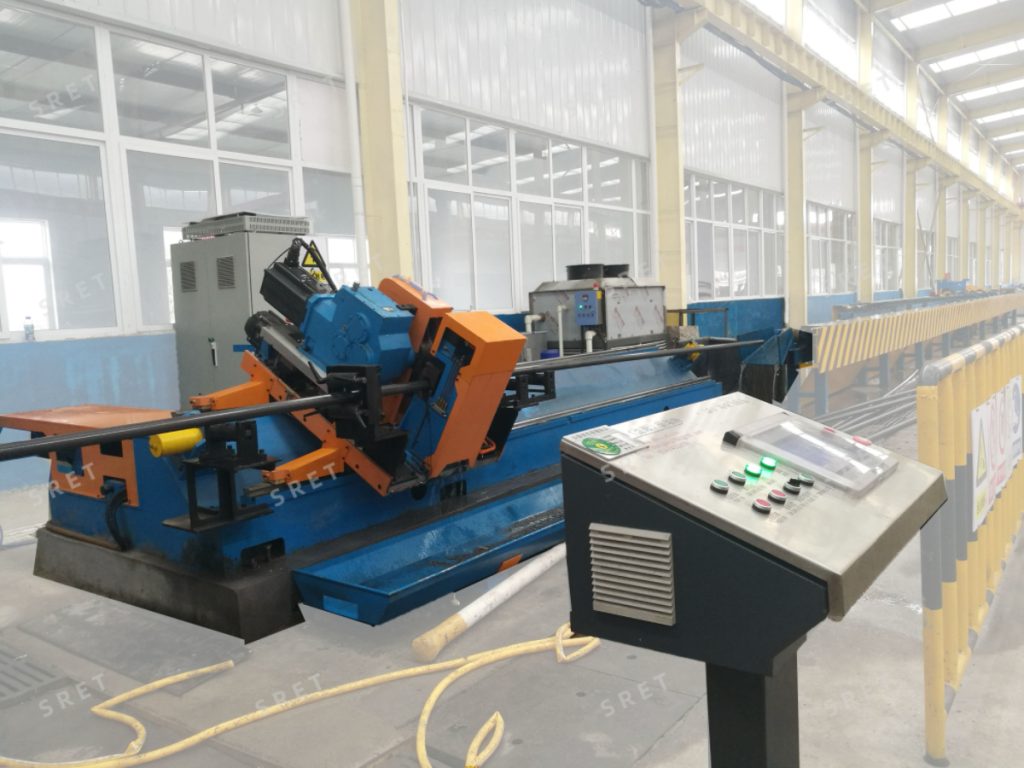
Both configurations use a travelling carriage to follow the tube during cutting. A speed-measuring unit provides movement signals to the control system, which coordinates carriage acceleration, tracking, clamping, sawing and return.
The carriage and the blades perform different movements:
For an ERW Tube Mill, matching the carriage movement to the tube is part of the flying cutting process. Adding a second blade changes the cutting arrangement, not this basic tracking requirement.
A single-blade configuration assigns the cutting operation to one saw unit. A spindle drive rotates the blade, while a controlled feeding mechanism advances it through the tube section.
In the arrangement described here, the blade follows a designed inclined feeding path. After completing the cut, it withdraws before the machine releases the tube and returns the carriage for the next cycle.
The applicable tube range depends on the blade, feeding geometry, clamping arrangement and machine specifications. The label “single-blade” alone does not establish the permitted tube size or cutting speed.
The sequential double-blade arrangement divides the cutting operation between two saw units. The first blade completes its assigned portion and retracts; the second blade then completes the remaining section.
The portions do not need to be described as two exact halves unless that is specified for the machine. The blade paths and their cutting coverage must be coordinated to complete tube separation.
Each saw unit requires a defined feeding and retraction sequence. The controls coordinate these movements with the clamping fixtures and carriage tracking.
This description applies to the sequential arrangement discussed in this article. It should not be used as a general definition of all double-blade flying cutoffs.
| Comparison Point | Single-Blade Arrangement | Sequential Double-Blade Arrangement |
|---|---|---|
| Cutting task | One saw unit completes the cut. | Two saw units complete assigned portions of the cut. |
| Blade sequence | One feeding and retraction sequence. | Coordinated feeding and retraction sequences for two blades. |
| Carriage movement | Tracks the moving tube during cutting. | Tracks the moving tube during both cutting stages. |
| Cutting range | Defined by the selected machine and tooling. | Defined by the selected machine, tooling and combined blade paths. |
| Length tolerance | Must be checked in the equipment specifications. | Must be checked in the equipment specifications; two blades alone do not establish a tighter tolerance. |
The original equipment description associates the double-blade arrangement with smaller-diameter blades and a wider cutting range. This should be treated as a feature of the specified design, not a universal rule.
Blade diameter must be considered together with the feeding path, the portion assigned to each blade and the available clearance around the tube and clamps.
When comparing equipment for a tube mill machine, check the actual tube range and tooling requirements rather than assuming that blade count alone determines cutting capacity.
A second blade changes how the tube section is cut. It does not, by itself, establish the machine’s cutting-length tolerance.
The stated tolerance must be confirmed for the selected equipment and operating conditions. The measurement, tracking, clamping and sawing sequence must all function as intended.
For an ERW tube mill machine installation, the comparison should therefore use the manufacturer’s model-specific specifications rather than a general claim that double-blade cutting is more accurate.
For a tube mill line, compare the complete cutting application rather than blade count alone:
These points connect the cutting arrangement to the intended production requirements without assuming that either configuration is universally preferable.
The carriage drive and motion controller coordinate acceleration, synchronous tracking and return. S-curve control can be used to make changes in carriage motion more gradual.
The installed motor and drive arrangement should be checked for the specific machine rather than described as identical across all versions.
The HMI provides access to the configured cutting settings, servo-position information, alarms and operating status. These functions support setup and monitoring of the cutting cycle.
TCT or HSS blades may be supplied according to the equipment configuration. Blade selection and cooling requirements must match the intended cutting application.
A blade cooling device should not be described as increasing the blade’s geometric cutting area. Its installed function and operating requirements should be stated according to the equipment documentation.
A remote diagnostic module, where supplied, provides access to equipment-status information for troubleshooting. It does not replace on-site checks when inspection or maintenance is required.
A single-blade configuration uses one saw unit to complete the cut. In the sequential double-blade arrangement described here, two saw units complete assigned portions in a coordinated sequence.
That should only be stated if the machine’s cutting program and geometry specify it. A more general description is that each blade completes its assigned portion of the cut.
Not necessarily. This article describes a sequential cutting arrangement. Orbital milling uses a programmed profiling movement. The actual blade paths and machine configuration determine the correct description.
These profiles can be supported within the configured equipment range. The permitted dimensions, clamping arrangement and cutting settings must be confirmed for the selected model.
No. Cutting-length tolerance is an equipment specification, not a result that can be inferred from the number of blades alone.
Yes. The travelling carriage follows the moving tube during the cutting cycle. The permitted line speed must remain within the selected machine’s operating range.
For model-specific tube ranges, cutting lengths, tolerances and operating speeds, see the cold saw flying cutoff product page. Confirm the required single-blade or double-blade configuration with the engineering team.