A semi-auto shear end welder trims and joins the tail of an outgoing steel coil to the head of the next coil. In an ERW tube mill line, this operation connects separate coils before the strip continues through the accumulator toward the forming section.
The defining feature of semi-automatic operation is the division of tasks between the operator and the machine. In the configuration described here, powered shearing and a controlled welding cycle are combined with operator positioning and alignment of the prepared strip ends.
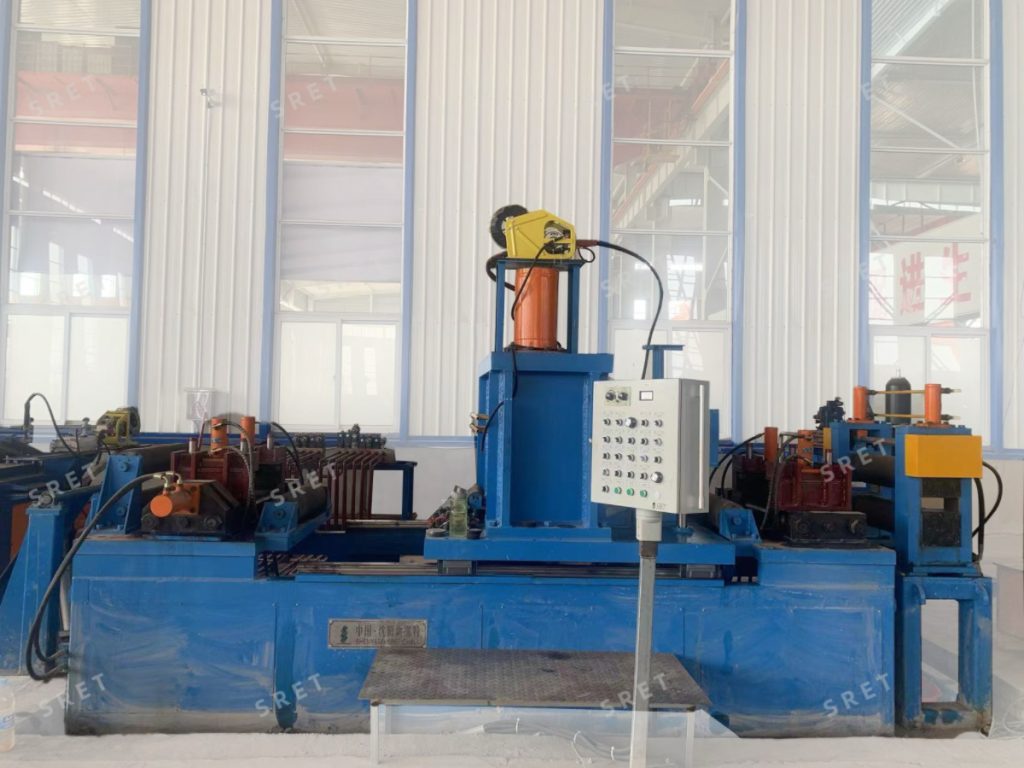
Semi-automatic does not mean that every movement is performed manually. The machine can carry out powered operations, while the operator completes or checks selected preparation steps and initiates the next stage.
For the arrangement described in this article, the operator aligns the trimmed coil ends, checks their position and secures them with the clamping platens before starting the welding cycle through the controls.
The exact division between manual and automatic tasks depends on the equipment configuration. Automatic centering, gap setting and reset functions should not be assumed unless they are specified for the machine.
The coil head and tail may contain irregular sections that are unsuitable for direct joining. The crop shear removes these portions to prepare the edges for positioning and butt welding.
Shearing and welding perform different functions. Shearing prepares the edges; alignment establishes their relative position; clamping holds them during welding; the welding operation connects the two coils.
For an ERW Tube Mill, this transverse coil-end joint is part of strip preparation. It should not be confused with the longitudinal seam formed later when the strip is shaped and welded into a tube.
The shearing device trims the coil ends under powered actuation. The strip must be positioned and held at the cutting station before the blade operates.
Blade material, clearance and cutting capacity are configuration-specific. They should be checked against the intended strip range rather than stated as universal specifications.
The pinch-roll arrangement moves the strip into the required working position. Operator adjustments establish where the irregular ends will be removed and where the prepared ends will meet.
The clamping platens hold the prepared strip ends during welding. The welding support provides the working area beneath the joint.
Clamping is not a substitute for alignment. The ends must be positioned correctly before they are secured.
The welding unit includes the power source and the associated wire-feeding and torch equipment for the selected process. The controls allow the operator to initiate and monitor the configured welding cycle.
Hydraulic and electrical systems may be dedicated to the machine or integrated with the entry section. Shared systems should only be described where they are part of the actual installation.
The purpose of preparation is to establish a joint that can pass through the downstream equipment. Before starting the welding cycle, the operator should follow the machine’s prescribed checks for:
These checks remain important even when the welding movement is controlled automatically. A programmed cycle does not correct an incorrectly prepared joint by itself.
The shear end welder connects successive coils, while the accumulator provides stored strip for downstream use during the joining operation.
In a tube mill line, these are complementary functions. The welder completes the connection; the accumulator bridges the temporary interruption in inlet feeding.
Whether a tube mill machine can continue running throughout the changeover depends on the usable strip reserve and the total time needed for preparation, alignment, welding and restarting.
For an ERW tube mill machine installation, the joining sequence therefore needs to be coordinated with accumulator storage and downstream strip demand. A semi-automatic welder alone does not guarantee uninterrupted production.
The main distinction is the amount of operator participation in positioning, alignment and cycle initiation.
A semi-automatic arrangement retains selected manual preparation tasks. An automatic arrangement may carry out more of the centering, joint positioning and welding sequence through the machine controls.
The comparison should be based on the actual task sequence rather than the equipment label alone. Cycle time, operator requirements and available functions must be confirmed for the selected configuration.
It trims and butt welds successive coil ends so that the connected strip can continue through the entry section. In the configuration described here, the operator participates in alignment and preparation before starting the controlled welding cycle.
Not necessarily. Manual positioning can be combined with a machine-controlled welding operation. The exact arrangement of torch movement, cycle initiation and reset functions depends on the equipment.
The permitted thickness range is model-specific. It must be confirmed together with strip width, material and welding capability. A general “above 2 mm” statement should not be applied to every semi-automatic configuration.
The process depends on the supplied welding unit and the intended material. If CO2-shielded or another MAG welding configuration is specified, the power source, wire and shielding-gas arrangement must match that application.
No. Trimming prepares the edges, but alignment, joint preparation, clamping and welding settings also affect the result. The completed joint must be checked according to the production procedure.
It can continue drawing from the accumulator while sufficient usable strip remains. The available reserve must cover the complete joining and restart sequence.
For available equipment types, strip-processing ranges and welding configurations, see the shear end welder product page. Confirm the semi-automatic task sequence and specifications with the engineering team.