Home >> News & Events >> How to Choose an ERW Tube Mill Line: Key Buyer Questions Answered and Why SRET Leads the Market

How to Choose an ERW Tube Mill Line: Key Buyer Questions Answered and Why SRET Leads the Market

An ERW tube mill line is a critical investment, so customers often compare not only technical specs but also process stability, product quality, and lifecycle costs when evaluating different suppliers. Modern electric resistance welded (ERW) lines combine continuous strip forming, high‑frequency welding, and precision sizing to deliver high-quality tubes for construction, automotive, energy, and infrastructure projects. Choosing the right line and partner directly affects yield, productivity, and compliance with international standards.[1][2][3]

ERW tube mill line
ERW tube mill line

What is an ERW tube mill line?

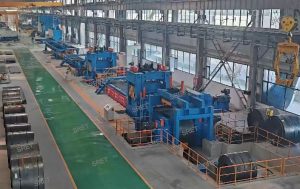
An ERW tube mill line is a continuous production line that forms steel strip into a tubular shape and joins the edges using electric resistance welding to create longitudinally welded tubes. The line typically starts from a steel coil, passes material through uncoiling, leveling, forming, welding, sizing, straightening, and cutting stations, and ends with bundled, inspected tubes ready for downstream use. Because all steps are integrated, ERW mills can produce large volumes of consistent product with relatively low labor input per ton.[2][4][1]

In the ERW process, high-frequency current is induced at the strip edges, heating them to a plastic or molten state before they are forged together under pressure without filler metal. This welding method produces a narrow, controlled heat-affected zone and supports high line speeds, which is why ERW tube mill lines are widely used for structural tubes, mechanical tubing, and low- to medium-pressure applications.[5][3][4]

ERW tube mill line
ERW tube mill line

How does an ERW tube mill line work?

The basic workflow of a typical ERW tube mill line follows a linear, coil-to-cut-length sequence. Key stages include:[3][1]

– Coil handling and preparation: Coils are loaded, uncoiled, and fed through a shear and end welder so production can run continuously as coils change.[1]

– Forming: A series of forming and fin-pass rolls progressively bend the flat strip into an open tube while maintaining edge alignment and strip tension.[3][1]

– High-frequency welding: Induction coils or contact shoes focus current at the strip edges; pressure rolls then forge the heated edges together to form the weld.[4][5]

– Bead removal, sizing, and straightening: Internal and/or external weld bead may be scarfed; the tube passes through sizing stands to achieve final diameter and wall thickness, then through straighteners.[6][1]

– Cutting and finishing: Flying saws or cold cut systems cut tubes to length before stacking, bundling, and inspection.[6][2]

For customers, understanding each section is important because mechanical design, control systems, and tooling quality in these stages determine maximum speed, dimensional accuracy, and uptime.[2]

ERW tube mill line
ERW tube mill line

What are the main advantages of ERW tube mill lines?

Customers typically choose ERW tube mill lines for their combination of throughput, efficiency, and flexibility. Common advantages include:[3]

– High production speeds: Continuous lines can produce dozens to hundreds of tubes per hour depending on diameter and wall thickness.[2]

– Good dimensional control: Modern forming and sizing stands, coupled with real‑time monitoring, provide tight tolerances on diameter, wall thickness, and straightness.[1][3]

– Material efficiency: ERW uses strip coil effectively, with minimal scrap compared to some competing processes.[1]

– Versatility: The same line, with appropriate tooling, can produce round, square, and rectangular tubes for multiple applications.[6][3]

Compared with seamless tube production, ERW mill lines usually offer lower cost for small- and medium-diameter tubes when service conditions are within the design envelope of welded pipe. That makes them attractive for structural, mechanical, and general engineering uses where weld integrity can be validated through appropriate NDT and standards compliance.[7][2]

ERW tube mill line
ERW tube mill line

What standards and specifications should an ERW tube mill line meet?

A frequent customer question is which product standards an ERW line can support and how that translates into machinery requirements. Typical downstream tube or pipe products are manufactured to national or international specifications, such as ASTM, EN, or API standards. For example, welded pipes may need to meet ASTM A53 or related standards for carbon steel pipes, or ASTM A554 and similar standards for stainless tubing, depending on the final use.[8][9][7]

From a machinery perspective, the line must be capable of:  

– Holding dimensional tolerances tighter than or equal to the chosen pipe/tube standard.  

– Supporting appropriate NDT integration (e.g., ultrasonic testing) where specified by pressure or structural codes.[9][5]

– Handling the grades and mechanical properties required, including higher-strength steels or stainless grades where forming loads and springback are greater.[9][2]

Buyers should match the ERW tube mill line’s forming capacity, welding power, and control systems to the most stringent product standard they plan to produce, then verify that with the manufacturer’s reference projects and test data.[2]

ERW tube mill line
ERW tube mill line

What are typical applications of ERW tube mill line products?

Customers often ask whether ERW tubes from a specific line can serve their application, particularly regarding strength and weld performance. ERW tube mill lines are widely used to produce tubes for:[3]

– Construction and infrastructure: Structural hollow sections for frames, columns, guardrails, and scaffolding.[3]

– Mechanical and automotive components: Chassis members, seat structures, exhaust components, and mechanical tubing.[2][3]

– Low- and medium-pressure piping: Water lines, sprinkler systems, and general fluid conveyance where codes allow welded pipe.[7][9]

– Furniture and general engineering: Tubes for racks, furniture frames, agricultural equipment, and more.[3]

Suitability depends on the tube design, material grade, welding quality, and inspection regime; for high‑pressure or critical service applications, additional standards and qualifications may apply.[7][9]

ERW tube mill line
ERW tube mill line

What key parameters should customers look at when selecting an ERW tube mill line?

Experienced buyers usually begin with a set of technical parameters before discussing options with manufacturers. Core selection criteria include:[1][2]

– Diameter and wall thickness range: Minimum and maximum OD, and wall thickness limits across round, square, and rectangular profiles.[6][3]

– Line speed: Maximum achievable speed for the intended product mix, recognizing that heavy wall or high‑strength materials may run slower.[6][2]

– Material range: Compatibility with carbon steel, low alloy, and possibly stainless steels, including yield strength ceilings.[9][2]

– Automation and control: Degree of automation for setup, roll change, speed synchronization, and quality monitoring.[6]

– Required product standards and certifications: Ability to integrate NDT, marking, and data capture to support customer or regulatory requirements.[7][9]

Defining these parameters clearly helps ERW tube mill line manufacturers configure the forming stands, welding section, drive systems, and finishing equipment appropriately.[1][6]

ERW tube mill line
ERW tube mill line
ERW tube mill line

How do quality control and inspection work on an ERW tube mill line?

Customers frequently ask how welding integrity and dimensional tolerances are guaranteed in continuous production. Well‑designed ERW tube mill lines incorporate quality control at several points:[5]

– Strip inspection: Visual and, in some cases, ultrasonic inspection before forming to detect base material defects.[2]

– Weld process control: Monitoring of welding current, voltage, squeeze pressure, and line speed; consistent weld bead shape and controlled extrusion are key indicators.[4][5]

– Inline NDT: Many lines use ultrasonic testing to detect internal or external weld flaws in real time, allowing adjustments or marking of suspect tubes.[5][9]

– Offline mechanical and corrosion testing: Tensile tests, flattening, flaring, and hydrostatic or pressure testing may be required by standards or customer specifications.[8][7]

Buyers should confirm what inspection and test equipment can be integrated into the ERW tube mill line and how results are recorded for traceability, especially where third‑party certification or regulatory compliance is required.[9][7]

ERW tube mill line
ERW tube mill line

What are the main cost drivers and ROI considerations for ERW tube mill lines?

Investors often focus on initial capital cost, but lifecycle economics for an ERW tube mill line depend on multiple interacting factors. Key cost drivers include:[2]

– Equipment configuration: Higher degrees of automation, stronger drive systems, and advanced control hardware increase capex but can lower operating costs over time.[6]

– Tooling and maintenance: Forming and sizing rolls, saw blades, and wear parts represent recurring costs; design that promotes easy changeover and long tool life can significantly cut downtime.[6][2]

– Energy and consumables: High-frequency welding power and drive motors consume energy; efficient designs and optimized process parameters reduce per‑ton energy costs.[5][2]

– Yield and scrap: Coil joining, forming stability, and welding control influence scrap rates; even small improvements in yield can materially affect profitability at high throughput.[5][2]

ROI analysis should consider expected utilization, product mix, margins on finished tubes, and local factors such as labor rates and energy prices over the anticipated lifespan of the line. Choosing a manufacturer that offers process optimization and operator training can also improve ramp‑up speed and long‑term returns.[1][2]

ERW tube mill line
ERW tube mill line

How does an ERW tube mill line address safety and regulatory issues?

Safety is a recurring concern, especially for customers installing their first large mill line. ERW tube mill lines involve high-speed strip, high-power welding equipment, rotating machinery, and heavy coils, all of which require robust safety design. Good practice includes:[9]

– Physical guarding and interlocks around rotating equipment, pinch points, and cutting systems.  

– Emergency-stop circuits and safety PLCs covering the full line.  

– Ventilation and fume extraction near welding and cutting stations.  

– Operator training in lockout/tagout, material handling, and emergency procedures.[9]

On the regulatory side, finished tubes must meet the safety and performance requirements of the applicable codes and standards, while the production facility must comply with local occupational safety and environmental regulations. Buyers should ask ERW tube mill line manufacturers about previous installations in similar regulatory environments and available documentation to support permits and inspections.[7][9]

ERW tube mill line
ERW tube mill line

What about environmental and energy considerations?

Many customers now factor in environmental performance when choosing ERW tube mill lines. Continuous welded tube production inherently has relatively high material utilization, but line design and operation can further reduce environmental impact by:[9]

– Optimizing energy efficiency in drives, high-frequency generators, and hydraulic systems.  

– Reducing scrap through better process control and inline monitoring.[5][2]

– Managing noise, fume, and waste according to local environmental regulations and best practices.[9]

Some operators also pursue ISO 14001 or related environmental management certifications, which require systematic control of waste and emissions; ERW tube mill line suppliers that understand these frameworks can help configure equipment and documentation accordingly.[9]

ERW tube mill line
ERW tube mill line
ERW tube mill line

How do control systems and digitalization influence ERW tube mill performance?

Customers often ask how “smart” an ERW tube mill line can be and what benefits advanced control systems provide. Modern lines may offer:[6]

– Automated setup and recipe management for different tube sizes and materials.  

– Closed-loop control of strip speed, motor torque, roll positions, and welding parameters.  

– Integration with MES or plant-wide systems to track production, quality data, and maintenance events.[2][6]

These features support faster changeovers, more consistent quality, and data-driven process improvements over time. When evaluating suppliers, it is useful to ask about PLC/drive platforms, remote diagnostics, and options for future upgrades as digital requirements evolve.[2][6]

ERW tube mill line
ERW tube mill line
ERW tube mill

How should customers evaluate and select an ERW tube mill line manufacturer?

From an E‑E‑A‑T perspective, customers benefit from manufacturers that demonstrate real-world experience, proven technical expertise, industry recognition, and transparent communication. Practical evaluation steps include:[2]

– Reviewing reference projects in similar product ranges and markets.  

– Assessing engineering depth, including ability to customize lines for specific standards or materials.  

– Verifying quality systems and documentation, such as adherence to recognized machinery standards and risk assessments.  

– Considering after‑sales support: spare parts availability, remote support capabilities, and training programs.[6][2]

Site visits, factory audits, and discussions with existing customers provide additional assurance about a manufacturer’s capacity to deliver and support an ERW tube mill line over its full lifecycle.[2]

ERW tube mill line
ERW tube mill line
ERW tube mill line

Recommended ERW tube mill line manufacturer in China – SRET Co., Ltd.

For buyers looking for an experienced and specialized ERW tube mill line manufacturer in China, SRET Co., Ltd. is a strong candidate to consider. Founded in 1989 in Shenyang by a group of senior university professors, SRET has focused for decades on the design, engineering, and manufacture of ERW tube mill lines and related equipment, giving it deep process knowledge and application experience across multiple industries. The company offers complete ERW tube mill line solutions—from entry sections through forming, high‑frequency welding, sizing, cutting, and finishing—tailored to customer-specific diameter, thickness, and product standard requirements.[3][1][2]

A highly qualified engineering team and experienced production staff, combined with ongoing innovation and quality improvement, position SRET as one of the leading Chinese manufacturers capable of supplying robust, efficient ERW tube mill lines that support high-grade tube production and long-term operational reliability. Customers seeking a trusted partner for ERW tube mill line projects can learn more about SRET’s solutions at the company’s dedicated ERW tube mill line page: https://www.sret-tech.com/erw-tube-mill-line-machine/.[1][2]

Authoritative references for further reading on ERW processes, welded tubing, and applicable standards include:  

– Overview of electric resistance welded pipe manufacturing and continuous mill processes – Science Direct engineering topics[2]

– Brief overview of electric resistance welding process parameters and quality factors – Atlas Tube[5]

– Measures and definitions related to carbon steel welded pipe and ERW products – Canada Border Services Agency[7]

– Stainless steel welded tubing specification ASTM A554, referenced by government and defense users – available via ASTM[8]

– Government technical guidance on welded stainless steel pipework and applicable standards – Hong Kong Water Supplies Department[9]

[1](https://txmachinery.net/the-introduction-to-erwelectric-resistance-weldingtube-mill-line-process/)

[2](https://www.sciencedirect.com/topics/engineering/electric-resistance-welded)

[3](https://www.toptubes.co.uk/blog/what-is-an-erw-tube-mill/)

[4](https://en.wikipedia.org/wiki/Electric_resistance_welding)

[5](https://www.atlastube.com/wp-content/uploads/2018/10/ERW-Process-Flyer.pdf)

[6](https://teknointelmetal.com/upload/06_Tube_Mills_2017_D.pdf)

[7](https://www.cbsa-asfc.gc.ca/sima-lmsi/mif-mev/cswp1-eng.html)

[8](https://www.barametall.hu/wp-content/uploads/2020/11/ASTM-A554.pdf)

[9](https://www.wsd.gov.hk/filemanager/en/content_1617/M-02-03_112018.pdf)

[10](https://www.youtube.com/watch?v=E8MGxZJA8CA)