A double-blade cold saw flying cutoff cuts tubes to preset lengths while they continue moving through an ERW tube mill line. Its travelling carriage follows the tube at line speed, allowing the clamping and sawing units to perform the cut without requiring the tube to stop.
Two coordinated motions define the process: the carriage tracks the moving tube, while the saw units feed their blades through the tube section. This article explains how these motions work together in the sequential double-blade configuration described below.
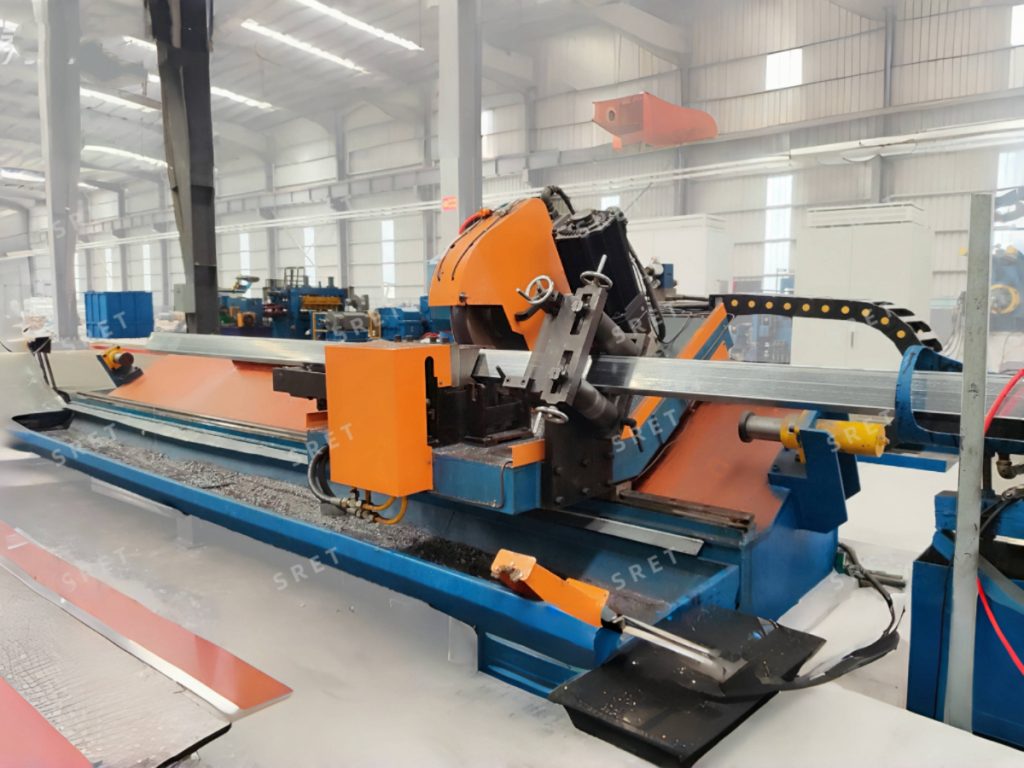
The tube continues travelling forward during cutting. The carriage therefore accelerates to match its speed before the clamping and sawing sequence begins.
Once synchronized, the carriage and tube move together in the production direction. The saw units can then carry out their cutting movements relative to the tube while the complete cutting assembly continues travelling along the line.
Carriage tracking and blade feeding are separate functions. Tracking follows the longitudinal movement of the tube; blade feeding moves the cutting tools through its cross-section.
The travelling carriage carries the clamping fixtures and the two feeding and sawing units. A rack-and-pinion drive moves the carriage along the base bed through acceleration, synchronous tracking and return.
A measuring roll fitted with a photoelectric encoder provides pulse signals to the motion control system. These signals are used to determine tube movement and coordinate the carriage with the preset cutting length.
The clamps hold the tube relative to the carriage during sawing. Hydraulic or pneumatic actuation may be used, depending on the machine configuration.
The clamping sequence is coordinated with carriage tracking and blade movement. The fixtures release after the cutting sequence has been completed.
Each saw unit combines blade rotation with a controlled feeding movement. Spindle drives rotate the blades, while servo-driven ball screws and linear guides control their feeding paths.
In the configuration described here, the two blades work sequentially. The first blade completes its assigned portion of the cut and retracts; the second blade then completes the remaining section.
The electrical system includes the motion controller, PLC, HMI, drives, encoders and sensors. Together, these components coordinate tube measurement, carriage movement, clamping and saw feeding.
Where hydraulic actuation is used, the hydraulic station and valve groups supply and control the associated movements. Remote diagnostic functions may also be provided as part of the selected control configuration.
The motion control system coordinates these stages as a repeated automatic cycle. Automatic sequencing does not remove the need for machine guarding, setup checks, blade inspection and operator supervision.
The distinguishing feature is the division of the cutting task between two saw units. Rather than assigning the complete cut to one blade, the described arrangement uses one blade for an initial portion and the other for the remaining section.
The blade paths must be coordinated so that the two cutting stages complete the tube separation. Their feeding movements and retraction sequence must also be compatible with the clamping arrangement and the available carriage travel.
The presence of two blades alone does not establish a particular cutting speed, tube size range or length tolerance. These remain equipment-specific specifications and should be checked on the product page.
The carriage must reach the required tracking speed, maintain it during cutting and return in time for the next cycle. S-curve acceleration and deceleration control is used to make changes in carriage motion more gradual and reduce mechanical shock.
The feeding path defines how each blade enters, progresses through and withdraws from the tube section. The two saw units must follow their programmed sequence without interfering with each other or the clamping fixtures.
The HMI provides access to cutting settings, servo-position information, operating status and alarms. These functions allow operators to check the programmed cycle and monitor the machine during production.
The machine is intended to produce clean cut surfaces, but cut quality should not be described as an unconditional guarantee. Blade condition, tool selection, feeding settings, tube support and clamping all need to suit the cutting application.
TCT and HSS blades are available according to the equipment configuration. Blade diameter and tooth specification should be confirmed for the selected machine and tube range rather than treated as universal values.
The travelling carriage matches the tube’s forward speed. The clamping and sawing units therefore move with the tube while the blades perform their cutting movements.
In the configuration described in this article, they cut sequentially: the first blade completes its assigned portion and retracts, followed by the second blade completing the remaining cut. The actual sequence should be confirmed for the specific machine design.
The names alone should not be treated as equivalent. This article describes sequential cutting by two saw units. The orbital milling configuration described elsewhere uses a profiling feeding path. The actual blade movement and machine configuration determine which description applies.
The described equipment supports these profiles within its specified operating range. Suitable blade paths, clamping fixtures and cutting settings must be matched to the tube section.
Either actuation method may be provided, depending on the selected configuration. The installed clamping system should be confirmed in the machine specifications.
No. The cutting cycle can run automatically after setup, but operators still need to monitor alarms, check blade condition and follow the equipment’s operating and safety procedures.
For available models, tube dimensions, wall thickness ranges, cutting lengths and operating speeds, see the cold saw flying cutoff product page. Confirm the required double-blade configuration with the engineering team.