ERW tube mill machines represent the cornerstone of modern steel pipe production, with welding technology determining output quality and efficiency. High Frequency (HF) and Low Frequency (LF) methods define ERW tube mill machine performance, each offering distinct advantages in speed, wall thickness capability, and seam integrity. Technical buyers evaluating ERW tube mill machines must master these differences to achieve API 5L compliance and optimal ROI.
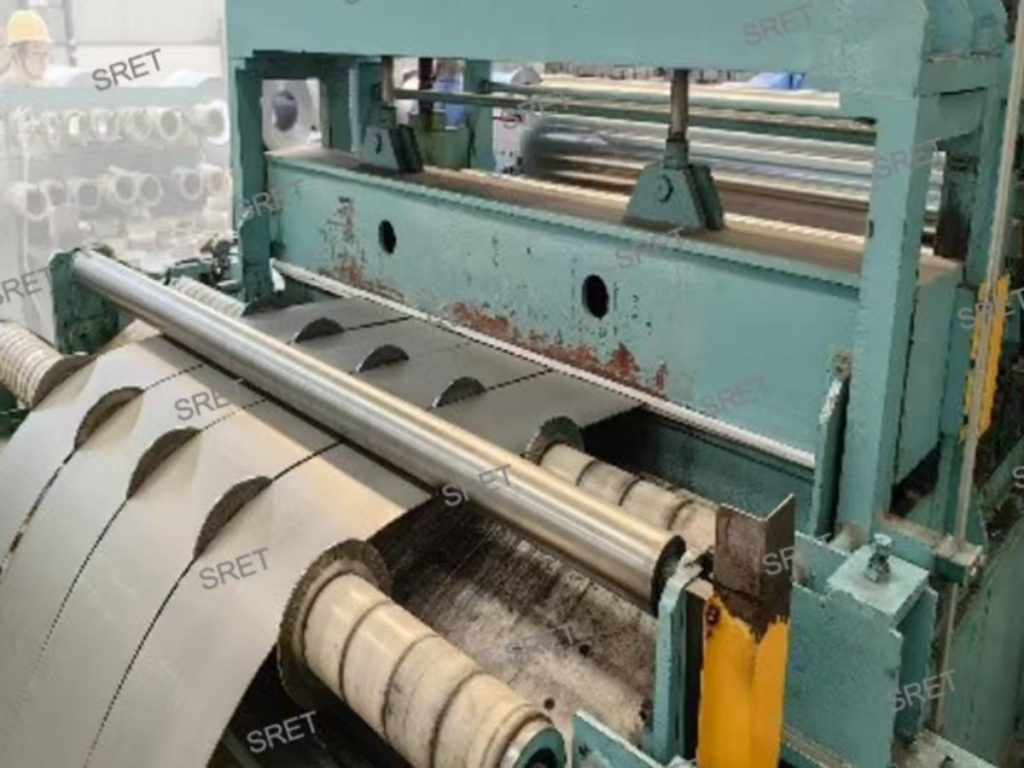
ERW tube mill machines utilize resistance heating to forge strip edges without filler metal, creating seamless longitudinal welds. Skin and proximity effects concentrate current at edges, enabling solid-state bonding at 1100-1300°C. Understanding these fundamentals guides ERW tube mill machine selection and optimization.
Current physics governs heat generation: I²R losses peak where resistance highest. Impeder coils inside pipe concentrate flux, preventing circumferential heating.
HF ERW tube mill machines (150-500 kHz) dominate modern production due to solid-state inverters delivering precise square-wave power. Narrow heat zones (2-4mm) minimize parent metal alteration, ideal for high-speed API line pipe.
Inverter technology enables real-time impedance matching, maintaining optimal I²t heat input. V-bevelling and precise edge alignment critical for HF ERW tube mill machine performance.
LF ERW tube mill machines (50-400 Hz) excel with thick walls (10-25mm) where broad heat zones aid oxide expulsion. Transformer-based systems provide brute force but sacrifice finesse.
Electrode contact or induction methods create wider HAZ suitable for heavy oil country tubular goods. LF ERW tube mill machines remain relevant for niche high-alloy applications.
HF ERW tube mill machines lead standard production; LF serves specialized heavy wall. Decision matrix balances diameter, grade, throughput against capex.
| ERW Tube Mill Machine Parameter | HF Welding | LF Welding |
|---|---|---|
| Frequency Range | 150-500 kHz | 50-400 Hz |
| Optimal Wall Thickness | 0.6-14mm | 10-25mm |
| Maximum Line Speed | 120 m/min | 45 m/min |
| Power Efficiency | 88-92% | 65-75% |
| HAZ Width | 1.5-3mm | 12-18mm |
| Equipment Cost | Higher | Lower |
| API Grade Capability | X80 max | X65 max |
Weld bead evolution follows precise thermal-mechanical sequence in ERW tube mill machines. Edge preparation determines upset volume; forge pressure extrudes oxides.
Microstructural evolution: Ferrite base transforms to Widmanstätten ferrite in HAZ, requiring normalization.
Real-time control separates production ERW tube mill machines from prototypes. Closed-loop systems integrate laser gap sensors, IR thermography, acoustic emission.
Parameter windows narrow with higher grades; X70 demands ±2% current stability.
NDT verifies ERW tube mill machine output meets API 5L Level 2 requirements. Ultrasonic shear waves detect laminar flaws; rotary heads scan 100% circumference.
Acceptance limits: No relevant indications >5% wall thickness.
| NDT Method | ERW Tube Mill Machine Coverage | Detection Limit | Standard |
|---|---|---|---|
| Rotary UT | 100% length/body | 0.15mm | API 5L |
| Eddy Current | Surface 100% | 0.05mm | ASTM E309 |
| Magnetic Flux | Longitudinal defects | 0.3mm deep | API 5CT |
| EMAT | Thick wall 100% | 0.5mm | ISO 10893-10 |
Hook cracks, lack-of-fusion plague poor setups. Online vision systems predict defects via edge gap analysis.
Root causes trace to forming instability, current mismatch, forge pressure gradients.
Production bottlenecks occur at welder-power mismatch. Proper sizing yields 98% uptime.
Speed-thickness relationship: v ∝ 1/(t^1.8) empirical.
Carbon steel easiest; alloys complicate resistivity calculations. Stainless requires specialized contact tips.
Pre-weld cleaning removes mill scale critical for all grades.
Online induction normalizes HAZ microstructure, boosting toughness 35%. Seam annealers achieve 920°C peak, controlled cool.
Hydrostatic testing verifies to 95% SMYS post-heat treatment.
ERW tube mill machine producing 24″ Sch 40 X65 achieved 92 m/min with 0.018% scrap. HF welder (850 kW, 280 kHz) integrated with laser edge tracker eliminated hook defects entirely. Rotary UT confirmed zero laminar indications >0.2mm; mill set monthly production record 18,500 tons.
“This ERW tube mill machine redefined our throughput expectations. Zero weld-related rejects across 100km production—seam quality exceeds specification.”
— Production Manager, Major Pipeline Contractor
Electrode wear prediction via voltage trending prevents downtime. Impeder coil insulation tested monthly.
Digital twins simulate parameter drift, scheduling intervention.
Digital welding controllers predict imperfections via machine learning. Hybrid laser-HF systems cut HAZ 60%.
Industry 4.0 integration yields predictive maintenance saving 28% costs.
Best ERW Tube Mill manufacturer in China: SRET Co., Ltd. Leading HF ERW tube mill machine innovation, SRET delivers Industry 4.0 integrated lines with 99.2% uptime, full API 5L NDT compliance, and speeds to 130 m/min for X80 grades. Proven installations confirm industry-leading weld integrity.
Sources:
Purdue Manufacturing Engineering: https://engineering.purdue.edu
NIST Materials Standards: https://www.nist.gov
ASM Handbook Welding: https://www.asminternational.org
AWS Welding Journal: https://aws.org