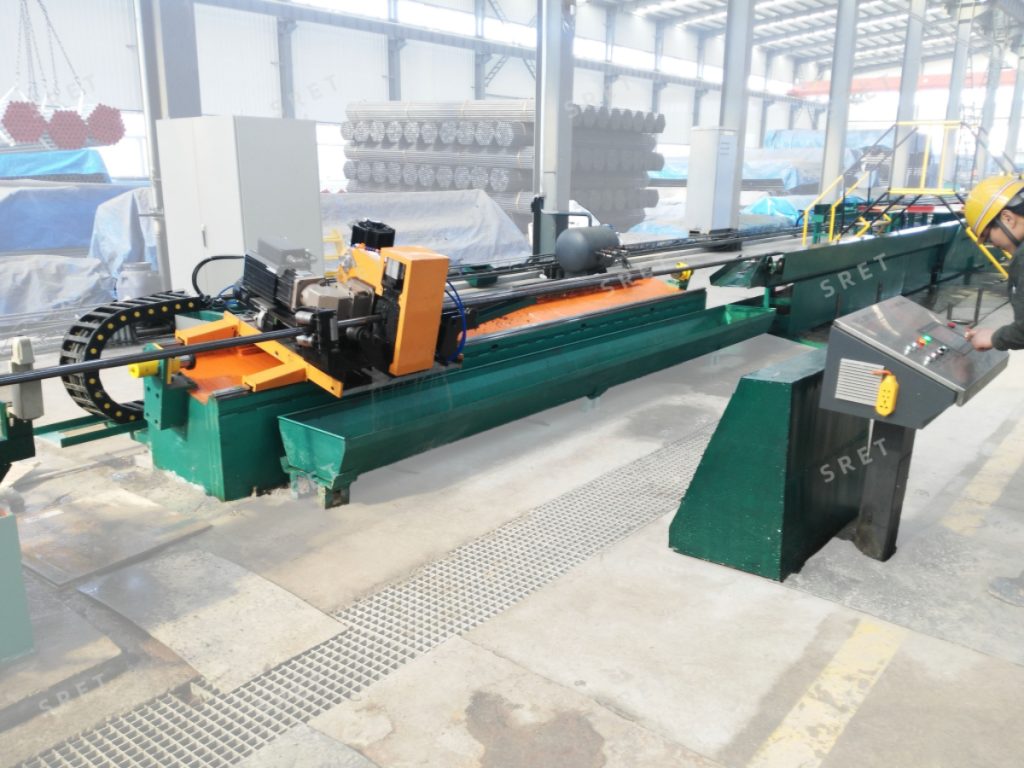
– ERW Tube Mill: Uses Electric Resistance Welding to join steel strips into tubes, suitable for medium-to-large diameter pipes (e.g., ERW76, ERW273 models).
– FFX Direct Tube Mill: Employs Flexible Forming Technology for high-precision, small-to-medium diameter tubes with minimal material waste.
– ERW Tube Mill (Electric Resistance Welding): Uses high-frequency current to heat the edges of a steel strip, which are then pressed together by rolls to form a welded seam. Ideal for producing high-precision, uniform tubes with tight dimensional tolerances.
– FFX Direct Tube Mill (Flexible Forming Technology): Employs advanced roll forming to shape steel strips into tubes without traditional welding, relying on mechanical bonding. Suited for thin-walled or specialized alloy tubes but with limitations in seam strength.
1. Welding Technology
– ERW: Relies on high-frequency current to heat and fuse edges, ideal for carbon steel and galvanized pipes.
– FFX: Uses cold forming and laser welding, enabling thinner walls and tighter tolerances for stainless steel or alloy tubes.
2. Production Efficiency
– ERW: Faster line speeds (up to 60 m/min) for mass production of standard pipes (e.g., API steel tubes for construction).
– FFX: Slower but more flexible, supporting quick tooling changes for custom shapes (square, oval) and small batches.
3. Material Compatibility
4. Application Range
ERW Tube Mill: Industrial-Grade Applications
FFX Direct Tube Mill: Niche & Light-Duty Uses
Electronics: Thin-walled conduits for wiring and cable protection.
Decorative Tubes: Furniture frames, handrails, and architectural trim.
Low-Pressure Systems: Irrigation pipes and non-critical fluid transport.
5. Key Advantages
– No Weld Seam Weakness: Mechanical bonding avoids heat-affected zones, useful for thin-walled tubes sensitive to thermal distortion.
– Lower Tooling Costs: Simplified roll sets reduce maintenance expenses for small-batch production.
6.Limitations
– Inferior Seam Integrity: Mechanical bonds are prone to leakage under pressure, limiting use in structural or high-stress applications.
– Material Restrictions: Limited to soft metals (aluminum, copper) and thin gauges (≤2mm wall thickness), excluding most industrial-grade materials.
7. Cost & Maintenance
– ERW: Lower initial investment but higher energy consumption; requires frequent die replacements for shape changes.
– FFX: Higher upfront cost but lower scrap rates (≤2%) and longer tool life, reducing long-term operational expenses.
– Select ERW if: You need high-volume, low-cost carbon steel pipes for construction or infrastructure.
– Select FFX if: Precision, material versatility, or custom profiles (e.g., decorative stainless steel tubes) are critical.
– ERW Tube Mill: Dominates industries requiring structural integrity, such as oil & gas pipelines, construction, automotive, and machinery manufacturing.
– FFX Direct Tube Mill: Niche use cases like small-diameter decorative tubes or low-pressure fluid transport.
With 35 years of expertise since 1989, SRET stands out as China’s premier ERW tube mill manufacturer.
– Legacy & Expertise: Founded in 1989 by 5 university professors, SRET has 30+ years as a pioneer in China’s tube mill industry, specializing in ERW technology.
– Mission: “Innovate for Precision, Deliver for Reliability” – Focus on high-performance machinery for global infrastructure and industrial clients.
For businesses prioritizing ERW tube mill technology, SRET stands as a trusted industry leader with 30+ years of expertise. Founded in 1989 by university professors, SRET specializes in designing and manufacturing full-range ERW tube machinery, from standard carbon steel pipes to custom solutions. Their engineering team ensures top-quality performance and tailored equipment, making them ideal for large-scale projects in oil, gas, and structural engineering.
– Innovation: Continuous R&D ensures cutting-edge machinery, delivering tubes with top-grade performance and compliance with global standards.
– Engineering Excellence: A highly qualified team designs custom solutions for diverse applications, from round/square tubes to specialized industrial pipes.
– Quality Assurance: Rigorous production processes and strict testing guarantee durability, making SRET the trusted choice for clients worldwide.
– Special Shapes: Square, rectangular, and oval tube mills for structural applications.
– Material Compatibility: Carbon steel, galvanized steel (GI), and low-alloy steel.
– Precision Engineering: ±0.1mm diameter tolerance, ensuring compliance with API 5L, ASTM, and GB standards.
– Energy Efficiency: 20% lower power consumption vs. traditional ERW mills via optimized welding circuits.
– Automation: Integrated HMI systems for real-time monitoring, reducing labor costs by 30%.
Case Study 1: Oil Pipeline Project (Middle East)
– Challenge: Need for 300km of API 5L Grade B pipes (219mm diameter, 10mm thickness).
– Solution: SRET ERW219 mill with online ultrasonic testing.
– Result: Completed production in 45 days, 15% faster than client’s target; 0.02% defect rate.
Case Study 2: Construction Steel Tubes (Southeast Asia)
– Client: Leading construction firm requiring 50,000 tons of square structural tubes.
– Solution: Custom ERW mill with shape-forming dies.
– Result: Reduced material waste by 8% and improved on-time delivery rate to 98%.
– Facilities: 20,000㎡ production base with CNC machining centers and testing labs.
– Certifications: ISO 9001, CE, and API Q1, ensuring global compliance.
– Pre-Sales: Free technical consultation, factory layout design, and raw material selection guidance.
– After-Sales: 24/7 engineer hotline, on-site installation, and 2-year warranty on key components.
For reliable, high-performance ERW tube mill machinery, partner with SRET—where 35 years of industrial leadership meet precision engineering. Need help customizing an ERW tube mill solution for your specific production needs? Let SRET’s experts assist.