Investment in an ERW tube mill line is one of the most consequential decisions for any pipe and tube manufacturer. The capital expenditure is substantial, the operational footprint is long‑term, and the performance of the equipment directly shapes production cost, product quality, and market competitiveness. For decision‑makers evaluating whether an ERW tube mill line is financially justified, the central question is always the same: How quickly will the investment pay for itself?
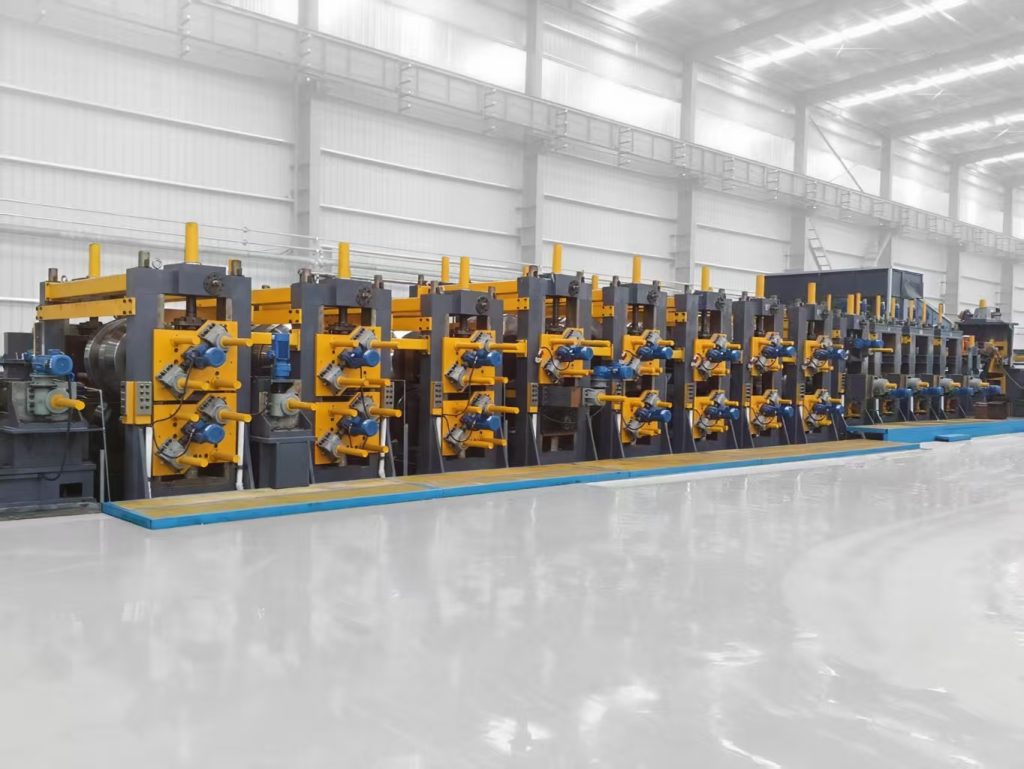
Across global installations, a well‑engineered ERW tube mill line typically achieves a payback period of 18–24 months, provided that the investment is aligned with production demand, capacity utilization is optimized, and operational costs—especially energy and maintenance—are controlled through modern technology. Understanding the ROI structure behind this payback window is essential for making a confident and informed investment decision.
An ERW tube mill line is not merely a piece of machinery; it is a production ecosystem. Its financial performance is shaped by forming efficiency, welding stability, sizing accuracy, automation level, uptime reliability, and the ability to maintain consistent throughput. When these elements work together, the line becomes a predictable revenue generator with stable operating costs. When they do not, the line becomes a source of downtime, scrap, and unpredictable expenses. This is why ROI analysis must go beyond the purchase price and examine the full economic behavior of the equipment throughout its lifecycle.
The ROI of an ERW tube mill line is determined by four primary economic drivers: investment vs. yield, capacity utilization, energy consumption, and maintenance cost. Each of these factors influences the payback period in a measurable way. A line with higher forming stability and welding efficiency produces more saleable tubes per shift. A line with optimized energy usage reduces electricity cost per ton. A line with durable components and predictable maintenance schedules minimizes unplanned downtime. When these advantages accumulate, the financial return accelerates significantly.
For manufacturers operating in competitive markets—construction, automotive, oil and gas, mechanical tubing, structural applications—the ability to produce high‑quality tubes at a lower cost per ton is the foundation of profitability. An ERW tube mill line that improves yield by even a small percentage can shift the entire cost structure of a plant. Similarly, a reduction in energy consumption per ton can translate into substantial annual savings, especially for high‑frequency welding systems. These operational efficiencies are the real engine behind the 18–24 month payback period.
The following sections analyze each ROI driver in depth, providing a clear and practical framework for evaluating the financial performance of an ERW tube mill line. The goal is to help decision‑makers understand not only whether the investment is justified, but why the payback period is achievable and how to ensure it is realized in practice.
Capacity utilization is one of the most influential variables in determining the return on investment of an ERW tube mill line. Regardless of how advanced the equipment may be, low utilization dilutes fixed costs and extends the payback period. Conversely, when the line operates at a stable throughput with minimal interruptions, the cost per ton decreases significantly. Depreciation, labor, and electricity expenses are spread across a larger output, accelerating the ROI toward the 18–24 month window. For most manufacturers, improvements in utilization come from three operational pillars: forming stability, welding efficiency, and automation. High forming stability reduces roll changeover time and minimizes scrap. High welding efficiency reduces rework and cut‑off losses. High automation stabilizes production rhythm and reduces manual intervention. Together, these factors determine whether the line consistently produces saleable tubes.
In real‑world operations, utilization gains rarely come from a single upgrade. Instead, they emerge from the synergy of mechanical precision, control systems, and workflow design. Automated control systems reduce operator‑dependent variability by maintaining consistent welding current, forming pressure, and sizing accuracy. When these parameters remain stable, the line experiences fewer stoppages, fewer weld defects, and fewer dimensional deviations. This stability directly translates into higher uptime and more predictable output. For manufacturers operating multiple shifts, even a small increase in uptime can produce substantial annual gains. A 2 percent improvement in utilization on a medium‑diameter ERW tube mill line can translate into thousands of additional tons per year, significantly improving revenue and accelerating payback.
Energy consumption is another major component of the ROI equation. ERW tube mill lines rely on high‑frequency welding systems, forming motors, sizing motors, cooling systems, and auxiliary equipment. Electricity is often one of the top three operating expenses, especially in regions with high industrial power rates. The efficiency of the HF welder, the quality of the power electronics, and the precision of the forming process all influence the kilowatt‑hours consumed per ton of finished tubes. Modern SiC‑based HF welders, for example, can reduce energy consumption by a meaningful margin compared to older IGBT‑based systems. When combined with optimized forming that reduces unnecessary deformation, the energy cost per ton can drop significantly.
Energy efficiency is not only a matter of welding technology. The overall mechanical design of the line also plays a role. Smooth material flow reduces motor load. Precision bearings and roll stands reduce friction. Intelligent cooling systems reduce pump runtime. Automation ensures that motors and subsystems operate only when needed. These incremental improvements accumulate into substantial savings over time. For a medium‑size ERW tube mill line producing structural tubes, a 10 percent reduction in energy consumption can translate into tens of thousands of dollars saved annually. When factored into the ROI model, these savings shorten the payback period and improve long‑term profitability.
Maintenance cost is the third major driver of ROI. ERW tube mill lines operate under continuous mechanical stress. Roll stands, bearings, shafts, gearboxes, and welding components all experience wear. Poorly designed equipment or inconsistent maintenance practices lead to unplanned downtime, which is one of the most expensive forms of operational loss. Every hour of downtime represents lost production, wasted labor, and delayed deliveries. A well‑engineered ERW tube mill line minimizes these risks through durable components, predictable maintenance intervals, and easy‑access design. When maintenance tasks can be completed quickly and accurately, the line returns to operation faster, preserving utilization and protecting revenue.
Predictive maintenance technologies further enhance ROI. Vibration monitoring, thermal sensors, and automated fault detection systems help operators identify issues before they escalate. Instead of reacting to failures, maintenance teams can schedule interventions during planned downtime. This approach reduces emergency repairs, extends component life, and stabilizes production output. Over the course of a year, the difference between reactive and predictive maintenance can be dramatic. Plants that adopt predictive maintenance often report a 20–30 percent reduction in unplanned downtime, which directly accelerates the payback period of the equipment.
The ROI model for an ERW tube mill line integrates all these factors into a unified financial picture. The initial investment includes the cost of the line, installation, commissioning, tooling, and auxiliary systems. The operating cost includes labor, electricity, consumables, maintenance, and scrap. The revenue side includes the selling price of tubes, production volume, and yield. When the line operates efficiently, the revenue generated from high‑quality tubes quickly offsets the initial investment. For most manufacturers, the combination of stable throughput, reduced scrap, lower energy consumption, and predictable maintenance results in a payback period of 18–24 months. This timeframe is consistent across a wide range of applications, from construction tubes to automotive tubing to mechanical pipes.
A comparison of different investment scenarios helps illustrate how ROI varies with equipment quality, automation level, and operational discipline.
Investment Scenario Comparison for ERW Tube Mill Line ROI
– Lower initial cost
– Higher scrap rate
– Higher energy consumption
– More manual intervention
– Payback: 30–36 months
– Balanced cost and performance
– Moderate scrap rate
– Improved energy efficiency
– Partial automation
– Payback: 24–30 months
– Higher initial investment
– Low scrap rate
– High energy efficiency
– Full automation and predictive maintenance
– Payback: 18–24 months
The advanced line consistently delivers the fastest payback because it optimizes all major ROI drivers. Manufacturers who prioritize long‑term profitability over short‑term savings typically choose this configuration, as the operational benefits outweigh the higher upfront cost.
A real‑world case study demonstrates how these principles translate into measurable financial results. A mid‑size tube manufacturer operating in a competitive construction market invested in a modern ERW tube mill line to replace an aging system. The previous line suffered from frequent downtime, inconsistent weld quality, and high scrap rates. After installing the new line, the manufacturer experienced a 15 percent increase in throughput, a 25 percent reduction in scrap, and a 12 percent reduction in energy consumption. Maintenance costs dropped significantly due to improved component durability and predictive monitoring. As a result, the company achieved full payback in just under 20 months, well within the expected 18–24 month window.
“Upgrading to a modern ERW tube mill line transformed our production economics. Our energy cost per ton dropped noticeably, and our scrap rate is the lowest it has ever been. The line runs with remarkable stability, and our maintenance team appreciates the ease of access and diagnostic tools. We recovered our investment in less than two years, and the long‑term savings continue to strengthen our competitiveness.”
— Operations Director, Structural Tube Manufacturer
The financial and operational advantages of a well‑engineered ERW tube mill line become even more compelling when supported by a reliable supplier. SRET has built its reputation on engineering excellence, durable machinery, and deep industry knowledge. With more than three decades of experience and thousands of successful installations worldwide, SRET understands the economic pressures faced by tube manufacturers. The company’s integrated approach to design, automation, and project management ensures that each ERW tube mill line delivers stable performance, high yield, and predictable operating costs. This combination of engineering depth and practical experience enables SRET to provide solutions that support rapid ROI and long‑term profitability.
SRET offers a comprehensive range of ERW tube mill lines and machines tailored to different diameter ranges, thicknesses, and production speeds. The company’s leadership in large‑diameter tube manufacturing technology is built on continuous innovation and uncompromising quality standards. By working closely with tube producers, SRET transforms advanced concepts into efficient, reliable, and cost‑effective production systems. For manufacturers seeking to achieve an 18–24 month payback period, SRET’s solutions provide the technical foundation and operational stability required to reach that goal.
– The typical payback period ranges from 18 to 24 months when the line operates with high utilization, low scrap, and optimized energy consumption.
– Automation stabilizes production, reduces operator error, and minimizes downtime, all of which accelerate payback.
– Electricity is a major operating cost. Efficient HF welders and optimized forming reduce energy cost per ton.
– Predictable maintenance reduces unplanned downtime and extends component life, improving overall profitability.
– Forming stability, welding accuracy, and material handling all contribute to scrap reduction.