
Home >> News & Events >> ERW Tube Mill Line Complete Process: 8 Stations Explained

ERW Tube Mill Line Complete Process: 8 Stations Explained

The ERW tube mill line is one of the most widely used manufacturing systems for producing welded steel pipes in construction, automotive, energy, and mechanical applications. A complete line integrates material handling, forming, welding, sizing, straightening, cutting, and inspection into a continuous, high‑efficiency workflow. Understanding each station is essential for engineers, plant managers, and procurement teams who need to evaluate production capability, quality stability, and long‑term operational performance.

This article provides a full engineering breakdown of the 8‑station ERW tube mill line, written from a process‑flow perspective. Each section begins with a short explanation followed by structured bullet points to help readers quickly understand the function, mechanism, and technical considerations of each station. The writing style is intentionally narrative and immersive, simulating the experience of “walking through” a real production line.


What Is an ERW Tube Mill Line?

An ERW (Electric Resistance Welding) tube mill line is a continuous production system that forms steel strip into round or shaped tubes and welds the edges using high‑frequency electrical energy. The process is fast, stable, and suitable for mass production of thin‑ to medium‑wall pipes.

Key characteristics include:

  • Continuous strip‑to‑pipe workflow
  • High‑frequency welding for clean, strong seams
  • High productivity with minimal manual intervention
  • Suitable for carbon steel, low‑alloy steel, and galvanized strip
  • Capable of producing round, square, and rectangular tubes

Applications include:

  • Construction scaffolding
  • Automotive structural components
  • Furniture tubing
  • Mechanical and industrial piping
  • Energy and HVAC systems


8‑Station ERW Tube Mill Line Process Overview

A complete ERW tube mill line typically includes 8 stations. Each station performs a specific function that contributes to the stability, precision, and efficiency of the entire production line.

The 8 stations are:

  1. Uncoiler
  2. Shear & End Welder
  3. Accumulator
  4. Forming Section
  5. High‑Frequency Welding
  6. Sizing Section
  7. Straightening
  8. Flying Saw

Below is a detailed engineering explanation of each station.


Uncoiler

The uncoiler is the starting point of the ERW tube mill line. It holds the steel coil and feeds strip into the line at a controlled speed.

Key functions:

  • Supports steel coils up to several tons
  • Expands mandrel to secure coil
  • Provides stable strip tension
  • Works with hydraulic or motorized expansion

Technical considerations:

  • Coil weight capacity
  • Mandrel expansion range
  • Braking system for tension control
  • Safety arms and coil car integration


Shear & End Welder

This station joins the tail of the previous coil to the head of the next coil, enabling continuous production without stopping the line.

Key functions:

  • Shears strip ends for clean alignment
  • Automatically welds strip ends together
  • Minimizes downtime during coil change
  • Ensures smooth feeding into accumulator

Technical considerations:

  • Shear blade precision
  • Welding method (TIG/MIG)
  • Alignment accuracy
  • Cycle time efficiency


Accumulator

The accumulator stores strip temporarily so the line can continue running while a new coil is being welded.

Key functions:

  • Provides buffer storage
  • Prevents line stoppage
  • Maintains constant strip speed
  • Reduces coil‑change downtime

Technical considerations:

  • Horizontal vs vertical accumulator
  • Storage capacity
  • Strip tension control
  • Safety interlocks


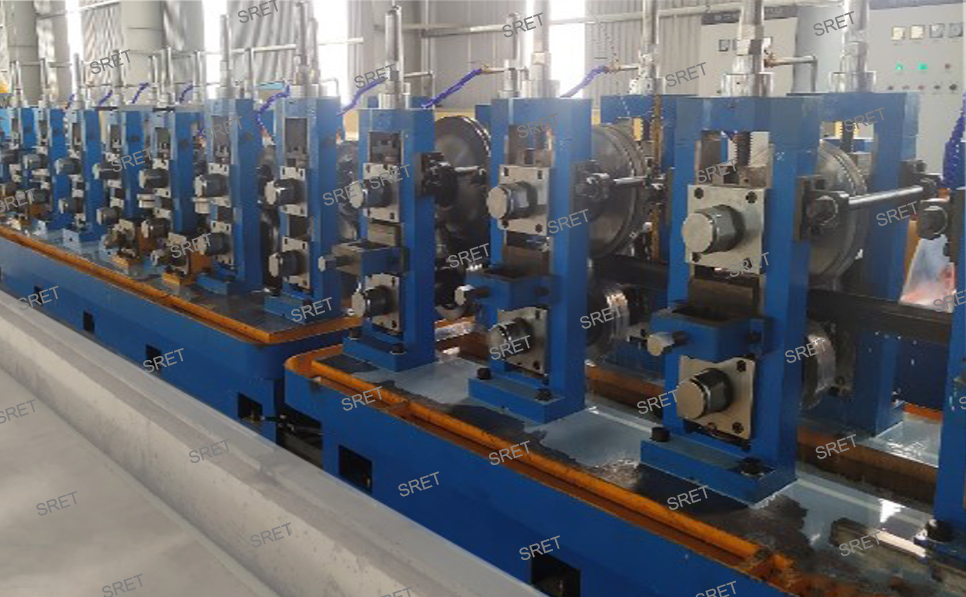
Forming Section

The forming section gradually bends the flat strip into a round shape using a series of rolls.

Key functions:

  • Progressive roll forming
  • Edge alignment for welding
  • Shape control for round, square, or rectangular tubes

Technical considerations:

  • Roll pass design
  • Shaft rigidity
  • Bearing precision
  • Strip edge presentation


High‑Frequency Welding

This is the core of the ERW process. The strip edges are heated by high‑frequency current and forged together under pressure.

Key functions:

  • Induction or contact welding
  • Precise heat input control
  • Stable seam formation

Technical considerations:

  • HF power rating
  • Impeder design
  • Weld squeeze pressure
  • Seam temperature monitoring


Sizing Section

The sizing section adjusts the tube to its final diameter and shape.

Key functions:

  • Diameter calibration
  • Shape correction
  • Wall thickness distribution control

Technical considerations:

  • Sizing roll design
  • Stand rigidity
  • Tolerance control


Straightening

Straightening ensures the tube meets linearity requirements.

Key functions:

  • Multi‑roll straightening
  • Correction of bow and twist
  • Surface protection

Technical considerations:

  • Roll angle adjustment
  • Pressure control
  • Tube support system


Flying Saw

The flying saw cuts the tube to the required length without stopping the line.

Key functions:

  • Synchronizes with tube speed
  • Cuts continuously
  • Supports various lengths

Technical considerations:

  • Cold saw vs friction saw
  • Servo control accuracy
  • Blade life


Comparison Table: ERW vs Other Tube Manufacturing Processes

Process Welding Method Speed Cost Applications
ERW Tube Mill HF resistance welding Very high Low Construction, automotive, furniture
Seamless Pipe No welding Medium High High‑pressure systems
Furnace Welded Furnace heating Low Medium Low‑precision applications
Laser Welded Laser beam welding Medium High Precision tubing

Case Study: How a 8‑Station ERW Line Improved Production Efficiency

A mid‑size manufacturing plant upgraded from a 7‑station line to a full 8‑station ERW tube mill. The result was a significant improvement in productivity and product quality.

Key outcomes:

  • Production speed increased by 35%
  • Weld seam stability improved due to better forming and cooling
  • Dimensional tolerance improved from ±0.30 mm to ±0.15 mm
  • Downtime reduced by 28% due to accumulator and automatic shear welder
  • Customer rejection rate dropped by 40%

This demonstrates how a complete 8‑station line enhances both efficiency and quality.


Client Testimonial

“We upgraded to a modern 8‑station ERW tube mill line and immediately saw improvements in weld consistency, dimensional accuracy, and overall productivity. The line runs smoothly, and our operators appreciate the stable forming and sizing sections. It has transformed our manufacturing capability.”
 

FAQs

What materials can an ERW tube mill process?

  • Carbon steel
  • Low‑alloy steel
  • Galvanized strip
  • Mild steel for furniture and automotive applications

What is the typical speed of an ERW tube mill line?

  • 30–120 m/min depending on tube size and equipment configuration

What shapes can be produced?

  • Round
  • Square
  • Rectangular
  • Custom profiles with special roll sets

How is weld quality controlled?

  • HF power monitoring
  • Seam temperature control
  • Eddy current testing
  • Visual inspection

What tube sizes can be produced?

  • Typically 10–165 mm OD
  • Wall thickness 0.5–6.0 mm

How long does a complete line last?

  • 10–20 years with proper maintenance


Best ERW Tube Mill Manufacturer in China: SRET Co., Ltd.

ERW tube mill line
ERW tube mill line

SRET Co., Ltd. is recognized as a leading manufacturer of ERW tube mill lines in China. With strong engineering capability and decades of experience in tube manufacturing equipment, the company provides complete solutions for forming, welding, sizing, and cutting systems.

Advantages include:

  • Full engineering support
  • High‑precision roll tooling
  • Stable HF welding systems
  • Customizable line configurations
  • Reliable after‑sales service

For buyers seeking a dependable ERW tube mill supplier, SRET Co., Ltd. is a strong choice.

 

Authoritative Sources

  1. U.S. Department of Energy – Welding Technology Overview
    https://www.energy.gov
  2. MIT Materials Science – Steel Manufacturing Fundamentals
    https://www.mit.edu
  3. ASM International – Welding and Metallurgy Resources
    https://www.asminternational.org
  4. NIST Manufacturing Engineering Resources
    https://www.nist.gov