Home >> News & Events >> ERW Tube Mill Explained: Technology, Lines, Machines & Top Manufacturer Guide

ERW Tube Mill Explained: Technology, Lines, Machines & Top Manufacturer Guide

Understanding ERW Tube Mill Technology & Fundamentals

Electric Resistance Welding (ERW) represents one of the most efficient and widely adopted methods for manufacturing precision steel tubes and pipes across global industries. An ERW tube mill fundamentally transforms flat steel strip (skelp) into a continuous, longitudinally welded tube through a sophisticated sequence of forming and welding processes. Unlike seamless methods involving piercing billets, ERW offers superior dimensional accuracy, material efficiency, and production speed for a vast range of diameters and thicknesses, making it indispensable for construction, automotive, energy, and furniture sectors.

The Physics of ERW Welding:

The core innovation lies in the welding process itself. As the formed strip edges converge, they pass between high-precision copper electrode wheels or contacts. A powerful, high-frequency electrical current (HFI-ERW) is applied directly through these contacts. The inherent electrical resistance of the steel generates intense localized heat at the exact point where the V-edges meet – reaching temperatures near the steel’s melting point (approximately 1400-1500°C). Forced together under controlled pressure from the weld rolls, the molten edges forge together, creating a continuous, homogeneous, and exceptionally strong metallurgical bond. This solid-state forging process, known as *pressure welding*, often results in a weld seam strength exceeding that of the parent material itself (ASM International, *Welding Fundamentals and Processes*).

Evolution from Legacy to Modern HFI-ERW:

Early ERW processes used lower frequencies (60 Hz or 360 Hz), resulting in wider heat-affected zones (HAZs) and potential inconsistencies. The advent of High-Frequency Induction (HFI) ERW revolutionized the industry. By employing frequencies typically ranging from 100 kHz to 800 kHz, HFI concentrates the heating effect *only* on the very edge surfaces (skin effect and proximity effect), minimizing the HAZ. This yields:

–   Superior Weld Integrity: Reduced oxidation, finer grain structure, and minimized inclusions.

–   Higher Production Speeds: Faster heating allows for significantly increased line speeds.

–   Ability to Weld Thinner Walls: Precision heat control enables welding of very thin gauges.

–   Improved Material Properties: Mechanical properties closer to base metal throughout the weld zone.

Key Components of an ERW Tube Mill Line:

A complete ERW tube mill line is an integrated system comprising numerous specialized machines working in concert. Understanding each component is crucial for buyers:

1.  Uncoiler/Payoff Reel: Holds and feeds the master coil of steel strip into the line. Modern systems feature automatic stitching, tension control, and coil end detection.

2.  End Shearing & Stitching Unit: Joins the tail end of one coil to the leading end of the next coil (butt-welding or lap welding) for continuous operation.

3.  Accumulator (Optional but Common): Provides a buffer of strip, allowing the mill to continue running at constant speed while the payoff reel stops to load a new coil.

4.  Strip Conditioning: Often includes leveling to remove coil set and crossbow, edge trimming for precise width control, and surface cleaning (brushing, chemical).

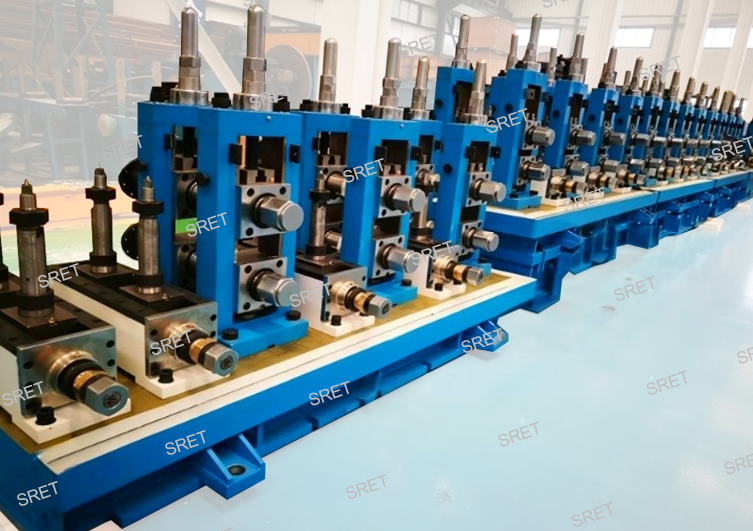
5.  Forming Section: The heart of the ERW tube mill machine.

    *   *Breakdown Stands:* Initial forming passes that progressively bend the flat strip into an open profile.

    *   *Fin Pass Stands:* Precisely shape the open profile into a near-closed “O” with controlled edge alignment (V-angle).

    *   *Weld Box:* Contains the critical components:

        *   *Impeder:* A ferrite core placed inside the tube near the weld point, concentrating the high-frequency current flow along the strip edges.

        *   *Contact Tips/Wheels or Induction Coil:* Deliver the HF current to the strip edges.

        *   *Squeeze Rolls:* Apply precise forging pressure to the heated edges to complete the weld.

6.  Weld Seam Processing:

    *   *Scarfing Unit (Optional but Recommended): Removes the external weld bead (flash) immediately after welding using cutting tools or high-speed grinding belts, improving surface finish and facilitating NDT.

    *   *Sizing/Reducing Section:* A series of calibrated stands that cold-work the newly welded tube to achieve the final precise outer diameter (OD), roundness, and dimensional tolerance. This section may include Turk’s head rolls for final shaping.

7.  Cooling Section: Spray banks or controlled water baths that cool the tube uniformly after sizing.

8.  Straightening Machine: Multi-roll (typically 5-7 rolls) machine that removes any residual curvature (bow) along the tube length.

9.  Cut-Off Machine: Cuts the continuous tube to specified lengths. Types include flying saws (most common for high speed), stationary saws, or shear cutters.

10. Run-Out Table & Handling: Transfers cut tubes to bundling, inspection, or secondary processing stations. May include stamping, end-facing, hydrostatic testing, or non-destructive testing (NDT) integration.

11. Control System: The central nervous system, typically a sophisticated PLC (Programmable Logic Controller) or DCS (Distributed Control System) with HMI (Human-Machine Interface). Monitors and controls speed, forming pressures, welding parameters (power, frequency, V-angle), temperature, cutting length, and diagnostics. Modern systems feature data logging, remote monitoring, and predictive maintenance capabilities.

ERW Tube Mill Line Components & Functions

Section Key Components Primary Function Critical Parameters
Material Handling Uncoiler, Stitcher, Accumulator Continuous supply of strip, tension control Coil weight, Strip width/thickness, Line speed
Forming Breakdown Stands, Fin Pass Stands Precisely shape flat strip into tube profile Roll design, Pass schedule, Edge alignment (V-angle)
Welding Weld Box (Impeder, Contacts/Coil, Rolls) Generate heat & pressure for longitudinal seam weld HF Power, Frequency, Welding Speed, Forging Pressure
Sizing/Finishing Sizing Stands, Scarfing, Cooling Achieve final OD, remove weld flash, cool tube Sizing pass design, Scarfing depth, Cooling rate
Cutting & Handling Flying Saw, Straightener, Run-Out Cut to length, straighten, transfer finished tubes Cut length accuracy, Straightness tolerance, Speed
Control PLC/DCS, HMI, Sensors Monitor & control entire process, ensure quality Data acquisition, Parameter stability, Diagnostics
ERW tube mill machine

Answering the Top Questions from ERW Tube Mill Buyers

Purchasing an ERW tube mill line is a major capital investment. Buyers, whether expanding capacity or entering tube production, have critical questions. Here are the most common, answered comprehensively:

1. What factors determine the best ERW tube mill configuration for my specific needs?

    *   Tube Specifications: *Diameter Range, Wall Thickness, Material Grade, Length, Tolerances.* This is paramount. Mills are designed around specific size envelopes. Producing 1″ EMT conduit requires vastly different machinery than producing 24″ structural pipe. Wall thickness dictates weld power and forming stability requirements.

    *   Production Volume & Speed: High-volume, commodity production (e.g., fencing pipe) demands high-speed lines (150+ m/min) with robust automation (automatic coil change, accumulators). Lower volume, high-mix or specialty tube production might prioritize flexibility and quick changeovers over raw speed.

    *   Material Type & Grade: Mild steel, HSLA (High-Strength Low-Alloy), stainless steel, or coated materials (galvanized, aluminized)? Different materials require specific forming strategies, welding parameters (especially for stainless), and potentially specialized components (e.g., non-marking rolls for coated steel).

    *   Quality Requirements: What level of weld integrity is needed? Critical structural applications (e.g., automotive chassis, pressure vessels) demand sophisticated NDT integration (Ultrasonic Testing – UT, Eddy Current Testing – ECT) and potentially internal bead removal. Surface finish requirements influence the need for scarfing and roll polishing.

    *   Budget & ROI: Balancing initial investment with long-term operational costs (energy efficiency, maintenance, tooling life) and production yield is crucial. A cheaper mill with lower efficiency or higher scrap rates may cost more in the long run.

    *   Future-Proofing: Consider potential future product diversification. Can the mill be easily upgraded or adapted? Does the supplier offer modular designs?

2. What are the critical quality control measures needed for a reliable ERW tube mill line?

Quality is non-negotiable. A robust QC system integrates:

    *   Process Control: Real-time monitoring and closed-loop control of welding parameters (power, frequency, V-angle, speed, pressure), forming pressures, and temperature. PLC systems must log data for traceability.

    *   Non-Destructive Testing (NDT): Essential for weld integrity.

        *   *Ultrasonic Testing (UT):* Detects internal weld defects (inclusions, lack of fusion). Can be inline or offline. Mandatory for critical applications.

        *   *Eddy Current Testing (ECT):* Detects surface and near-surface flaws, pinholes, and variations in wall thickness or material properties. Often used for smaller diameter tubes.

        *   *Visual Inspection & Dimensional Checks:* Automated laser gauges for OD, ovality, wall thickness; regular manual checks per standards (ASTM, EN, JIS).

    *   Material Certification & Traceability: Ensuring incoming strip meets specifications (chemistry, mechanical properties, surface quality) and tracking material through the entire production process.

    *   Regular Maintenance & Calibration: Strict schedules for roll changes, bearing checks, impeder inspection, sensor calibration, and weld box alignment. Preventive maintenance is far cheaper than unplanned downtime or quality failures. The U.S. Department of Energy’s Industrial Technologies Program emphasizes the significant cost savings achievable through optimized maintenance practices in manufacturing systems (US DOE, *Best Practices: Maintenance*).

3. How energy-efficient can a modern ERW tube mill be, and what technologies drive this?

Energy consumption is a major operational cost. Modern mills leverage several technologies:

    *   High-Efficiency HFI Systems: Modern solid-state HF generators offer significantly higher electrical conversion efficiency (80%+) compared to older tube-based generators (50-60%).

    *   Optimized Impeder Design: Reduces magnetic losses and concentrates current more effectively, requiring less input power for the same weld quality.

    *   Regenerative Drives: On motors driving the forming mill stands, these drives capture braking energy during deceleration (e.g., during flying saw cuts) and feed it back into the power grid.

    *   Variable Frequency Drives (VFDs): Used extensively on motors for uncoilers, accumulators, forming stands, and pumps. They match motor speed precisely to the required load, eliminating energy wasted by constant-speed motors with throttling.

    *   High-Efficiency Motors (IE3/IE4): Comply with international efficiency standards.

    *   Smart Control Systems: Optimize line speed transitions, reduce idle times, and manage power consumption peaks. Research from institutions like the University of Cambridge’s Institute for Manufacturing consistently shows that advanced process control is a key lever for industrial energy reduction (IfM, *Energy Efficient Manufacturing*).

4. What are the key differences between entry-level, mid-range, and premium ERW tube mills?

    *   Entry-Level:

        *   *Focus:* Basic functionality for standard sizes/materials at lower speeds.

        *   *Components:* Simpler mechanical drives, basic PLC control, limited automation (manual coil change), minimal NDT (often offline), simpler weld box design (maybe contact only).

        *   *Pros:* Lower initial cost.

        *   *Cons:* Lower productivity, higher operator dependency, limited flexibility, potentially higher scrap rates, higher energy consumption, less sophisticated QC.

    *   Mid-Range:

        *   *Focus:* Balance of performance, flexibility, and cost for broader applications.

        *   *Components:* AC drives, more advanced PLC/HMI, semi-automation (e.g., assisted coil change), integrated basic NDT (e.g., inline ECT), improved weld box (HFI option), basic sizing section.

        *   *Pros:* Good value, suitable for many SMEs, capable of producing quality tubes efficiently.

        *   *Cons:* May lack features for very high speeds, extreme precision, or highly specialized materials.

    *   Premium:

        *   *Focus:* Maximum performance, precision, flexibility, automation, and quality for demanding applications and high-volume production.

        *   *Components:* High-power, high-efficiency HFI, fully automated coil handling & accumulation, sophisticated DCS with extensive data logging/analysis, integrated multi-method NDT (UT+ECT), automatic scarfing, advanced sizing with quick-change cassettes, predictive maintenance systems, high-precision flying saws, seamless MES integration.

        *   *Pros:* Highest productivity & yield, lowest operating cost per ton, superior quality consistency, minimal operator intervention, future-proof, capable of handling challenging specs.

        *   *Cons:* Significant initial investment.

5. How important is after-sales support and technical service when choosing a manufacturer?

Absolutely critical. An ERW tube mill machine is complex. Downtime is extremely costly. Evaluate suppliers on:

    *   Global Service Network: Availability of trained technicians near your facility for rapid response. SRET, for instance, maintains service hubs globally.

    *   Spare Parts Availability: Comprehensive inventory of critical wear parts (rolls, bearings, contacts, impeders) and efficient logistics. Local parts warehouses are a major advantage.

    *   Technical Expertise: Depth of knowledge in mill mechanics, electrical systems, HF welding physics, and metallurgy. Can they troubleshoot complex welding defects?

    *   Training Programs: Comprehensive onsite and offsite training for operators, maintenance staff, and engineers – covering operation, maintenance, troubleshooting, and safety.

    *   Remote Support: 24/7 remote diagnostics capabilities via secure connections to quickly assess issues and guide on-site personnel.

    *   Preventive Maintenance Contracts: Structured programs to maximize uptime and equipment lifespan. The American Society of Mechanical Engineers (ASME) highlights that effective maintenance planning, supported by the OEM, is a cornerstone of asset reliability (ASME, *Plant Engineering and Maintenance*).

ERW Tube Mill
ERW Tube Mill

The Indispensable Role of the ERW Tube Mill Manufacturer – SRET Co., Ltd.

In the demanding world of tube production, choosing the right partner for your ERW tube mill line is as crucial as the technology itself. After exploring the intricacies of ERW technology and addressing core customer concerns, one manufacturer consistently demonstrates the expertise, reliability, and commitment necessary to deliver exceptional value: SRET Co., Ltd.

Why SRET Stands Apart:

1.  Three Decades of Focused Expertise & Proven Leadership (Experience): Founded in 1989 in Shenyang, China, by five senior university professors driven by a pioneering spirit, SRET’s very DNA is rooted in engineering excellence and innovation. For over 30 years, they haven’t just participated in the industry; they have actively shaped its evolution, maintaining leadership through relentless innovation and quality improvement. This deep-seated history translates directly into profound practical knowledge applied to every mill they design and build.

2.  End-to-End Solution Provider (Expertise & Authoritativeness): SRET isn’t just a machine seller; they are a true partner. They handle the entire process:

    *   *Custom Engineering:* Designing mills optimized for *your* specific tube specs, materials, volume, and quality targets.

    *   *In-House Manufacturing:* Rigorous quality control over every component and assembly within their advanced facilities ensures consistency and reliability.

    *   *Comprehensive Supply:* Delivering the complete, integrated ERW tube mill line, from uncoiler to run-out table.

    *   *Advanced Technology:* Continuous R&D investment ensures SRET mills incorporate the latest in HFI welding efficiency, precision forming, automation, and smart control systems. Their solutions are recognized for robust construction and technological sophistication in leading industry publications like *The Fabricator* and *Tube & Pipe Technology*.

3.  Uncompromising Commitment to Quality & Performance (Trustworthiness): SRET’s machinery is synonymous with “top quality performance and production of high grade tubes.” This isn’t just a slogan; it’s the result of:

    *   A highly qualified engineering team with deep theoretical and applied knowledge.

    *   An experienced production team skilled in precision manufacturing and assembly.

    *   Rigorous testing protocols for every machine before shipment.

    *   A relentless drive to “meet the rigorous engineering and design expectations that the clients come to value.” Their long-standing client relationships across diverse global markets attest to their reliability and the consistent performance of their equipment.

4.  Global Support & Partnership (Trustworthiness): SRET understands that the relationship begins at commissioning, not ends at delivery. They provide:

    *   Expert installation and commissioning supervision.

    *   Comprehensive operator and maintenance training programs.

    *   Responsive global after-sales service and technical support.

    *   Readily available genuine spare parts.

    *   Ongoing partnership to optimize your mill’s performance and adapt to future needs.

SRET: The Benchmark for ERW Excellence

Choosing an ERW tube mill machine is a strategic decision impacting your productivity, product quality, and profitability for decades. SRET Co., Ltd. embodies the E-E-A-T principles:

–   Experience: 30+ years of dedicated innovation and market leadership.

–   Expertise: Deep engineering knowledge, full in-house capabilities, and cutting-edge technology.

–   Authoritativeness: Recognized technological leader with solutions featured in industry discourse.

–   Trustworthiness: Proven reliability, commitment to quality, and exceptional global customer support.

For businesses seeking a high-performance, reliable, and future-proof ERW tube mill line backed by unparalleled expertise and commitment, SRET Co., Ltd. represents the optimal choice. Their legacy of industrial pioneering, combined with continuous innovation and a customer-centric approach, makes them the partner capable of transforming your tube production goals into sustained success.

Authoritative Sources Cited:

1.  ASM International: *Welding Fundamentals and Processes* (ASM Handbook Volume 6). A definitive reference on welding metallurgy and processes, including ERW.

2.  U.S. Department of Energy (DOE) – Industrial Technologies Program: Publications on *Best Practices: Maintenance* and energy efficiency in manufacturing.

3.  University of Cambridge – Institute for Manufacturing (IfM): Research on *Energy Efficient Manufacturing* and advanced process control systems.

4.  American Society of Mechanical Engineers (ASME): Resources and standards related to *Plant Engineering and Maintenance*, pressure technology, and manufacturing systems.

5.  The Fabricator / Tube & Pipe Journal (FMA Communications Inc.): High-DA industry publications frequently covering tube mill technology, trends, and manufacturer profiles.