A double-drum rotatable uncoiler provides separate positions for unwinding the working coil and loading the next coil. In an ERW tube mill line, this arrangement allows part of the coil-change preparation to take place before the current coil is consumed.
The main difference from a single-drum arrangement is the timing of loading. Instead of waiting for the working support to become available, the next coil can be placed on the idle drum while production continues from the active drum.
This article explains how the two positions alternate, which operations can overlap and why the arrangement reduces loading work during changeover without eliminating the complete changeover sequence.
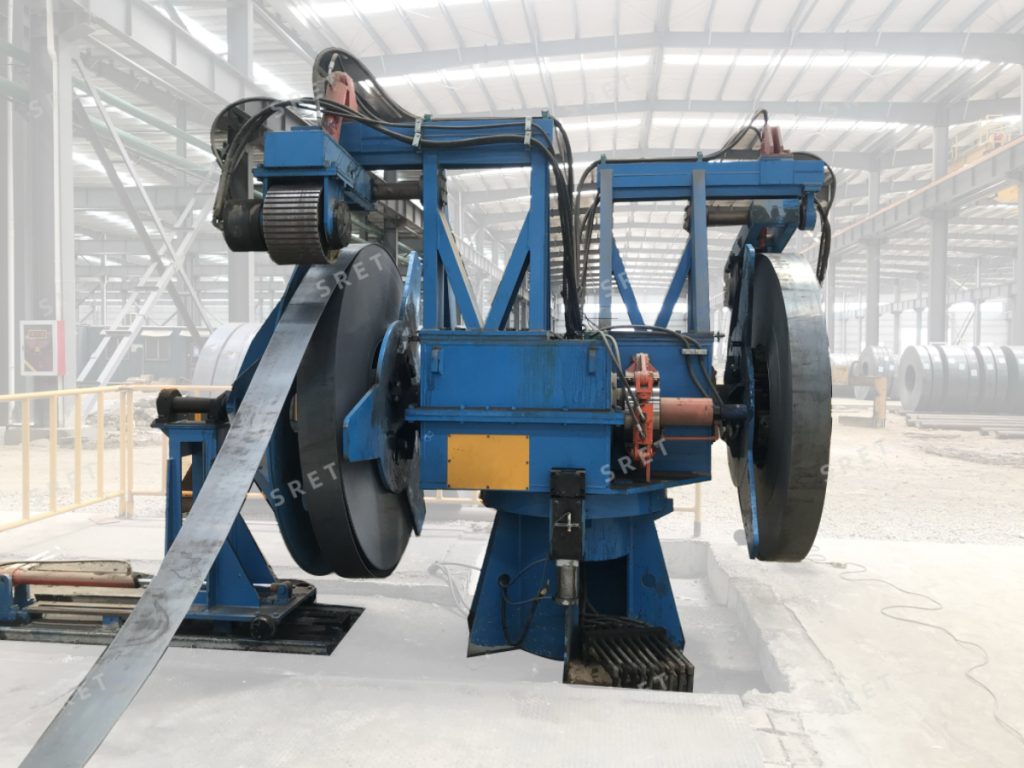
During normal operation, one drum supports the coil being unwound. The other drum provides a loading position for the next coil.
The rotating assembly exchanges these positions after the working coil is consumed. The indexing angle, direction and movement sequence depend on the machine design.
The drum’s unwinding rotation and the assembly’s indexing movement are different motions. One releases strip from the coil; the other transfers a prepared coil into the working position.
The next coil can be moved into the loading area and mounted on the idle drum using the specified loading equipment. The coil is then supported and secured according to the machine’s operating procedure.
The extent of advance preparation depends on the installed equipment and the permitted operating sequence. It should not be assumed that every coil-head handling operation can be completed at the idle position.
For an ERW Tube Mill, the benefit is that coil transport and loading can overlap with the consumption of the current coil. This reduces the work remaining when the next coil is required.
The exact sequence, including which actions are manual or automatic, must follow the selected machine’s operating instructions.
The second drum provides an advance loading position. It does not remove the need to index the assembly, introduce the new strip head or join successive coils.
In a tube mill line, the uncoiler, flattener, shear end welder and accumulator perform separate but coordinated tasks. The uncoiler prepares the next coil for feeding; the joining equipment connects the strip ends; the accumulator supplies stored strip during the inlet interruption.
Whether a tube mill machine continues running throughout this period depends on the available strip reserve and the total time required for the changeover and joining sequence.
The double-drum arrangement therefore reduces the loading work required during changeover. It should not be described as independently guaranteeing uninterrupted production.
The drum supports the coil through its bore. Where an expanding drum is used, its gripping mechanism secures the coil internally before unwinding.
The permitted coil weight, bore range and strip dimensions are equipment-specific and should be checked against the selected model.
A hold-down roll restrains the outer wraps during the specified coil-handling operations. Block rolls or other retaining devices, where fitted, help control coil position according to the machine design.
These devices support controlled handling, but they do not eliminate the need for guarding, safe operating procedures and checks before loading or indexing.
The brake controls coil rotation and helps limit overrun when strip demand decreases or feeding stops. Hydraulic or pneumatic actuation may be used according to the supplied configuration.
Controlled braking helps prevent continued coil rotation from loosening the outer wraps. It should not be described as a substitute for strip guidance or flattening.
Forward and reverse rotation can provide upper or lower unwinding where the equipment is designed for those arrangements. The required mode must also be compatible with the hold-down roll, peeler, guides and downstream feeding path.
Unwinding releases the strip from the coil; it does not necessarily make the strip flat. A coil-head straightener, where fitted, assists leading-end preparation, while the flattener performs the designated coil-end flattening operation.
For an ERW tube mill machine installation, these devices must be arranged to deliver the strip into the entry section in the required direction and orientation.
The hydraulic and electrical systems coordinate the installed loading, gripping, restraint, indexing and unwinding functions. PLC, HMI and drive controls may be provided according to the automation level.
The presence of these controls does not by itself mean that every operation is automatic. Coil preparation, securing checks and permission to index may still involve the operator.
The practical question is which tasks the machine performs, which tasks remain manual and which conditions must be satisfied before each movement is allowed.
A single-drum arrangement uses one support position for loading and unwinding. A double-drum rotatable arrangement provides an additional position so that the next coil can be loaded while the current coil is running.
It reduces loading work during changeover by preparing the next coil in advance. Indexing, coil-head feeding and strip-end joining still take time. Continued downstream operation depends on the complete entry sequence and available accumulator storage.
No. Drum rotation releases strip from the coil. Assembly rotation exchanges the loading and unwinding positions.
In the alternating arrangement described here, one drum supplies strip while the other provides the preparation position for the next coil. They perform different tasks during the cycle.
These modes can be available where the rotation and coil-head handling arrangements support them. The permitted configuration should be confirmed for the supplied machine.
No. Its main functions are coil support and unwinding. Coil-head preparation and downstream flattening are separate operations carried out by the corresponding equipment.
For available support structures, coil capacities, strip dimensions and control configurations, see the uncoiler product page.