The central spiral roll track guides strip out of the storage area of a horizontal spiral accumulator. Working with the outlet de-twist guide stand, it forms part of the strip exit path toward the forming mill.
In an ERW tube mill line, these components should be distinguished from the equipment that feeds strip into the accumulator and builds the stored reserve. Passive exit rolls guide the moving strip, but they do not make the complete accumulator a drive-free system.
This article explains the role of the central exit track, the outlet guide stand and the relationship between strip storage and continuous mill feeding.
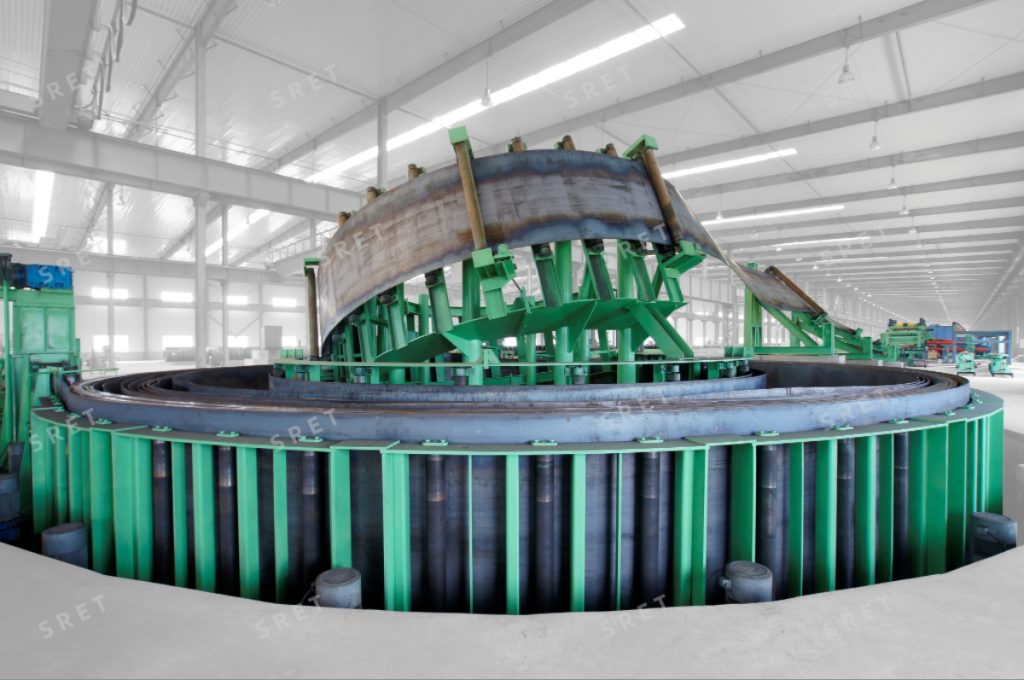
A horizontal spiral accumulator stores strip between the coil-end joining equipment and the forming mill. The stored reserve allows the downstream mill to continue receiving material while the upstream entry section completes the required coil-end preparation and joining operations.
In the arrangement described in SRET’s product information, strip enters through the inlet equipment and accumulates in loops. The forming mill pulls strip from the inner portion of the stored material through the central exit path.
The central spiral roll track therefore performs an exit-guidance function. It should not be described as the complete storage area or as the only component responsible for continuous feeding.
The component information supplied for this article identifies the following arrangement:
| Component | Roll Arrangement | Listed Roll Material |
|---|---|---|
| Central spiral roll track | Passive rolls | 45# steel |
| Outlet de-twist guide stand | Passive rolls | 45# steel |
These details describe the two listed components, not every roll or drive in the complete accumulator. Model-specific construction should be checked against the equipment drawing and technical specification.
The central track supports and guides the strip as it leaves the accumulator’s inner exit region. In the described arrangement, the downstream forming mill provides the pulling action that draws strip through this path.
The passive rolls rotate with strip movement rather than using individual drive motors. Their role is to provide the specified guidance through the exit geometry.
After leaving the central track, the strip passes through the outlet de-twist guide stand. This arrangement guides the strip toward the horizontal orientation required by the downstream entry path.
Its function should be described as strip reorientation and guidance. It should not be presented as a general-purpose straightener or as a guarantee that every strip-shape or alignment problem will be removed.
The absence of individual motors on the exit rolls does not mean that the complete accumulator operates without powered equipment.
SRET’s published accumulator description includes inlet pinching rolls and powered accumulation rollers, while the forming mill pulls strip through the central outlet. These functions operate within the same material-handling system.
When reviewing a tube mill line proposal, distinguish between:
This distinction is more useful than describing the entire machine simply as powered or passive.
The storage cycle depends on the relationship between the strip entering and leaving the accumulator. Exact machine sequences vary, but the following distinction is important.
When the inlet supplies strip faster than the outlet delivers it to the mill, stored strip length increases. The filling sequence must remain within the permitted storage capacity and operating limits.
When inlet and outlet strip speeds are equal, the stored length remains approximately constant, apart from transitional effects within the operating sequence.
When the inlet supplies strip more slowly than the outlet, stored length decreases. If inlet feeding stops during coil-end preparation and joining, the downstream mill continues drawing from the available reserve.
After the joint is completed and entry feeding resumes, the system can rebuild storage according to the specified control sequence.
Continuous feeding depends on having enough usable strip to cover the period when the entry section cannot supply material at the required rate.
For an ERW tube mill machine, the review should therefore consider the usable storage length, mill speed, expected joining time and operating margin. Reaching the accumulator’s full-storage condition does not automatically prove that every changeover can be completed without stopping the mill.
The central exit track and outlet guide stand support this process by guiding the withdrawn strip. They do not create additional storage capacity or remove the need to complete the upstream work within the available supply time.
The supplied component information lists 45# steel for the passive rolls in both units. This is a material designation, not a complete statement of roll performance.
If surface quality or wear performance is important to the application, ask the supplier to confirm the applicable heat treatment, hardness, surface finish and inspection requirements.
Do not assume that the material name alone guarantees a particular service life or eliminates the possibility of strip marking.
When specifying the accumulator exit arrangement for a tube mill machine, confirm:
For an overview of the complete equipment, see SRET’s horizontal spiral strip accumulator product page.
No. In the arrangement discussed here, the central track guides strip out of the storage area. It should be distinguished from the complete accumulation system.
No. Passive exit guidance can operate alongside powered inlet and storage equipment. The drive arrangement should be reviewed for the complete accumulator.
It guides the exiting strip toward the orientation required by the downstream path. Its function should not be confused with general strip flattening or straightening.
Under steady conditions, equal strip speeds maintain the reserve approximately constant. The reserve decreases when the outlet withdraws strip faster than the inlet supplies it.
It supports continued feeding during the specified interruption at the entry section. Actual operation depends on the available reserve, mill speed and time required to complete the upstream work.