Pipe end finishing is not complete when a machine has cut a flat end or chamfer. The result should be confirmed against the agreed product requirements before the tube moves to the next operation.
For an ERW tube mill machine installation, this review is especially useful before hydrostatic testing. End condition, burr removal and handling arrangements affect how the project defines readiness for the next inspection step.
This guide focuses on end-quality planning and handover, not on equipment configuration. For equipment descriptions, operating sequence and customization information, see SRET’s end facing machine.
“Flat head and chamfer” describes a machining operation, but it does not establish the finished result by itself.
The project should record the product standard or customer specification used to define the end condition. This should include the required end profile, chamfer arrangement, burr condition and inspection method.
| Requirement | Information to Confirm |
| Tube specification | Diameter or section dimensions, wall thickness and length |
| End profile | Required flat end condition and tolerance |
| Chamfer | Required form and dimensional requirement |
| Burr condition | Whether inside and outside burr limits apply |
| Inspection | How measurement or visual acceptance is performed |
| Standard | Applicable API, AWWA or other agreed requirement |
SRET describes the equipment as suitable for applications intended to meet internationally recognized standards, including API and AWWA. Confirm the specific standard, grade and tube size during project review rather than assuming that every product condition is covered by that general statement.
A machine able to perform end preparation does not by itself prove that every finished tube meets a particular acceptance requirement.
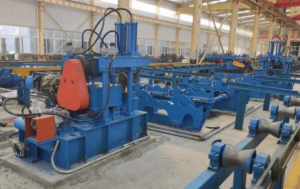
Acceptance should be based on defined measurements and agreed inspection records obtained from representative tubes made under the planned operating conditions.
Terms such as “clean,” “accurate” or “burr-free” are not measurable acceptance terms unless they are supported by a defined criterion.
The product page states that SRET provides custom-made end facing machines for different lengths, thicknesses and diameter ranges, with various models available.
For planning purposes, prepare a product-range sheet containing:
A general description such as “medium to large tubes” or “high-speed production” does not let the supplier review suitability. If a specification falls outside the quoted range, mark it as requiring engineering confirmation.
Before the end facing machine receives tubes, the project should confirm the incoming tube condition.
The product page describes positioning and transfer elements, but not a complete tube-condition specification. Project documents should define the required incoming condition rather than assume the machine will compensate for every upstream variation.
Where the end facing machine follows other finishing equipment, confirm which equipment establishes straightness and which establishes final end condition.
The product page identifies HMI-based setting of servo parameters and timing actions, with preset configurations available for multiple specifications.
For acceptance planning, confirm the following:
Avoid saying that “no adjustment is needed” when specifications change. Selecting a preset does not remove the agreed product-change checks. If the supplied configuration includes mechanical changeover steps, include them in the operating instructions.
End finishing and hydrostatic testing are separate operations with different purposes.
SRET’s tester page describes testing by filling a pipe with liquid and holding pressure for a specified time. It also notes that tester design depends on tube end condition, outside diameter variation, length, grade and pressure requirement.
| Handover Item | Why It Matters |
| End condition | Defines the product presented to the test equipment |
| Tube length | Affects handling and positioning |
| Outside diameter variation | Included in tester design considerations |
| Grade and pressure requirement | Determines project test requirements |
| Product identification | Prevents mixing test parameters between batches |
| Rejected tubes | Defines removal from the standard transfer path |
A satisfactory end finish should not be presented as a guarantee that a tube will pass hydrostatic testing. That outcome depends on the tube, the test requirement and the test system.
The tube leaves the end facing machine through a transfer arrangement defined by the supplied layout. The project should state what happens after the end operation is complete, whether the tube moves to a conveyor, a test line, a packaging path or another area.
These are interface questions. Write them into the technical agreement instead of inferring them from a general statement that the line is “continuous.”
The final acceptance document should link the finished product with the settings used.
| Record Item | Include |
| Product | Specification, size and length |
| Setup | Parameter set identification |
| Equipment condition | Cutter and tooling state, as required by procedure |
| Inspection | Measured end condition and burr check |
| Approval | Who accepted the first-off tube |
| Handover | Destination and relevant test requirement |
| Exceptions | Any limitation, deviation or follow-up |
This record shows which product, settings and inspection method were actually approved.
A useful end-finishing plan starts with the finished-end requirement, then confirms how it will be inspected and handed over.
For an ERW tube mill line, this makes the end facing stage easier to coordinate with hydrostatic testing and downstream handling. The equipment page then provides product-configuration information, while the project specification records the requirements each tube must satisfy.