A coil change interrupts strip feeding at the entry section, but it does not necessarily require the forming mill to stop. Stored strip can provide a temporary supply while the outgoing coil tail and incoming coil head are prepared and joined.
The important operating question is not simply whether an accumulator is installed. It is whether the available strip reserve, joining sequence and return to normal feeding are coordinated for the intended production conditions.
This article examines what to review before, during and after a coil change. For equipment structures, model specifications and published operating modes, see SRET’s horizontal spiral accumulator product page.
The accumulator’s role can be understood through three operating stages:
| Stage | Entry-Side Condition | Main Operating Concern |
| Before the interruption | Strip can still be fed into storage | Establish the required usable reserve |
| During end preparation and joining | Normal entry feeding is interrupted | Supply the mill from stored strip |
| After joining | Entry feeding becomes available again | Restore the reserve while supporting production |
Reviewing these stages separately helps distinguish having strip in storage from having enough usable reserve for the complete operation.
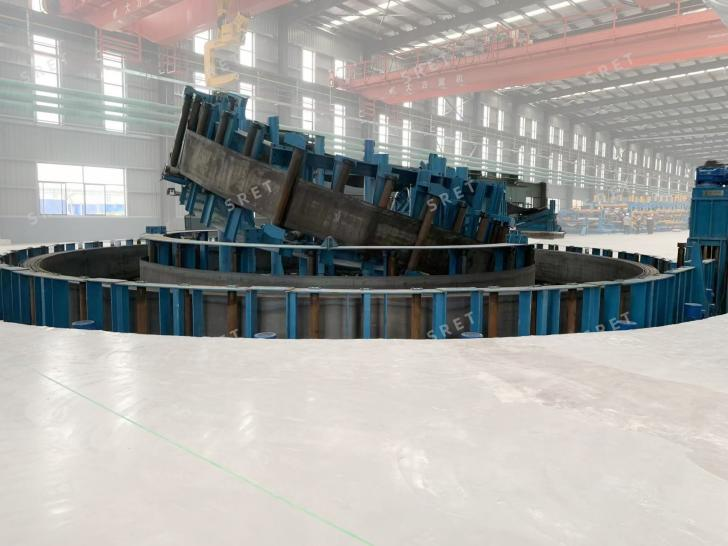
Preparation should begin before the outgoing coil is exhausted.
The review should establish how operators identify the storage condition and how the required reserve is reached before entry feeding stops. Empty and full detection can indicate defined storage limits, but the control documentation should explain what each signal means and how the line responds.
Useful questions include:
The operating plan should use the reserve available under the actual production conditions, rather than assume that the accumulator is always full when a coil ends.
The entry-side interruption includes more than welding travel time.
Depending on the supplied arrangement, it can include presenting the incoming strip, positioning both ends, trimming, preparing the joint, clamping, welding, checking the connection and resetting the equipment.
When reviewing the available operating window, confirm which tasks are included in the quoted joining time. Identify any additional handling or inspection separately.
A useful timing review follows the actual sequence:
This prevents a short welding-time figure from being mistaken for the duration of the entire coil-change operation.
Completing the joint does not immediately restore the strip reserve. If the forming mill continues running, strip is still leaving the accumulator while entry feeding resumes.
The relationship between inlet and outlet speed determines the direction of the storage change:
| Operating Condition | Effect on Stored Strip |
| Inlet speed exceeds outlet speed | Storage increases |
| Inlet speed equals outlet speed | Storage remains approximately unchanged |
| Inlet speed is below outlet speed | Storage decreases |
These relationships assume that inlet and outlet speeds refer to strip travel and are measured consistently.
The important distinction is between resuming feeding and replenishing storage. Matching the mill’s strip consumption can maintain the remaining reserve, but it does not recover the strip used during joining.
The control proposal should therefore explain how the system transitions from restarting entry feed to restoring the required storage condition.
The equipment description includes stop, high-speed fill-in, synchronized-speed and jog modes. Their practical use should be defined in the machine’s operating instructions.
For example, the review should identify:
A list of available modes is not a complete operating procedure. Operators need to understand the conditions for entering and leaving each mode, together with the applicable machine-safety requirements.
Storage indication is one part of the review. The strip must also transfer through the inlet guides, storage area, central exit track and outlet guides under the agreed operating conditions.
During commissioning, the acceptance procedure should define how strip tracking and surface condition will be checked. It should also identify how the permitted strip specifications and operating modes will be demonstrated.
Avoid treating phrases such as “smooth pulling” or “automatic operation” as acceptance criteria on their own. The proposal should translate these descriptions into checks appropriate to the supplied equipment.
Remote monitoring, where included, can provide access to selected status information. It does not replace physical inspection or the approved response to a machine alarm.
A single successful changeover does not explain whether the operating sequence is suitable for repeated production.
The review should also consider whether storage is restored before the next interruption. This is especially relevant when the production schedule involves frequent coil changes or additional entry-side tasks.
Record the sequence using consistent start and finish points. Where delays occur, separate them by cause—for example, material presentation, end preparation, welding, inspection or recovery of entry feeding.
This provides a clearer basis for improving the process than assigning every delay to the accumulator.
Before commissioning or revising the procedure, confirm:
These points help connect individual machine functions into a workable coil-change procedure.
Continuous production during a coil change depends on the available reserve and the coordinated operation of the entry equipment, joining machine and forming mill.
This article addresses that operating relationship rather than defining the capacity of a particular model. For strip-width and thickness ranges, published storage capacities and filling speeds, refer to SRET’s accumulator specifications and model information.