The SRET XFJ219 is a milling-type orbital cold saw cut-off for online tube cutting in an ERW tube mill line. It cuts moving tube into preset lengths using a traveling carriage that synchronizes with the production line during the cutting cycle.
The XFJ219 provides a cutting option for round and square tube applications within its specified range. Selecting the configuration requires a review of the tube dimensions, wall thickness, material grade, cut length and production speed, together with the interfaces of the surrounding equipment.
The product-page specification lists the following operating range for the XFJ219:
| Item | XFJ219 Specification |
|---|---|
| Round tube outside diameter | 114–219 mm |
| Square tube size | 60–200 mm |
| Wall thickness | 3.5–12.0 mm |
| Cut length | 4.0–18.0 m |
| Listed cutting-length tolerance | Within ±2 mm |
| Maximum listed speed | 60 m/min |
These figures define the published model range, rather than confirming that every combination of tube size, wall thickness and cut length can be processed at the maximum listed speed. The proposed operating conditions should be confirmed for the intended application.
For rectangular tubes, provide both side dimensions and the wall thickness for a separate application review, as the XFJ219 parameter table does not list a dedicated rectangular-tube range.
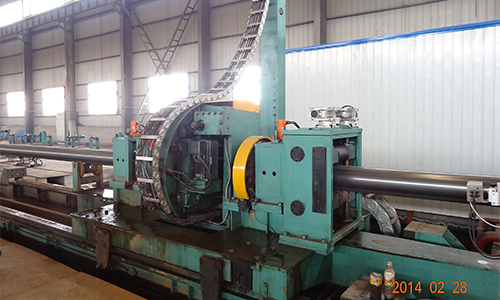
The orbital milling-type cold saw cut-off uses a coordinated sequence of measurement, carriage tracking, clamping, cutting and return.
As the tube approaches the cut-off section, a measuring roll and encoder provide speed and length signals to the motion control system. This information allows the system to coordinate the cutting cycle with the moving tube and the preset cut length.
The traveling carriage accelerates to match the tube’s running speed. During cutting, it tracks the moving tube so that the cutting equipment can operate while traveling with the product.
This synchronized movement is a central feature of the online cutting process.
At the required position, the fixtures clamp the tube and the sawing system performs the cut. The orbital milling equipment range includes polar-coordinate and rectangular-coordinate profiling arrangements, which use different blade-feeding paths.
The feeding arrangement, blade configuration and clamping method should be identified in the technical proposal for the supplied XFJ219.
After cutting, the clamps release the tube. The carriage and cutting mechanisms return to their starting positions to prepare for the next cycle. The motion control system coordinates these actions as part of the automatic operating sequence.
A suitable cut-off configuration must match both the tube specification and the required production duty. Tube dimensions alone do not fully define the application.
The equipment review should cover the material grade, wall thickness, required cut length and target production speed. It should also establish the saw blade arrangement, cutting parameters and clamping requirements.
The wider equipment range includes different profiling systems and cutting modes. Their availability should be confirmed for the proposed XFJ219 configuration rather than assumed from the general series description.
Cut quality and length accuracy should also be addressed in the proposal, with agreed inspection methods and acceptance conditions for the intended products.
The cut-off section must work with the upstream sizing section and downstream tube-handling equipment. For a new line or an existing-line installation, review the tube travel direction, working height, installation space and control interfaces.
To support equipment selection, provide:
These details help define a project-specific configuration rather than relying only on the model’s published maximum values.
SRET supplies ERW tube mill lines and supporting equipment, including orbital milling-type cold saw cut-offs. For an XFJ219 inquiry, provide your tube specifications, required cut lengths, production speed and line-layout information. These details form the basis for reviewing the cutting configuration and its integration into the complete production line.