In an ERW tube mill line, the uncoiler supports a steel coil and unwinds the strip for the flattener or the next entry-section process. Also called a decoiler, it provides controlled strip delivery while keeping the coil supported during rotation.
Single-drum, double-drum rotatable and face-to-face conehead designs perform this basic function through different coil-support and loading arrangements. Understanding these differences helps explain how each design handles coil preparation, unwinding and changeover.
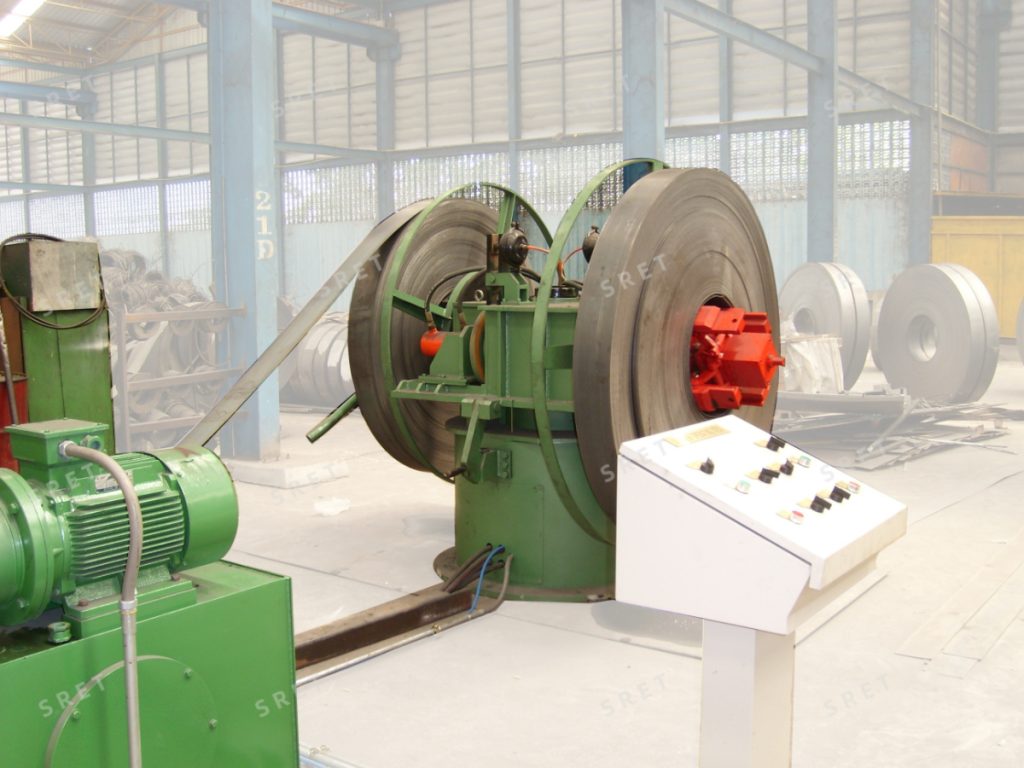
The uncoiler receives a coil from the loading equipment, holds it in the working position and allows the strip to be drawn or fed into the line. Coil-head handling devices, where fitted, help open and guide the leading end toward the next machine.
Uncoiling should be distinguished from flattening and coil joining. The uncoiler opens the coil; the flattener prepares the coil ends; the shear end welder connects successive coils. A strip accumulator provides stored strip while coil changeover and joining take place.
The uncoiler therefore forms part of the entry system, but does not by itself turn separate coils into a continuously connected strip.
The exact sequence depends on the support structure and installed auxiliary equipment. A typical loading and coil-head preparation cycle includes the following stages:
A single-drum uncoiler supports the coil on one drum, commonly in a cantilever arrangement. The coil is loaded onto the drum, secured by the internal gripping mechanism and prepared for unwinding.
A hold-down roll helps restrain the outer wraps during coil-head opening. Depending on the configuration, a peeler and straightener assist with guiding the leading end into the entry section.
The drum may be actively driven or passively rotated by the downstream strip pull. The loading trolley, drum expansion mechanism, hold-down roll and braking system each perform a separate task; their actuators and control arrangements depend on the equipment configuration.
Because loading and unwinding use the same drum, the next coil must be loaded after the previous coil has been removed or consumed. The overall changeover sequence also depends on coil preparation, strip-end joining and available accumulator storage.
A double-drum rotatable uncoiler provides two coil-support positions on a rotating assembly. One drum occupies the unwinding position while the other can be used to prepare the next coil.
After the working coil is consumed, the assembly indexes to bring the prepared coil into the unwinding position. The required indexing movement and preparation sequence depend on the machine design.
The main operational difference is the overlap between unwinding and loading. Preparing the next coil while the current coil is running reduces the amount of loading work required during changeover.
This does not mean that all changeover time is eliminated. Indexing, coil-head feeding and strip-end joining still need to be completed. Continued downstream production depends on the coordinated entry sequence and sufficient strip storage in the accumulator.
A face-to-face conehead uncoiler uses opposing support heads that engage the coil bore from both sides. This differs from the single-sided support arrangement of a cantilever drum.
The support heads move into position through the machine’s hydraulic or motor-driven mechanism. Their engagement with the coil bore establishes the support required for unwinding.
This arrangement is used for heavy-coil applications where bilateral support is required. Its suitability must be assessed against the actual coil weight, width, bore dimensions and equipment ratings, rather than strip thickness alone.
Depending on the configuration, unwinding can be active or passive. Supporting rolls and braking equipment assist coil handling and controlled rotation where provided.
The distinction between active and passive unwinding concerns how the coil rotates:
These arrangements should not be confused with coil-head opening. A driven hold-down roll may assist with opening and feeding the leading end, but its presence alone does not define the drive arrangement used throughout unwinding.
The braking system helps control coil rotation and limits overrun when strip feeding slows or stops. Hydraulic or pneumatic actuation can be used, depending on the design.
Controlled braking helps prevent the coil from continuing to rotate and loosening its outer wraps after the downstream demand decreases. It works together with the drive, hold-down devices and entry-section controls.
Braking should not be described as a substitute for strip centering or flattening. Those functions are carried out by the corresponding guide and processing equipment.
The uncoiler supplies strip to the entry section, where coil ends are prepared and joined before the material continues toward forming and welding.
The equipment performs distinct but coordinated functions:
This division of functions explains why an uncoiler’s loading arrangement alone cannot determine whether the entire tube mill line runs without interruption.
An uncoiler supports a steel coil, opens its leading end and allows the strip to be fed into the next process. The coil is supported by a drum or opposing heads, and rotation can be active or passive depending on the design.
It allows the next coil to be loaded at a separate position while the current coil is unwinding. Once the current coil is consumed, the rotating assembly brings the prepared coil into the working position. This reduces loading work during changeover, but does not eliminate indexing and strip-joining operations.
A face-to-face conehead arrangement supports the coil through opposing heads engaging its bore from both sides. A cantilever single drum supports the coil from one side. The required structure depends on the coil specifications and support requirements.
Upper or lower unwinding can be provided where the machine design supports the required rotation direction and coil-head handling arrangement. The available mode should be confirmed for the selected configuration rather than assumed for every model.
No. Its main role is coil support and unwinding. A coil-head straightener, where fitted, assists leading-end preparation, while the downstream flattener performs the designated coil-end flattening operation.
For available models, coil weight limits, strip dimensions and support configurations, see the uncoiler product page.