The cold saw flying cutoff is an online cutting device used in ERW tube mill lines to cut finished tubes to fixed lengths while the line is running. Using a computer-based motion control system, the machine synchronizes its travelling carriage with the tube mill line speed and performs precise flying cuts. The result is accurate cut lengths with smooth, burr‑free surfaces for round, square and rectangular steel tubes in continuous production.
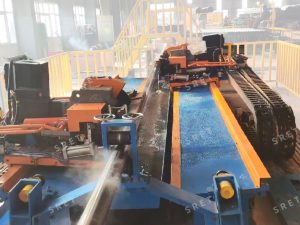
The cold saw flying cutoff consists of mechanical, hydraulic and electrical systems:
When finished tubes exit the sizing mill and pass through the speed measuring roll, a photoelectric encoder converts the tube running speed and length into pulse signals and transmits them to the motion control system.
Driven by an AC servo motor (or DC motor in some designs), reducer and rack‑and‑pinion mechanism, the travelling carriage accelerates rapidly to track the moving tube and maintains synchronization with the tube mill line speed. Once the preset cutting length is reached, hydraulic or pneumatic clamping fixtures on the carriage firmly hold the running tube.
The saw blade, driven by a spindle servo motor and a customized reducer, is fed via a ball screw and linear guide transmission. It cuts the tube at a designed inclined angle to optimize chip formation and blade life. After the cut is completed, the clamps release, and the carriage quickly decelerates and returns automatically to the standby position for the next cycle. The entire process realizes fully automated online cutting in an ERW tube mill line.
The cold saw flying cutoff is designed for round, square and rectangular welded tubes. It can be adapted to a range of conventional tube specifications used in ERW tube mill lines.
With an optimized mechanical structure and saw feeding path, together with calculated cutting parameters, the equipment is designed to produce smooth, burr‑free cutting surfaces with relatively low noise. In most cases, no secondary trimming is required.
The machine supports two mainstream saw blade types: TCT (tungsten carbide tipped) and HSS (high‑speed steel). Blade diameter and tooth configuration are selected according to tube size, wall thickness and material.
Yes. After the cutting parameters are programmed, the machine automatically performs carriage acceleration, synchronous tracking, clamping, cutting and return to the original position, enabling continuous unmanned operation in a tube mill line.
Many configurations are equipped with a remote diagnostic module that allows real‑time equipment status to be monitored from off‑site locations. This can support remote fault diagnosis and help reduce maintenance response time.
In a complete ERW tube mill line, the cold saw flying cutoff is typically installed after the sizing mill and before downstream handling and finishing equipment. For more details on cold saw flying cutoff models and technical specifications, see our cold saw flying cutoff product page.