In an ERW tube mill line, the uncoiler (decoiler) is installed at the entry section to receive, support and unwind steel coils, providing a stable strip feed for the flattener and downstream processes. It is one of the key pieces of equipment that prepares the steel strip before it enters the forming and welding sections of the tube mill machine.
Uncoilers are commonly used with carbon steel, alloy steel and stainless steel coils, including grades such as Q235, Q275, Q355 and Q345. Typical coil inner diameters are 508 mm, 610 mm and 760 mm. The uncoiler can be arranged for right‑to‑left or left‑to‑right feeding, and different structural types are available to match various production capacities and process requirements in a tube mill line.
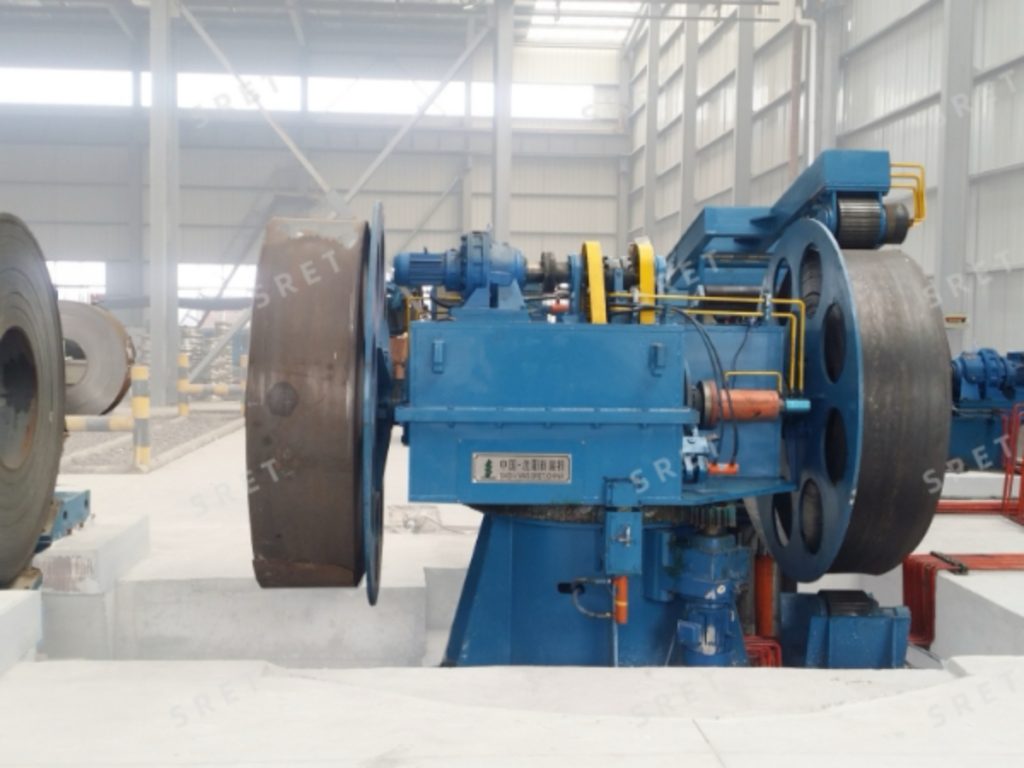
The main function of the uncoiler is to receive steel coils transported by a loading trolley, support the coils, and open them to feed the strip to the flattener or the next process. A typical operating sequence in an ERW tube mill line is as follows:
The drum or conehead can be designed to rotate actively (powered) or passively, depending on the required tension control and line configuration.
This type uses a dual‑drum rotatable structure to support continuous cyclic operation in a tube mill line. While one drum is unwinding, the other can be loaded with a new coil, reducing non‑productive time between coil changes.
The equipment consists of mechanical, hydraulic and electrical systems, and can be equipped with an optional coil preparation saddle and loading trolley, as well as standard hold‑down roll and block roll devices. Hydraulic braking units and control modules (PLC, HMI, VFD) are used to regulate unwinding speed and tension.
Forward and reverse rotation enable upper and lower unwinding configurations. A pneumatic or hydraulic adjustable braking system helps prevent coil loosening during operation. The integrated mechanical design and human‑machine separation layout contribute to operational safety and ease of maintenance in continuous tube mill line applications.
The single drum uncoiler adopts a compact cantilever structure, which reduces the footprint in the workshop. On the basis of basic unwinding functions, it is equipped with additional auxiliary devices such as a coil head peeler and a coil head straightener.
These devices pre‑straighten the coil head to reduce bending defects, providing more consistent feeding conditions for the flattener and subsequent processes in the tube mill machine. A VFD‑driven loading trolley and hydraulic lifting system enable automatic coil handling and positioning. A supporting roll device assists stable bottom unwinding, and a hydraulic braking system contributes to stable tension control.
With a relatively simple structure and moderate maintenance requirements, this type is often used in small to medium‑capacity tube mill lines where space and investment cost are important considerations.
This heavy‑duty gantry‑type uncoiler is designed for special‑specification and heavy steel coils, such as strip thickness above 4 mm and variable inner diameters. It adopts a symmetric face‑to‑face double drum or conehead support structure to carry heavy coils with improved stability.
The control system can automatically calculate loading and unwinding parameters based on the entered coil data, supporting functions such as one‑click loading, automatic coil center calibration, and intelligent deceleration and braking when approaching the coil tail. A VFD anti‑shake drive system helps avoid coil offset caused by sudden start and stop, contributing to smooth unwinding.
High‑precision adjustable braking force allows adaptation to various coil specifications and material conditions. Supported by heavy‑duty rails and drag chains, this type is suited to high‑precision, heavy‑load welded tube production in demanding tube mill machine environments.
When selecting an uncoiler for an ERW tube mill line, the following factors are typically considered:
Single drum uncoilers are often chosen for more compact lines with moderate capacity. Double drum rotatable uncoilers are preferred when continuous operation and reduced coil‑change time are important. Face‑to‑face double drum or conehead uncoilers are typically selected for heavy coils and thick‑strip applications in high‑load tube mill machines.
Uncoilers are compatible with carbon steel, alloy steel and stainless steel coils, including common grades such as Q235, Q275, Q355 and Q345. Typical coil inner diameters are 508 mm, 610 mm and 760 mm, with a wide range of strip widths and thicknesses to match different welded tube production requirements.
Single drum uncoilers have a compact structure and are often used in small to medium‑capacity tube mill lines where space and cost are key considerations. Double drum rotatable uncoilers support non‑stop cyclic loading and unwinding, which can improve line utilization in high‑output continuous production. Face‑to‑face double drum or conehead models are typically applied to heavy coils and thick strips (for example, above 4 mm).
Most modern uncoilers for ERW tube mill lines are equipped with PLC, HMI and VFD control systems. These enable automatic coil loading, unwinding, speed regulation and braking. Braking force and operating speed can be adjusted to adapt to different coil weights and processing requirements.
Uncoilers can be arranged for right‑to‑left or left‑to‑right feeding, and can support both upper unwinding and lower unwinding configurations. The layout can be adapted to the customer’s production line arrangement and workshop constraints.
Uncoilers are designed with robust mechanical structures and standardized hydraulic and electrical systems to support reliable long‑term operation. Devices such as hold‑down rolls and block rolls help prevent coil bounce, and human‑machine separation layouts contribute to operational safety. Routine maintenance mainly focuses on mechanical wear parts, hydraulic components and electrical checks.
In a complete ERW tube mill line, the uncoiler works together with the flattener, entry guide stands, shear end welder, strip accumulator and forming sections. For more details on uncoiler models and technical specifications, see our uncoiler (decoiler) product page.