Electric Resistance Welding (ERW) is one of the most widely adopted methods for manufacturing precision steel tubes and pipes. An ERW tube mill transforms flat steel strip (skelp) into a continuous, longitudinally welded tube through a coordinated sequence of forming and welding processes. Compared with seamless methods that pierce solid billets, ERW offers strong dimensional accuracy, material efficiency, and production speed across a wide range of diameters and thicknesses — making it a core production method for construction, automotive, energy, and furniture industries.
As the formed strip edges converge, they pass between high-precision contact points where a high-frequency electrical current is applied directly through the strip. The steel’s own electrical resistance generates intense localized heat exactly where the edges meet — reaching temperatures near the steel’s melting point. Forced together under controlled pressure from the weld rolls, the heated edges forge together into a continuous, homogeneous metallurgical bond. This solid-state forging process, known as pressure welding, typically produces a weld seam strength that matches or exceeds that of the parent material.
Early ERW processes used lower welding frequencies, which resulted in wider heat-affected zones and less consistent welds. The shift to High-Frequency Induction (HFI) welding — typically in the 100 kHz to 800 kHz range — concentrates the heating effect on the very edge surfaces, minimizing the heat-affected zone. This delivers several advantages: stronger, more consistent weld integrity; higher achievable line speeds; the ability to weld thinner wall gauges; and mechanical properties closer to the base metal throughout the weld zone.
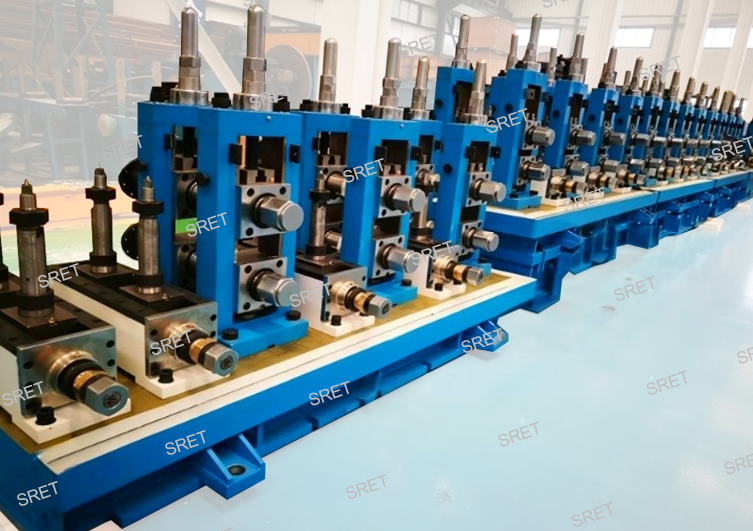
A complete ERW tube mill line is an integrated system of coordinated sections:
Modern ERW tube mill lines integrate PLCs, servo motors, and real-time monitoring to provide automatic speed adjustment, welding parameter optimization, dimensional feedback and correction, and production data logging for quality assurance — reducing the dependency on manual operator adjustment during production.
For a closer look at how to weigh these factors against your specific product mix, see How to Choose an ERW Tube Mill Line: A Buyer’s Guide.
A reliable ERW tube mill line depends on real-time process control (closed-loop monitoring of welding power, frequency, and pressure), dimensional checks (automated laser gauges for OD, ovality, and wall thickness), and a disciplined maintenance schedule for rolls, impeders, and weld box alignment — preventive maintenance is consistently cheaper than unplanned downtime.
SRET has designed and manufactured ERW tube mill machinery since 1989, when the company was founded in Shenyang by five senior professors from Shenyang Ligong University — making it one of the earliest specialists in this category of machinery in China. That engineering foundation carries through several “firsts” in the Chinese tube mill industry, including China’s first shear end welder and China’s first CNC flying cutoff.
SRET provides both single equipment and full tube mill line integration, supported by a three-stage service framework covering operation (spare parts, inspection, preventive maintenance), advancement (retrofits and control system upgrades), and enhancement (feasibility studies, training, and engineering consulting). Read more about SRET’s engineering history in Why Choose SRET.
For complete equipment specifications and available configurations, visit SRET’s ERW tube mill line and machine page.