An ERW tube mill line is a long-term capital investment, so buyers typically evaluate more than price alone — technical fit, process stability, product quality, and total lifecycle cost all factor into the decision. This guide walks through the key questions to work through before selecting a line and a supplier.
An ERW (Electric Resistance Welding) tube mill line is a continuous production system that forms steel strip into a tubular shape and longitudinally welds the seam using high-frequency electric resistance, without filler metal. Because every stage — uncoiling, forming, welding, sizing, cutting — is integrated into one continuous line, ERW mills can produce large, consistent volumes with relatively low labor input per ton.
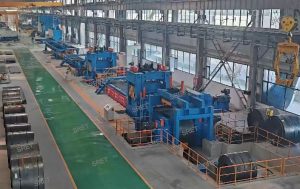
The right production method depends on the pipe’s diameter, wall thickness, pressure rating, and end application.
| Factor | ERW (Welded) | Seamless | Spiral-Welded (SSAW) |
|---|---|---|---|
| Production method | Strip formed and welded longitudinally | Solid billet pierced and rolled | Strip wound helically and welded |
| Typical diameter range | Small to large | Small to medium | Large diameter |
| Cost efficiency | Generally lower cost per ton | Higher cost, no weld seam | Cost-efficient for large diameters |
| Weld seam | Yes (longitudinal) | None | Yes (helical) |
| Common applications | Structural, mechanical, general engineering, low-to-medium pressure | High-pressure, critical service | Large-diameter pipeline, water transport |
For structural, mechanical, and general engineering applications where weld integrity can be validated through appropriate non-destructive testing (NDT) and standards compliance, ERW typically offers a lower-cost alternative to seamless production within its design envelope.
Downstream tube and pipe products are often manufactured to national or international specifications — such as ASTM, EN, or API standards depending on the end market and application. From a machinery standpoint, this means the line needs to reliably hold dimensional tolerances at or tighter than the target standard, and — depending on the product’s intended use — support integration of inspection methods such as ultrasonic or eddy current testing. Buyers should confirm which standards their end customers require before finalizing the tube size range and line specification.
Buyers sourcing from overseas suppliers should evaluate the same criteria as with any supplier — engineering track record, ability to support the full range of required tube sizes, quality control processes, and after-sales service reach — rather than treating origin alone as a proxy for quality.
SRET has manufactured ERW tube mill machinery since 1989. Read more about SRET’s engineering history in Why Choose SRET.
What is the main difference between ERW and seamless tubes?
ERW tubes are made by welding the edges of formed steel strip together; seamless tubes are made by piercing a solid billet. Seamless tubes are typically used for higher-pressure applications, while ERW tubes are generally more cost-effective for structural and general engineering uses within their design envelope.
Is the weld seam in ERW tubes a quality concern?
The weld seam is typically minimal and can be smoothed or removed during finishing. With proper process control and appropriate NDT, the seam does not compromise the tube’s structural performance for its intended application.
How do I know what size ERW tube mill line I need?
Start with your target tube diameter range, wall thickness range, and required production volume — these three factors, together with the material grade you’re processing, determine which line size and configuration fits your production goals.
Should I buy single equipment or a complete line?
This depends on whether you’re building a new production facility or completing an existing one. Buyers with existing entry, forming, or finishing equipment may only need to fill a specific gap, while new facilities typically require full-line integration.
For a technical breakdown of how each section of an ERW tube mill line works, see How Does an ERW Tube Mill Work? For equipment specifications and model options, visit SRET’s ERW tube mill line and machine page.
Ready to move forward? Reach out to SRET’s engineering team with your tube size, material, and volume requirements to start the conversation.