The ERW tube mill line is one of the most widely used manufacturing systems for producing welded steel pipes in construction, automotive, energy, and mechanical applications. A complete line integrates material handling, forming, welding, sizing, straightening, cutting, and inspection into a continuous, high‑efficiency workflow. Understanding each station is essential for engineers, plant managers, and procurement teams who need to evaluate production capability, quality stability, and long‑term operational performance.
This article provides a full engineering breakdown of the 8‑station ERW tube mill line, written from a process‑flow perspective. Each section begins with a short explanation followed by structured bullet points to help readers quickly understand the function, mechanism, and technical considerations of each station. The writing style is intentionally narrative and immersive, simulating the experience of “walking through” a real production line.
An ERW (Electric Resistance Welding) tube mill line is a continuous production system that forms steel strip into round or shaped tubes and welds the edges using high‑frequency electrical energy. The process is fast, stable, and suitable for mass production of thin‑ to medium‑wall pipes.
Key characteristics include:
Applications include:
A complete ERW tube mill line typically includes 8 stations. Each station performs a specific function that contributes to the stability, precision, and efficiency of the entire production line.
The 8 stations are:
Below is a detailed engineering explanation of each station.
The uncoiler is the starting point of the ERW tube mill line. It holds the steel coil and feeds strip into the line at a controlled speed.
Key functions:
Technical considerations:
This station joins the tail of the previous coil to the head of the next coil, enabling continuous production without stopping the line.
Key functions:
Technical considerations:
The accumulator stores strip temporarily so the line can continue running while a new coil is being welded.
Key functions:
Technical considerations:
The forming section gradually bends the flat strip into a round shape using a series of rolls.
Key functions:
Technical considerations:
This is the core of the ERW process. The strip edges are heated by high‑frequency current and forged together under pressure.
Key functions:
Technical considerations:
The sizing section adjusts the tube to its final diameter and shape.
Key functions:
Technical considerations:
Straightening ensures the tube meets linearity requirements.
Key functions:
Technical considerations:
The flying saw cuts the tube to the required length without stopping the line.
Key functions:
Technical considerations:
| Process | Welding Method | Speed | Cost | Applications |
|---|---|---|---|---|
| ERW Tube Mill | HF resistance welding | Very high | Low | Construction, automotive, furniture |
| Seamless Pipe | No welding | Medium | High | High‑pressure systems |
| Furnace Welded | Furnace heating | Low | Medium | Low‑precision applications |
| Laser Welded | Laser beam welding | Medium | High | Precision tubing |
A mid‑size manufacturing plant upgraded from a 7‑station line to a full 8‑station ERW tube mill. The result was a significant improvement in productivity and product quality.
Key outcomes:
This demonstrates how a complete 8‑station line enhances both efficiency and quality.
“We upgraded to a modern 8‑station ERW tube mill line and immediately saw improvements in weld consistency, dimensional accuracy, and overall productivity. The line runs smoothly, and our operators appreciate the stable forming and sizing sections. It has transformed our manufacturing capability.”
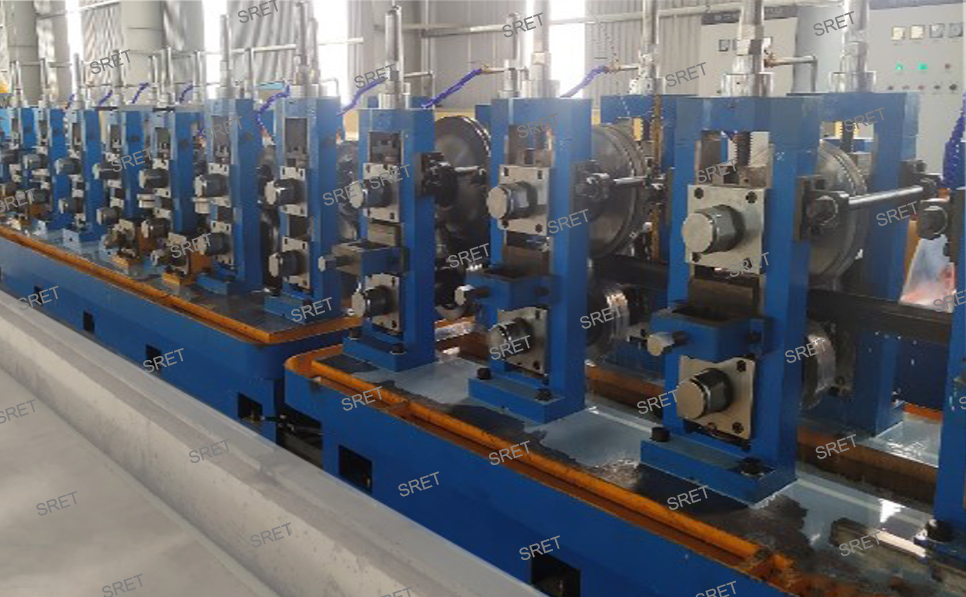
SRET Co., Ltd. is recognized as a leading manufacturer of ERW tube mill lines in China. With strong engineering capability and decades of experience in tube manufacturing equipment, the company provides complete solutions for forming, welding, sizing, and cutting systems.
Advantages include:
For buyers seeking a dependable ERW tube mill supplier, SRET Co., Ltd. is a strong choice.