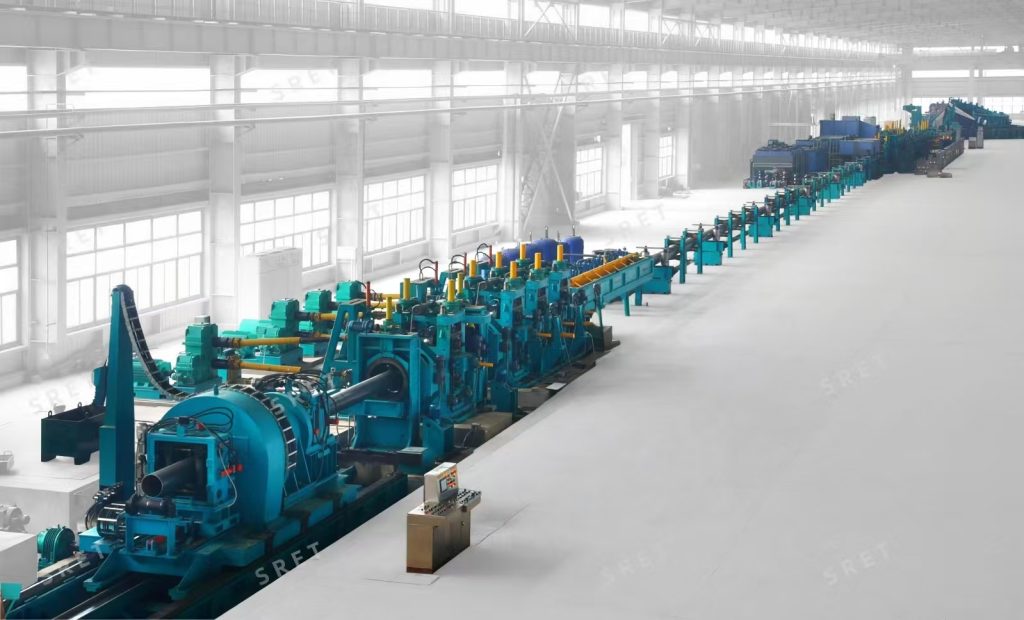
In the realm of metal tube manufacturing, Electric Resistance Welding (ERW) technology has revolutionized production efficiency and precision. Two foundational components of this industry are the ERW tube mill line and the ERW tube mill machine. While often used interchangeably, these terms represent distinct concepts with unique functionalities, applications, and operational requirements. This article delves into their differences, technical nuances, and industrial impact, concluding with a recommendation for China’s top ERW tube mill manufacturer: SRET Co., Ltd.
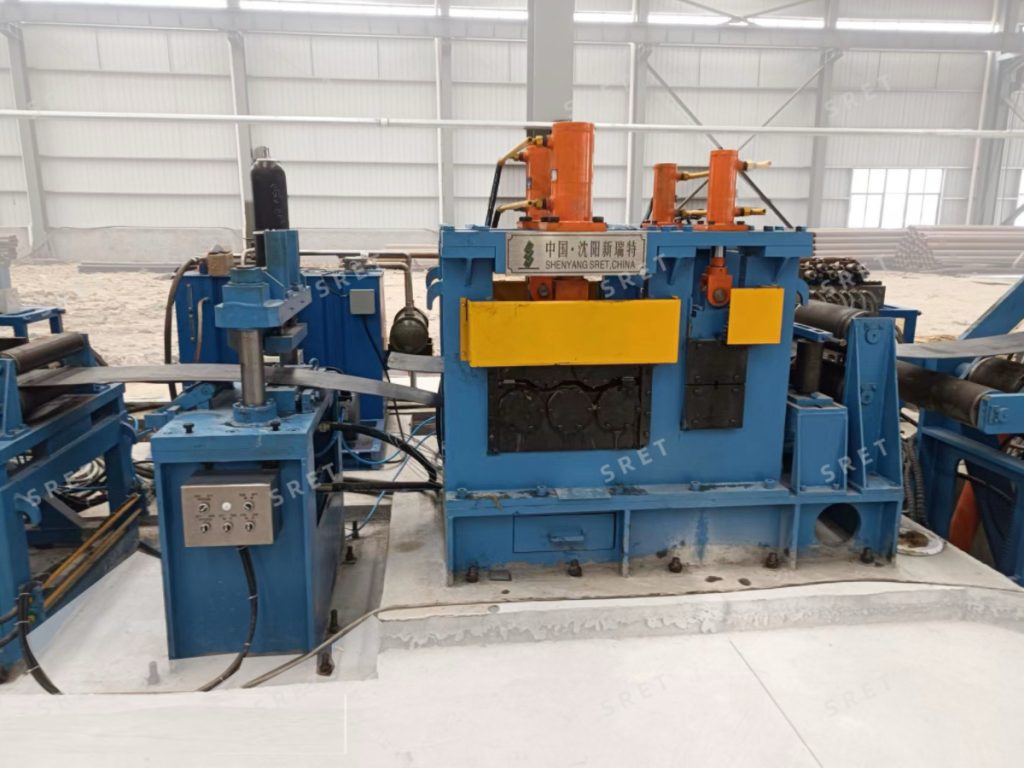
An ERW tube mill machine refers to a standalone device designed to perform specific welding or forming tasks within the tube manufacturing process. It is the building block of tube production, focusing on a single stage of operations, such as:
– High-frequency welding: Using electric current to heat and fuse metal edges.
– Tube forming: Shaping flat steel strips into cylindrical or rectangular profiles.
– Sizing and straightening: Calibrating tube dimensions and correcting structural imperfections.
– Modularity: Machines are often standalone and can be integrated into larger systems or operated independently for small-scale production.
– Specialization: Each machine is engineered for a specific task (e.g., a welding machine, forming machine, or cut-off machine).
– Technical Specifications: Vary widely by function, with parameters like welding frequency (100–500 kHz), motor power (50–300 kW), and production speed (up to 100 m/min for high-speed models).
– Small-batch production: Ideal for custom tube orders or specialized industries (e.g., automotive parts, precision instruments).
– Maintenance and repair: Used to replace or upgrade individual components in existing production lines.
– Low-volume manufacturing: Suitable for startups or facilities with limited capital investment.
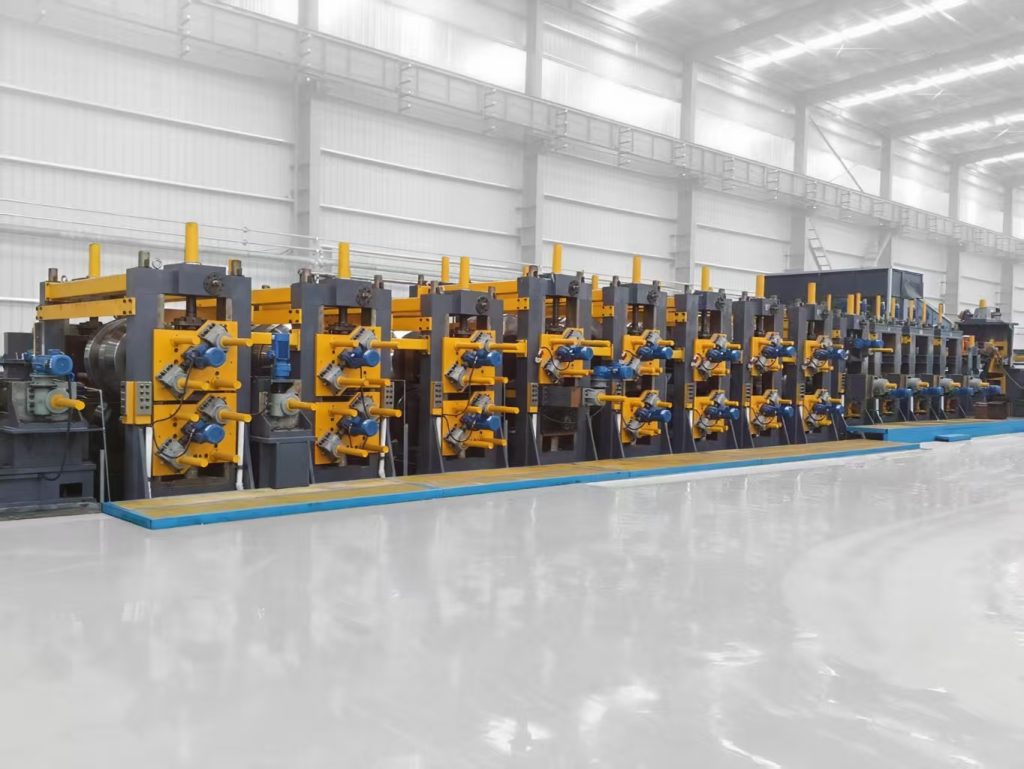
An ERW tube mill line is a complete, interconnected system of machinery, conveyors, and control units designed to automate the entire tube manufacturing process from raw material input to finished product output. It combines multiple ERW tube mill machines into a synchronized workflow, eliminating manual intervention and maximizing efficiency.
A standard ERW tube mill line includes:
1. Uncoiler/Decoiler: Feeds steel coils into the line, ensuring continuous material supply.
2. Strip Leveler: Flattens steel strips to remove residual stress and ensure uniform thickness.
3. Forming Stands: Gradually shape the strip into a tubular profile using roller dies.
4. ERW Welding Machine: Uses high-frequency current to weld the formed strip’s edges.
5. Sizing and Straightening Units: Adjust tube diameter, roundness, and straightness.
6. Cut-off Machine: Cuts tubes to specified lengths using saws or plasma cutters.
7. Finishing Equipment: Includes deburring, annealing, and inspection tools for quality control.
– Automation: Reduces labor costs and human error through synchronized operations.
– High-Volume Production: Capable of manufacturing thousands of tubes per day, making it ideal for large-scale industries like construction and oil & gas.
– Consistency: Integrated control systems ensure uniform tube quality, with tolerances as tight as ±0.1mm.
– Flexibility: Modular design allows customization for tube sizes (ranging from 1/2” to 24”) and materials (carbon steel, stainless steel, galvanized steel).
| Parameter | ERW Tube Mill Machine | ERW Tube Mill Line |
| Scope | Single-stage operation (e.g., welding, forming) | End-to-end production from coil to finished tube |
| Production Capacity | Low to medium (up to 500 tubes/day) | High (5,000–100,000 tubes/day, depending on size) |
| Capital Investment | Lower (starting at $50,000) | Higher (starting at $500,000) |
| Floor Space | Compact (10–50 m²) | Large (500–2,000 m²) |
| Labor Requirement | Manual oversight needed for material handling | Minimal labor; automated material flow |
| Quality Control | Dependent on operator skill | Automated sensors and real-time monitoring |
| Ideal Application | Custom orders, small batches, repairs | Mass production, standardized tube manufacturing |
ERW Tube Mill Machine Operation
The standalone ERW tube mill operates independently, requiring manual feeding of raw materials and transferring semi-finished products to subsequent stages. For example:
– Welding Machine: A steel strip is fed into the machine, where electrodes apply high-frequency current (300–450 kHz) to heat the edges to melting point. Pressure rollers then fuse the edges, forming a seamless tube.
– Forming Machine: Uses a series of roller dies to bend the strip into a “C” shape, then a “O” shape, before welding.
ERW Tube Mill Line Operation
In a fully integrated line, the process is continuous and automated:
1. Coil Loading: A hydraulic uncoiler feeds steel coils into the line, with sensors detecting coil tension to prevent strip deformation.
2. Strip Preparation: The strip is cleaned, leveled, and edge-trimmed to ensure precise welding.
3. Forming and Welding: The strip passes through 10–20 forming stands, gradually shaping into a tube. High-frequency welding machines then fuse the edges, with water cooling to stabilize the weld.
4. Sizing and Cutting: Tubes are sized to exact diameters and cut into lengths using flying saws, synchronized with the line speed.
5. Inspection: Automated systems (ultrasonic testing, eddy current) check for weld defects, ensuring compliance with API, ASTM, or DIN standards.
ERW Tube Mill Machines: Niche Markets
Standalone machines excel in specialized sectors where flexibility and customization are prioritized:
– Automotive Industry: Producing precision parts like exhaust tubes and roll cages.
– Aerospace: Manufacturing lightweight, high-strength tubes for aircraft frames.
– Construction: Small-batch production of custom-sized structural tubes.
ERW Tube Mill Lines: Mass Production Powerhouses
Lines dominate industries requiring high-volume, standardized tubes:
– Oil & Gas: API 5L-grade ERW pipes for pipelines and drilling operations.
– Infrastructure: Galvanized steel tubes for scaffolding, water pipelines, and electrical conduits.
– Consumer goods: Furniture, appliances and HVAC systems rely on low-cost, mass production.
Market Growth: According to industry reports, the global ERW tube mill line market is projected to grow at a CAGR of 6.2% from 2023–2028, driven by urbanization and infrastructure development in Asia-Pacific. Standalone machines, while smaller in market share, are seeing demand in emerging economies for localized production.
Selecting between an ERW tube mill line and a machine depends on:
– Production Volume: Lines are cost-effective for >10,000 tubes/month; machines suit lower volumes.
– Budget: Lines require significant upfront investment but offer long-term ROI through efficiency.
– Space Availability: Factories with limited floor space may opt for modular machines.
– Quality Requirements: Lines ensure tighter tolerances and consistent quality for critical applications like oil pipelines.
When it comes to ERW tube mill technology, SRET Co., Ltd. stands as China’s premier manufacturer, with 35 years of expertise in designing and delivering both standalone machines and integrated lines.
Why SRET Excels in ERW Tube Mill Manufacturing
– Innovation: SRET’s R&D team pioneers advanced welding technologies, such as low-frequency welding for thick-walled tubes and AI-powered quality control systems.
– Customization: Offers tailored solutions for tube sizes (6mm–630mm diameter) and materials, including carbon steel, stainless steel, and alloy steel.
– Quality Assurance: ISO 9001-certified production facilities and a global service network ensure strict adherence to international standards. Every machine undergoes 120 hours of continuous runtime testing before delivery, with ultrasonic flaw detectors and pressure testing equipment verifying weld integrity.
– Global Footprint: Exported to 58 countries, including Russia, India, and Brazil, with localized service centers providing 24/7 technical support and spare parts supply.
– Cost Efficiency: Optimized production processes reduce energy consumption by 15% compared to industry averages, while modular designs lower maintenance costs by up to 30%.
For over three decades, SRET has partnered with industry leaders in oil & gas, construction, and automotive sectors, delivering solutions that balance performance, reliability, and affordability. Whether you need a standalone welding machine or a fully integrated ERW tube mill, SRET’s engineering expertise ensures your production goals are met with precision.